Crayfish Factory #4: Kreef – Kelp Karnivore
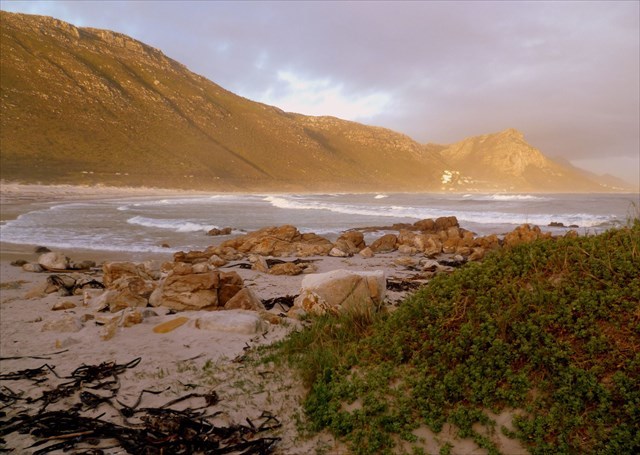
A maintenance visit to the area and booking of our first Covid-19 jab at nearby Ocean View prompted a celebratory placing of this new cache, a screw-capped, camo-taped plastic pot, to complement the original three. I hope it further enhances your visit to this exposed and scenic location.
As with the others, to find the cache, click on the image above which will take you to a jigsaw puzzle, completion of which will reveal the cache coordinates and a helpful hint.
"The link to the website has not been checked by Groundspeak nor by the reviewer for possible malicious content and access to the site is therefore at your own risk"
The marine crustacean, the Cape or West Coast rock lobster or spiny lobster (Jasus lalandii) - aka crayfish or ‘kreef’ in Afrikaans - is a species of spiny lobster found off the coast of Southern Africa (ie. from Southern Namibia to Eastern Cape).

It is usually found on rocky reefs in shallow waters (but may be found as deep as 46m) where it shelters in crevices. It is often seen in groups with antennae protruding from the shelter. It swims backward in emergencies using the tail, but generally crawls around on the reef.
It grows very slowly up to 46cm long with a carapace of up to 18cm, and can live up 50 years or more.

It has a most unusual, lengthy and complex life-cycle. After mating, females ‘in berry’ carry 100,000-1,000,000 orange eggs on tiny hairs beneath their tails. After 80-90 days, the eggs hatch and produce tiny transparent spider-like larvae (naupliosoma) which moult and become phyllosoma larvae with long, hairy legs.
These drift with the ocean currents for over 7 months and moult 11 times! Some may even be carried to South America and back. The final larval stage (the puerulus), a 20mm transparent colourless mini-lobster, swims inshore and finds refuge under a rock or a crevice where it continues to grow reaching maturity after 4-5 years. See here for a detailed description of the life-cycle.
Not surprisingly given its long and complex life-cycle, it is impossible to farm rock lobster.
 They are an important link in the kelp forest food chain. As carnivores, they eat mussels, urchins, starfish, abalone (perlemoen), and even barnacles. Where they occur in large numbers, they may devour whole populations of sea urchins, for example. However, they are also prey for other kelp predators such as octopuses, dogsharks, seals and . . . humans.
Over its range it is widely caught for its meat, with over 6,500 tonnes being caught annually in lobster pots and hoop nets. It is a highly regarded, if rather expensive, seafood being braaied or cooked in seafood stews, particularly in coastal areas along its range.
In the past, the South African rock lobster fishery would catch about 4 000 tonnes of lobster annually. But this has declined dramatically since due to their slow growth rates, overfishing and poaching. It is estimated that there are <3% of pre-exploitation numbers left.
In order to conserve stocks and prevent overfishing, individual fishing quotas are allocated by the government to commercial fishermen and companies, totalling 1,700 t which contributes some R200 million to the economy.
There is also a closed season from 1 June to 15 November, a size limit of 80 mm (carapace length) and a ban on catching ovigerous females (females which are brooding their eggs – or ‘in berry’).
In addition, recreational crayfishers catch around 70 tonnes/year - a substantial amount. For this to be  sustainable the relevant regulations must be followed and required permits obtained from local post offices.
Only 4/person/day are allowed which must be transported whole and not sold. The minimum size is 8cm and female lobster in berry must not be taken but should be return to the sea immediately.
During the catching season the lobsters are a big part of the local social culture – both catching and eating them.
Red tides can have a major impact on the lobsters. These are caused by decaying phytoplankton blooms and often occur in areas with many lobsters. Oxygen levels drop dramatically and the lobsters move inshore, searching for oxygenated water. Subsequently they may be stranded by the receding tide, resulting in what is erroneously called a ‘rock lobster walkout’. The largest such stranding occurred in Elands Bay in 1997 when some 2,000 tonnes were lost.