This is an Earthcache – as such, there is no physical cache. Instead you will partake in a geology lesson by making observations and answering 3 questions about the marble Milford War Memorial at the posted coordinates. Permission for this listing has been granted by the Milford Parks & Recreation. All public parks, owned and operated by the City of Milford, shall be closed from sunset to sunrise daily.

THE MILFORD WAR MEMORIAL
On Memorial Day in 1950 the Milford War Memorial Committee started fund-raising campaign to raise $3000 to erect a monument dedicated to all of those who have served in this country’s wars. A local company, William V. Sipple & Son would go on to erect this 10-foot shaft from Georgia marble at the north end of Plaza Square. This spot was chosen so that it would be visible from nearly all parts of the Milford business district. It was supposed to be dedicated on Armistice Day, but the ceremony was rescheduled to November 19, 1950. It was then that the Milford War Memorial unveiled by the areas Gold Star Mothers. The dedication ceremony was preceded by a parade of units from the US Army, VFW, American Legion, the Delaware National Guard, with music provided by Milford’s High School Band.

The Milford War Memorial stood tall and strong at the intersection of Walnut & Front Streets for over 50 years until it was relocated here to Bicentennial Park.
MARBLE IS A METAMORPHIC ROCK
Marble is a metamorphic rock. These types of rocks start out as some other type of rocks, but have been substantially changed from their original igneous, sedimentary, or earlier metamorphic form. Metamorphic rocks form when rocks are subjected to high heat, high pressure, hot mineral-rich fluids or, or some combination of these factors. During metamorphosis the rock remains completely solid with varying pressure and magnitude. This leads to alternating layers of newly formed minerals.
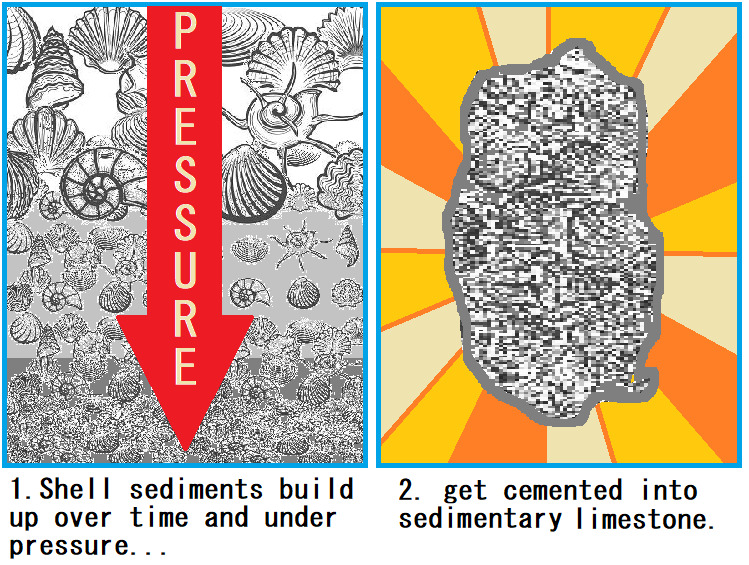
This particular shaft of Georgia marble in front of you was formed millions of years ago from living organisms. These animals had shells made of calcium carbonate that piled up over time when they died. Over many years these sediments became buried. The more layers that were added created more pressure. This pressure cemented these shell fragments together to form a sedentary limestone.
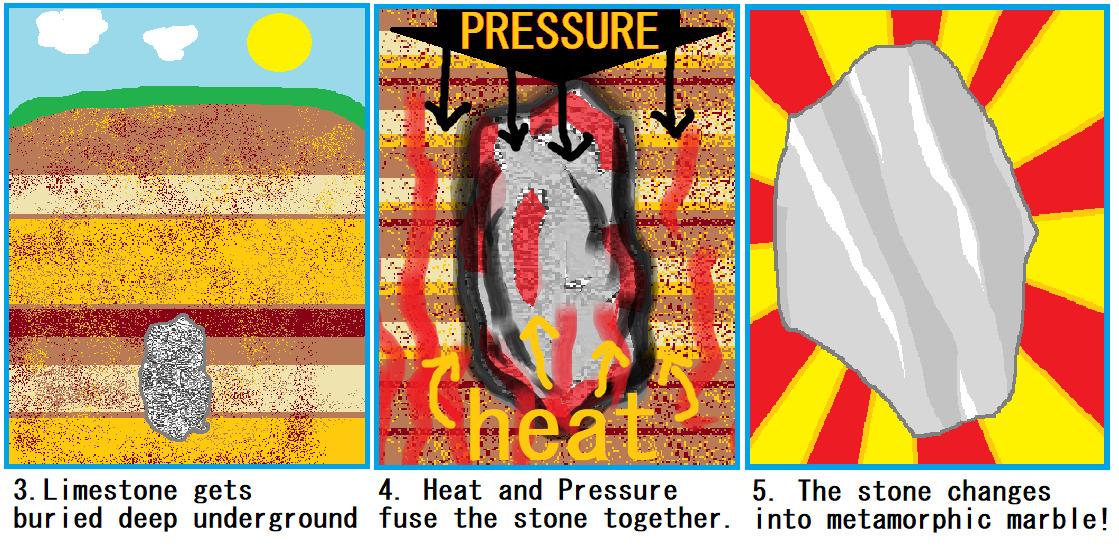
Over time this limestone was buried deep in the earth and became exposed to high pressure and heat which metamorphosized the stones composition from limestone to marble. Millions of years of uplifting and erosion exposed this marble to Georgia's surface, where it was later quarried and sculpted into the shape you see here today!
The texture of metamorphic rocks is classified as either foliated or non-foliated. Foliated rock is a type of metamorphic rock having identifiable layers, textures, and patterns. Non-foliated metamorphic rocks do not have a layered or banded appearance.
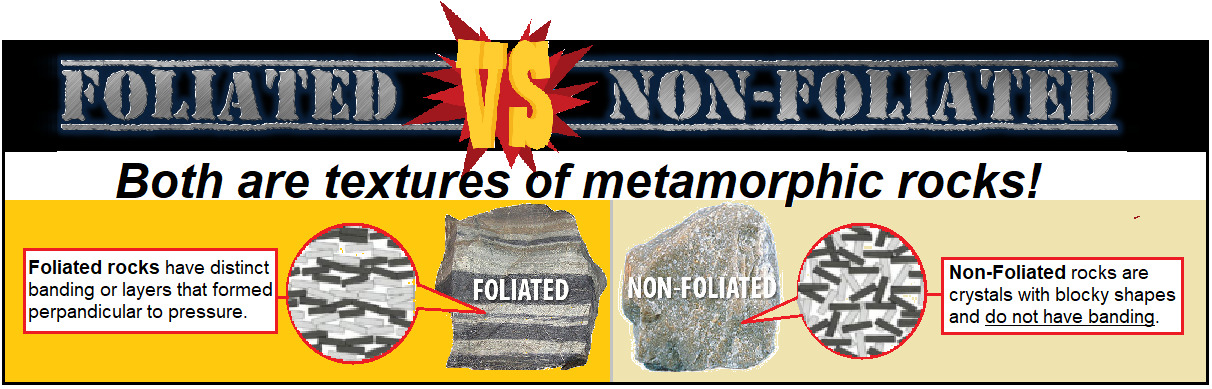
Marble is usually a light-colored rock. When it is formed from a limestone with very few impurities, it will be white in color. Marble that contains impurities such as clay minerals, iron oxides, or bituminous material can be bluish, gray, pink, yellow, or black in color.
All of the marbles of Georgia occur in the northern part of the state and are confined to a narrow belt, about sixty miles long and one to three miles wide. There are three types of Marble that come from the marble outcrops in Georgia.
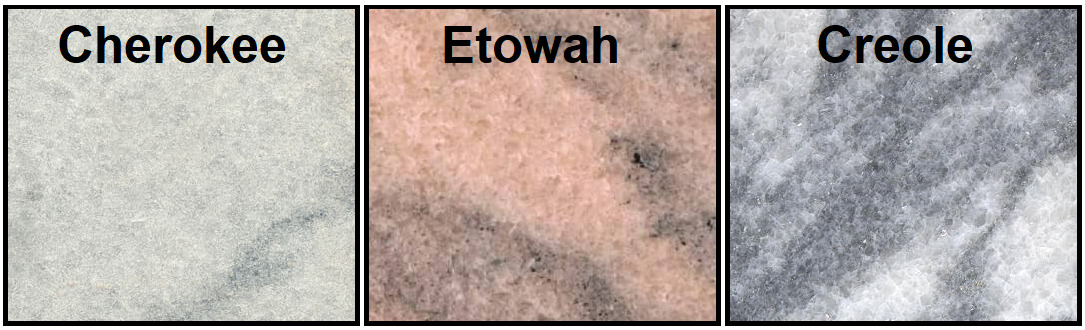
CHEROKEE: This is a light gray marble with white crystals and discreet veins across the surface.
ETOWAH: The fleshy color of the stone is due principally to the presence of iron oxide and graphite.
CREOLE: The gray is from an impurity of clay that mixed with the limestone before it became metamorphized.
As a building marble, the Georgia stone has very few equals in the United States. It’s purity and great strength matched together with its extremely low absorption properties make it perfect for all classes of exterior uses.
LOGGING REQUIREMENTS:
To log this Earthcache: Read the geology lesson above. Answer all three questions posted below. Answers can be sent via e-mail or messenger contacts on my Geocaching profile within a reasonable time. Group answers are fine, just list the members of your part with your answers. Do not post the answers to the questions in your logs.
QUESTION 1. Where does the Calcium Carbonate come from that makes up marble?
QUESTION 2. Touch and observe the texture of the marble. Would you classify the texture of this stone as being foliated or non-foliated?
QUESTION 3. Using the diagram of Georgia's Three Marbles above, which marble do you think this is?
A. Cherokee
B. Etowah
C. Creole
OPTIONAL PHOTO: Posting a photo that readily indicates that you (and anyone else logging the find) are at the location.
 Awesnap has earned GSA's highest level:

REFERENCES
1. Milford Vets To Seek $3000 Journal-Every Evening, Wilmington, Delaware, May 22, 1950
2. Georgia Marble, Mark Gelbart, GeorgiaBeforePeople, February 2, 2014, Blog, wordpress.com
3. Mad About Marble: A Geological Look at a Classic Stone, Use Natural Stone, Website, epd.georgia.gov
4. Geology of the Tate Quadrangle, Georgia, W.S. Bailey, Bulletin No. 43, Geological Survey of Georgia, 1928, usenaturalstone.org