There is nothing at the posted coordinates. This is an Earthcache in which you make observations as part of an earth science lesson. For more information about Earthcaches, visit EarthCache.org.
The Wheeling Suspension Bridge
This bridge and area is rich with geological lessons as well as cultural history.
Answer the following questions and then send me a message to get credit for this Earthcache.
Some notes before starting...
- This EarthCache is located at the Wheeling Suspension Bridge which is free to explore and walk across.
- While the bridge spans the Ohio River, the Earthcache focuses only on the tower on the West Virginia Side. While cool to see, You do not need cross the bridge to complete this EarthCache.
- Because this Earthcache requires observing aspects of the Wheeling Suspension Bridge, it is only to be completed in daylight hours. (Although the area is accessible 24/7 but not well lighted at night).
- No tools are needed for this earthcache. (Just your eyes, hands, and gps.) Please DO NOT scratch any of the blocks.
- All the info you need is on the cache page or at the location.
(Bibliographic sources are attached as an image here.)
Logging Requirements
- According to the cache page, what is weathering?
- Which of the properties mentioned on the cache page does Sandstone have that makes it a "durable building stone"?
- Observe a section of the bridge's tower without soot. Name all the colors that can be seen in the grains of the Sandstone.
- Estimate the amount of soot on the tower. Using 0-100%, how much of the tower is covered?
With your hands, touch sections of the tower with and without soot. Do the two sections feel different? Also, write your theory as to why this is.- Do you see any indications of weathering? If so what kind is it?
- Optional: pictures of you and/or your GPS at the bridge are appreciated but not required.
The Wheeling Suspension Bridge
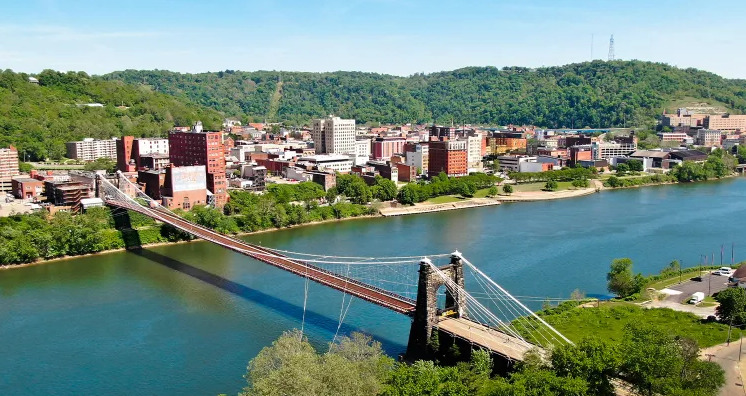
The Wheeling Suspension Bridge is a suspension bridge spanning the main channel of the Ohio River at Wheeling, West Virginia. It was the largest suspension bridge in the world from 1849 until 1851. Charles Ellet Jr. (who also worked on the Niagara Falls Suspension Bridge) designed it and supervised construction of what became the first bridge to span a major river west of the Appalachian mountains. It linked the eastern and western section of the National Road, and became especially strategically important during the American Civil War. This bridge was designed during the horse-and-buggy era, which required a 2-ton weight limits and vehicle separation requirements in later years until it was closed to automobile traffic in September 2019. It is now only open to pedestrians and bicycles.
The main span is 1,010 feet (310 m) from tower to tower. The east tower rests on the Wheeling shore, while the west tower is on Wheeling Island. The east tower is 153.5 feet (46.8 m) above the low-water level of the river, or 82 feet (25 m) from the base of the masonry. The west tower is 132.75 feet (40.46 m) above low water, with 69 feet (21 m) of masonry. The Wheeling Suspension Bridge was designated a National Historic Landmark on May 15, 1975.
Sandstone
Sandstone is a sedimentary rock composed of sand-sized grains of minerals, rocks, or organic materials. It also contains a cementing material that binds the grains together and may contain silt- or clay-sized particles that occupy the spaces between the grains. The formation of Sandstone involves two principal stages:
- First, layers of sand-sized grains accumulate as the result of settling particles, either from water (as in a stream, lake, or sea) or from air (as in a desert).
- Once particles have accumulated, they become sandstone when the layers are compacted by pressure of overlying deposits and cemented by the precipitation of minerals within the pore spaces between sand grains.
Like sand, sandstone may be any color, but the most common colors are tan, brown, yellow, red, gray, pink, white and black. It was formed during the Carboniferous Period (358.9–298.9 million years ago). Within most sandstone, the grain/sand material present is quartz, and the cementing material that binds it together is Kaolinite, a clay mineral mixed with shale. In the sandstone, the quartz grains have been naturally coated with shale-oil. Since oil and water do not mix, much of Sandstone resists water, and thus resists weathering and deterioration from rain. Sandstone is commonly used in construction because it is abundant, relatively resistant, and relatively soft, making it easy to carve. This makes Sandstone a durable building stone for projects around the world.
Weathering
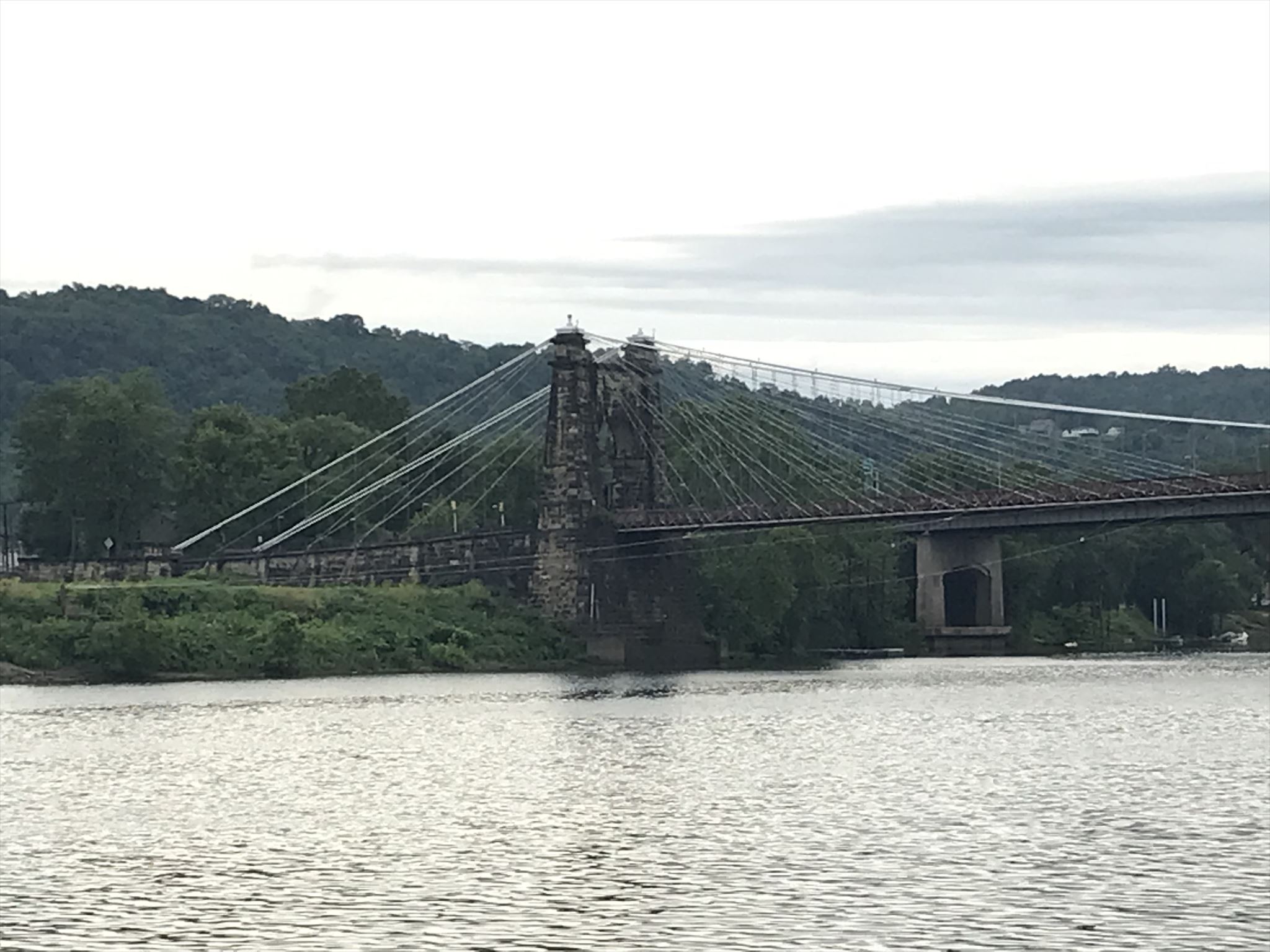
In the early to mid 1900's, the area had a large amount of air pollution. It is largely the results of mining, steam ships, coal-fueled trains, and the increased use of combustion engines. Over time, the soot (impure carbon particles) from pollution slowly blackened the Sandstone of the bridge. While there has been various proposals about cleaning the sandstone and returning it to its orginal idea, this is not very feasible. The sandstone's shale-oil has bonded with years of soot from the atmosphere. The soot and dirt on the stone is particularly well attached and ingrained into most of the surface, and to remove the soot would mean removing the surface. This would then allow the bridge to then weather and deteriorate. Thus, all cleaning proposals have been at a standstill while possible options are considered, and so the sandstone making up both towers has remained in its present condition. This condition is that the sandstone towers are still covered with soot giving clear evidence of the heavy air pollution in 19th century Wheeling. You can see the blackened soot and dirt on a majority of the blocks making up each of the towers.
While the towers and bridge is in stable condition, the soot does react with the sandstone in a process called weathering. Weathering is the decomposition of any rocks, soils, and minerals through direct contact with the Earth's atmosphere. It is often a very slow process. There are three basic types of weathering:
- Mechanical Weathering often occurs due to wind, rain, and changing temperatures (such as freezing/thawing). Mechanical, also known as physical weathering, can be divided into two main categories: fracturing and abrasion. Over time, pieces of rock can split off a rock face and big boulders are broken into smaller rocks and gravel Essentially this type of weathering physically breaks up the rock.
- Chemical Weathering is related to chemical reactions. An example of chemical weathering is water dissolving limestone. In many places around the planet, water contains many weak acids such as carbonic acid. This weak, but abundant, acid is formed when carbon dioxide gas from the atmosphere mixes with rainwater. Sulfur dioxide and nitrogen gases create other types of acid rain that act as chemical weathering agents. Other times it is pollution (both man-made and natural causes) that bring contrasting elements together which decomposes and works at decaying rocks and minerals.
- Biological Weathering (or sometimes called Organic) is due to fungi, lichens, plants, and animals. Tree roots, for example, cause a significant amount of biological weathering by moving the rock. (Uneven sidewalks are a great visual of this type since the roots are pushing the cement up which is then exposed to more elements.) But even much smaller plant-related actions can weather rocks. Such weathering can be quite subtle but can cause significant change over time.
Logging Requirements
- According to the cache page, what is weathering?
- Which of the properties mentioned on the cache page does Sandstone have that makes it a "durable building stone"?
- Observe a section of the bridge's tower without soot. Name all the colors that can be seen in the grains of the Sandstone.
- Estimate the amount of soot on the tower. Using 0-100%, how much of the tower is covered?
With your hands, touch sections of the tower with and without soot. Do the two sections feel different? Also, write your theory as to why this is.- Do you see any indications of weathering? If so what kind is it?
- Optional: pictures of you and/or your GPS at the bridge are appreciated but not required.
How To Get Credit
To get credit for this cache, send me your answers to the questions, and your observations of the locations.
Do not post the answers with your log!
Using my profile, send me a message with your answers and observations.
- You do not have to wait for me to respond to log your find. I will contact you if your answers need extra work.
But if I do not receive a message from you with the answers, I will delete your log without notice.
- If you are in a group, only one member needs to email me the answers, as long as the message says which people are with the team. (List the team members since I do not know who was with you and only part of your usual team may be present.) Otherwise the "unlisted" team members' log will be deleted.
Any Lognotes with answers will be deleted. Please do not post your answers in your log.
You need to actually visit the location and make observations. No Arm Chair Logging.
Logs that indicate otherwise will be deleted without notice.
First to Find goes to determined2 who found it approximately 42hours after it published.
Congratulations!!!