This is an Earthcache – as such, there is no physical cache. Instead you will partake in a geology lesson by making observations and answering 6 questions about the crinoid fossils on the limestone marker at the posted coordinates. A camera phone with zoom or a magnifying glass will be helpful to zoom in on them.

Recently I was searching for an old cache here called The Elves are Inclined to be Evil. After finding it, me being an self proclaimed "Earthcache Nut" I couldn't help myself but to take a closer look at the nearby limestone marker. On the back I was very surprised to see a very exciting patch of fossils! BOOM! Man I just couldn't wait to share this fun discovery with the rest of the geocaching world.
LIMESTONE
The stone monument you see before you is made of a sedimentary rock that is formed from living organisms in a shallow inland sea over 300 million years ago. These fossilized creatures had shells made of calcium carbonate that piled up over time when they died.

The bodies of these creatures sunk in warm tropical waters that were shallow enough for waves to move coarse carbonate sand across the seafloor. Battered by constant wave action, the larger shells were battered and broken, while the smallest particals washed away. Over time and under these shells fossilized and were cemented into limestone.
CRINOIDS
With their cluster of waving arms atop a long stem crinoids are sometimes called “sea lilies” because they resemble flowers. Truth be told, crinoids are not plants. Instead they are echinoderms like their relatives starfishes, sea cucumbers, and sea urchins.
Crinoids have lived in the world's oceans since at least the beginning of the Ordovician Period, which was roughly 485 million years ago. They peaked during the Mississippian Period, when the shallow, marine environments they carpeted were widespread on several continents.

Crinoids came close to extinction toward the end of the Permian Period, about 252 million years ago. The end of the Permian was marked by the largest extinction event in the history of life. Fossil records show that nearly all crinoid species died out at this time. The few surviving lineages eventually gave rise to the crinoids that are still populating the oceans today.
The massive limestone formations in North America are made up almost entirely of crinoid fragments.
LOGGING REQUIREMENTS:
To log this Earthcache: Read the geology lesson above. Answer all six questions best as you can by using the PHOTO below. If you do not have a magnifying glass you can use the camera on your cell phone to get a closer look. Answers can be sent via e-mail or messenger contacts on my Geocaching profile within a reasonable time. Group answers are fine, but do not post the answers to the questions in your logs.
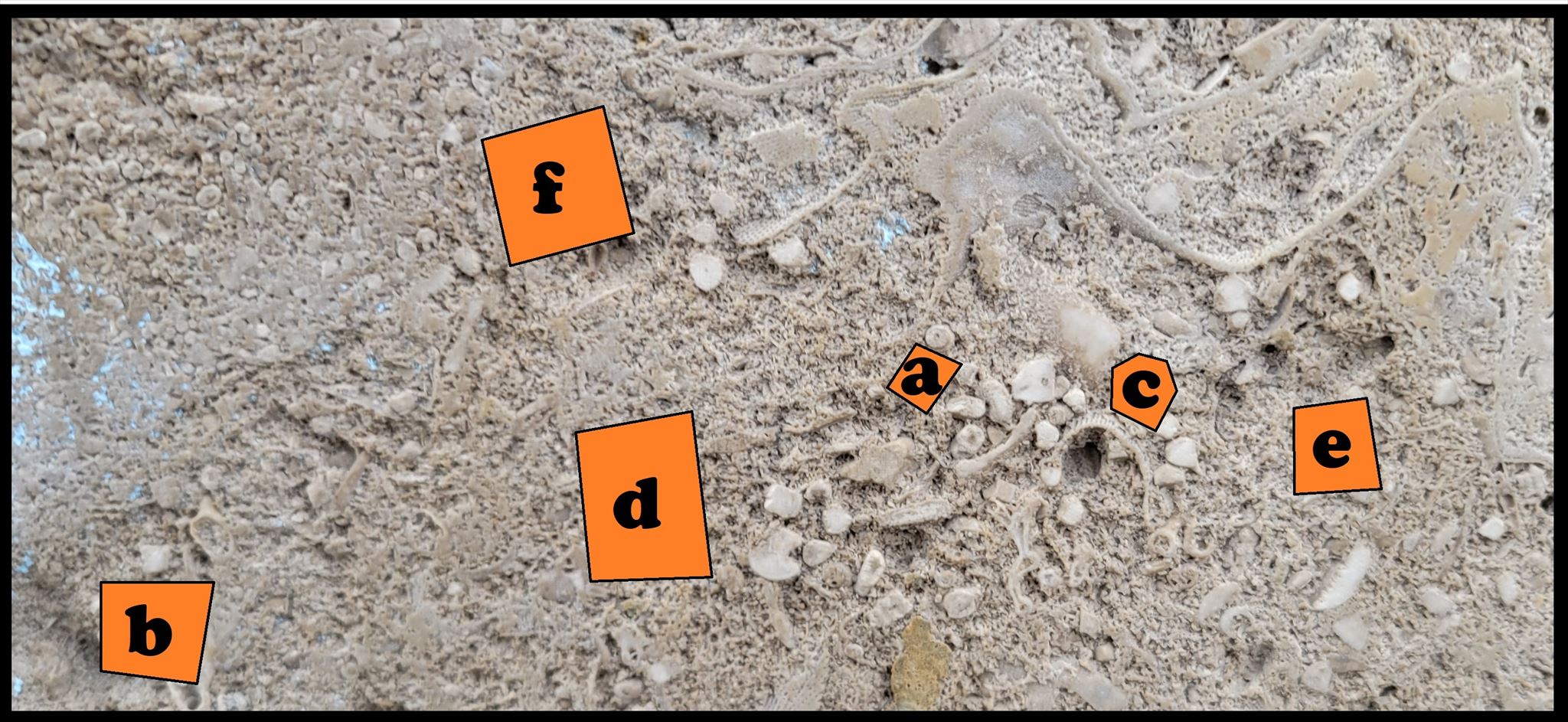
QUESTION 1. How many segments spaces do you see on the Crinoid Column under a ?
QUESTION 2. Do you think b is hiding a Crinoid Crown, or do you think it is from a different creature?
QUESTION 3. Is the Crinoid being obscured by c larger than a dime? (0.705 inches (17.91 millimeters) in diameter)
QUESTION 4. Under the d can you observe any fossilized roots?
QUESTION 5. Do you think that the fossil under e is a crinoid stem or something else?
QUESTION 6. Do you think that the circular fossil under f is a crinoid?
OPTIONAL PHOTO: Posting a photo that readily indicates that you (and anyone else logging the find) are at the location. DO NOT POST ANY PHOTOS OF THE FOSSILS USED FOR THIS EARTHCACHE PUZZLE!
Awesnap has earned GSA's highest level:

REFERENCES
1. Crinoids Fossil Identification, Website, fossilidentification.org
2. INDIANA LIMESTONE Wayne G. Powell, 2004, website, academic.brooklyn.cuny.edu
3. Guide for Beginning Fossil Hunters Charles Collinson, Illinois State Geological Survey, Geoscience Education Series 15, 2002, PDF, ideals.illinois.edu