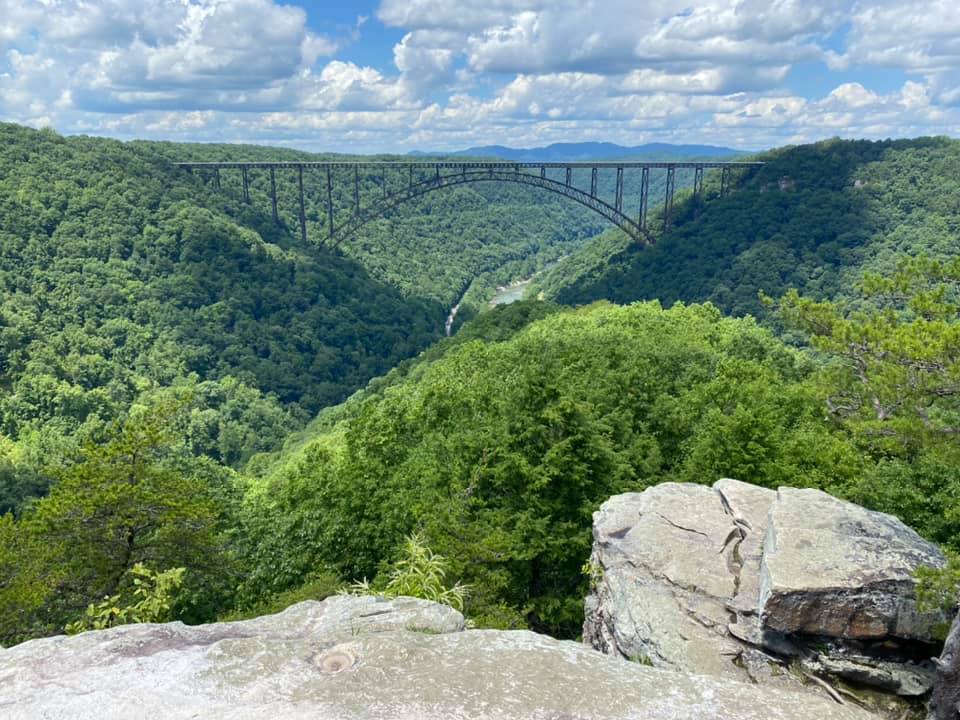
The New River Gorge is America's newest National Park. Officially the New River Gorge National Park and Preserve, it encompasses more than 70,000 acres along the New River which is one of the oldest rivers in the continent. The listed coordinates will bring you to Long Point, which is one of the most popular trails in the park and it offers panoramic views of both the gorge and the New River Gorge Bridge. The hike is 3.2 miles roundtrip. The rocks in this part of the gorge are mostly shale and sandstone (with some layers of coal as well). Siltstone and sandstone are both sedimentary rocks. Siltstone is mostly composed of silt and has a gray/red/brown color. Sandstone is composed of sand particles and can also be found in variety of colors including tan, brown, yellow, red, gray and white. Sandstone layers are highly resistant to weathering and erosion because of it has a high quartz content.
Fractures are surfaces along which rocks or minerals have broken, resulting in two free surfaces where none existed before. Fractures are commonly caused by stress exceeding the rock strength, causing the rock to lose cohesion along its weakest plane. There are two main categories to describe fractures. Systematic fractures are roughly planar and are parallel to each other, while nonsystematic fractures are irregular and in some cases may be curved. When there is more than one type of fracture within rock, it is often referred to as a joint system. Fractures are often found along weak spots within the rock, and are primarily caused by frost action. During the winter, water may enter fractures within the rock, and when it freezes, it expands, the fracture becomes slightly larger. This process continues until the rock eventually breaks away.

Logging Requirements:
- Examine the rock that you are standing on. Which type of fracture appears most common? Are you able to see any weak spots?
- Do you see any bedding planes? If so, is the thickness consistent or does it vary?
- Based on your observations, how do you think this area might look 100 years from now?
- Upload a photo taken at Long Point. You do not need to be in the photo, though it is strongly encouraged.