In geology , cross-bedding, also known as cross-stratification, is layering within a stratum and at an angle to the main bedding plane. The sedimentery structures which result are roughly horizontal units composed of inclined layers. The original despositional layering is tilted, such tilting not being the result of post-depositional deformation. Cross-beds or "sets" are the groups of inclined layers, which are known as cross-strata.

Cross-bedding forms during deposition on the inclined surfaces of bedforms such as ripplies and dunes ; it indicates that the despositional enviroment contained a flowing medium (typically water or wind). Examples of these bedforms are ripples, dunes, anti-dunes, sand dunes , waves, hummocks, bars , and delta slopes. Environments in which water movement is fast enough and deep enough to develop large-scale bed forms fall into three natural groupings: rivers, tide-dominated coastal and marine settings. So you have to ask yourself, Was Kentucky , or this particular area ever under water? And the answer to that is YES. The fossil record shows that there were shallow seas covering the state (and most of North America) at various points in time. In addition there were sometimes vast swamps filled with dense plant life. Their remains created rich coal seams in parts of the state. But that lesson is for another day.
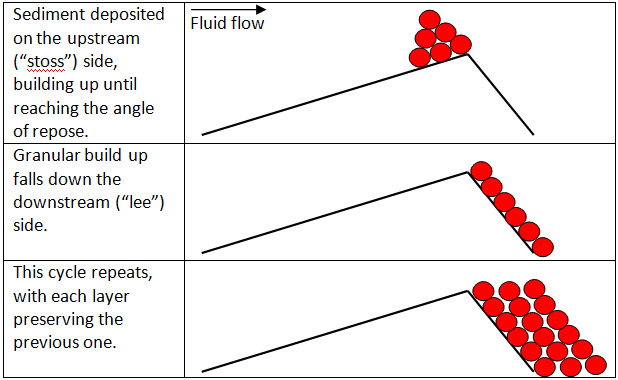
Above is how the layers of Cross-Bedding at and near GZ formed
The angle and direction of cross-beds are generally fairly consistent. Individual cross-beds can range in thickness from just a few tens of centimeters, up to hundreds of feet or more depending upon the depositional environment and the size of the bedform. Cross-bedding can form in any environment in which a fluid flows over a bed with mobile material. It is most common in stream deposits (consisting of sand and gravel), tidal areas, and in aeolian dunes.

The sediment that goes on to form cross-stratification is generally sorted before and during deposition on the "lee" ( the protected side ) side of the dune, allowing cross strata to be recognized in rocks and sediment deposits. Cross-bedded sediments are recognized here at GZ by the many layers of "foresets", which are the series of layers that form on the lee side of the bedform (ripple or dune). These foresets are individually differentiable because of small-scale separation between layers of material of different sizes and densities. Sediments in Kentucky mainly consist od shale,clay , sandstone ,conglomerate,Limeston, Dolostone,Coal,Geodes and Agate.
TYPES OF CROSS BEDDING

Tabular (planar) cross-beds ( SEE PICTURE at the TOP of this PAGE)
Tabular (planar) cross-beds consist of cross-bedded units that have large horizontal extent relative to set thickness and that have essentially planar bounding surfaces. The foreset laminae of tabular cross-beds have curved laminae that have a tangential relationship to the basal surface.
Tabular cross-bedding is formed mainly by migration of large scale, straight crested ripples and dunes. It forms during lower flow regime conditions and its individual beds range in thickness from a few tens of centimeters to a meter or more, but bed thickness down to 10 centimeters has been observed. Where the set height is less than 6 centimeters and the cross-stratification layers are only a few millimeters thick, the term cross-lamination is used. For larger features, the term cross-bedding is used. They occur typically in granular sediments, especially sandstone, and are indication of sediments deposited in deltas, sand dunes and glaciers.
Trough cross-beds
These are layers of sediment that are inclined relative to the base and top of the bed they are associated with. Cross beds can tell modern geologists many things about ancient environments such as- depositional environment, the direction of sediment transport (paleocurrent) and even environmental conditions at the time of deposition. Typically, units in the rock record are referred to as beds, while the constituent layers that make up the bed are referred to as laminae, when they are less than .5 inches thick and strata when they are greater than .5 inches in thickness. Cross beds are angled relative to either the base or the top of the surrounding beds. As opposed to angled beds, cross beds are deposited at an angle rather than deposited horizontally and deformed later on. Trough cross-beds have lower surfaces which are curved or scoop shaped and truncate the underlying beds. The foreset beds are also curved and merge tangentially with the lower surface. They are associated with sand dune migration.

To recieve credit for this EC please message me the answers to the following questions regarding the lesson here:
1) After reading about the two types of cross-bedding, what type do we have here? And Why do you think so
2) Standing at GZ and walking the length( left to right) of the Cross-Bedding example , how high does the widest section measure?
3) What type of Rock is the "filler" between the layers ? Describe its texture.
4) Take a picture of you or your group with an example of the cross-bedding in the background.
References used to create this EC are below:
https://en.wikipedia.org/wiki/Cross-bedding
https://pubs.geoscienceworld.org/sepm/jsedres/
Sediment - Wikipedia
Sedimentary Rocks, Kentucky Geological Survey, University of Kentucky (uky.edu)