When I wrote this cache, I thought Lower Hutt Station was no longer in use. But when I placed the cache I saw that Snapper terminals had been installed! Okay, so not a lost station of the Hutt. But I had already put it all together, so you may as well enjoy the result!
Hutt Station, the first station on the Hutt Line, was opened in April 1874 to no fanfare at all. Usually there were big parties and sometimes the day was declared a holiday. There certainly was a party for the day construction on this line started. But on opening day there were just 20 men, two women and a number of boys to see the first train leave for Pipitea (the other end of the line, the terminus at Wellington). Hutt Station consisted of a small building with a waiting room with four chairs for women only. Men had to stand outside, regardless of the weather. There was a goods shed and a locomotive depot.
The line was popular from the start, with more income from passengers than freight. In the first three months there were 23,398 fares. Trains to Pipitea ran three times each day, taking 30 minutes and charging 1s 9d for first class and 1s 6d for second class (second class had no seat cushions and no window blinds).
In October of 1875 Hutt station was renamed as Lower Hutt - Upper Hutt station was opened in February of 1876. A larger building with additional amenities was built in 1892. The stop was renamed again, as Western Hutt, following the opening of the Waterloo interchange in November 1988. In 1906 the station building was replaced again, with the current George Troup design. In 1981 the station was closed for freight traffic, making the Melling Branch one of only two commuter-only services in the country (the other being the Johnsonville line). The rail line was doubled and the route around the harbour straightened (well, made less curvy!) between 1904 and 1911. In 1899 discounted workmen's tickets were introduced. These were return-trip tickets that had to be used in the week they were issued. The success of the workmen's tickets led them to be introduced on other lines and led to the creation of the modern dedicated commuter train. It was not till the mid 1950s that the fare had risen to those paid when the line originally opened - the basic fare of 1s 6d remain unchanged for 70 years.
It should be noted that the Hutt Line - the Piptea to Hutt Station segment especially - was also NZR's test bed. Westinghouse air brakes were tested on this line in 1876, stopping a train in half the distance of the original hand brake system. Gas lighting for passenger cars were trialled in 1879. Despite the proximity to the sea between Wellington and Petone washout problems were minimal as there was even an interesting way to flag maintenance - the engine drivers were given a number of red arrows to throw out onto the track wherever they thought it needed work. It was the linesman's job to report the whereabouts of the arrow and failure to do so would cost them half a day's pay.
Lower Hutt Station was one of the busiest on the Hutt Line and remained so until the 1960s. It had the interesting honour of having one of the longest platforms in the country. These were shortened when Petone to Melling was dropped back to single track in 1958 (it had been doubled since 1905).
Although the site is still in NZR ownership, the station building is now leased out to a number of retail outlets. Access to the cache is via the public carpark behind Station Village or via a pedestrian access on the north edge of the station building (daytime only). Check out the waypoints.
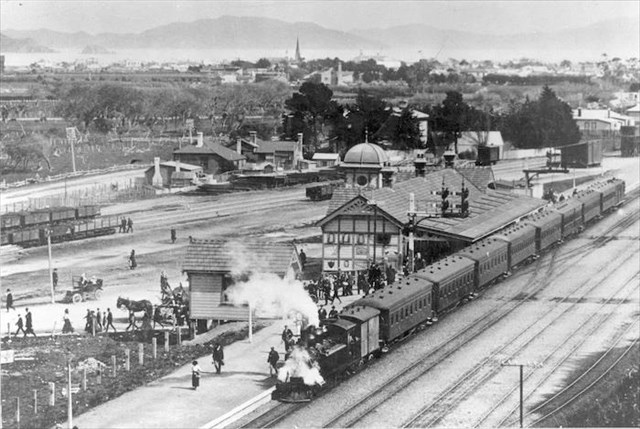
Western Hutt, c1910 |
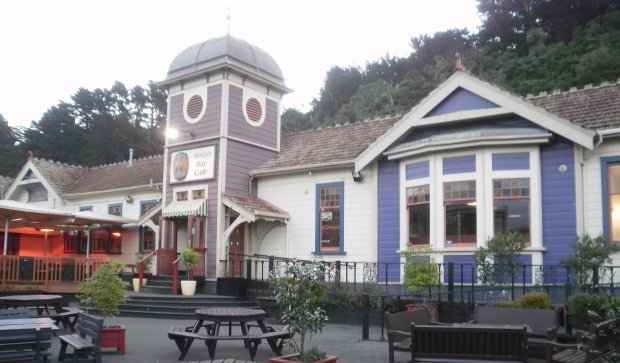
Lower Hutt, 2012 |
References:
"Western Hutt railway station", Wikipedia.org
Scoble, J: "Names and Opening and Closing Dates of Railway Stations", published by the Rail Heritage Trust of New Zealand, 2010.
Parsons, D: "Wellington's Railways Colonial Steam to Matangi", published by the New Zealand Railway & Locomotive Society, 2010