Skip to content

The Dunes of Látrabjarg EarthCache

Hidden : 8/20/2021
Difficulty:
2.5 out of 5
Terrain:
2 out of 5

Size: Size:   other (other)

Join now to view geocache location details. It's free!

Watch

How Geocaching Works

Please note Use of geocaching.com services is subject to the terms and conditions in our disclaimer.

Geocache Description:


The Dunes of Látrabjarg

Latrabjarg


The Dunes of Látrabjarg


Volcanic Islands - like Iceland - usually have beaches made of volcanic material (mostly basalt). Due to the black colour of the basalt, the beaches are more or less coloured black, i.e. they consist of tiny, black basalt particles. Here in Látrabjarg you can observe something special that you would not expect: dune beaches made of white sand. This earthcache should bring you closer to the peculiarity of these beaches and teach you how they were created. Here in the area of Látrabjarg, in the far northwest of Iceland, you will find a striking geological feature: almost white lime sand beaches with sand dunes behind - a landscape that one would not expect in Iceland, which was formed by volcanic activity. The peculiarity of the dunes in the Látrabjarg area is that the predominant sediment here is lime sand from the shells of marine mollusks. This is a peculiarity for Iceland as most of the island's beaches are made of black basalt sand. However, when you look
closer to the sand , you will see it is not pure white here either, as it has a small proportion of basalt grains.

Coastal Dunes

Coastal dunes are dunes that occur in humid and arid areas, they are connected to flat coasts. The sand for this type of dune is brought in from the sea beach, it is blown in from the sandy beach by prevailing onshore winds, so it originally comes from the sea that builds up the sandy beach. Depending on the development of the vegetation in the backland of the beach, different types of dunes can arise, ranging from irregular shapes to parabolic dunes.
The dunes formation takes place in several phases, whereby a dune, depending on the circumstances, does not reach every phase. They differ particularly in terms of the flora that colonize them, with different plant communities replacing each other over time. The first phases, which are strongly characterized by grass, are characterized by strong mechanical loads, during which, for example, sand repeatedly spills the plants.
The size and morphology of coastal dunes is dependent on the complex interaction between controlling winds, sediment supply, and the geomorphology of the nearshore and beach environment. At the most basic level, coastal dunes can be divided into those that form from the direct supply of sediment from the beach face (primary dunes), and those that form from the subsequent modification of primary dunes (secundary dunes).

Depending on the characteristics and availability of the sediment supply, dominant wind velocity and direction, moisture and vegetation present, and the geomorphology of the nearshore and beach face, dunes of various size and morphology are formed. Sand deposition, accretion, and erosion within the coastal
environment result in the development of a variety of dune morphologies; however, a general classification into primary and secondary dunes can be made.
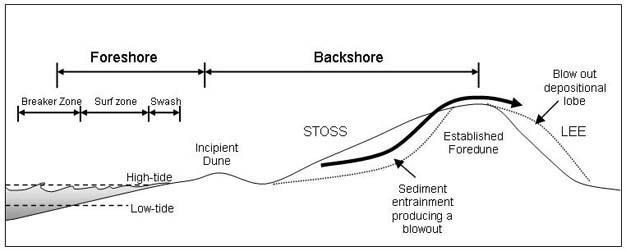
Primary dunes can be defined as dunes with a sand supply derived primarily from the beach and impeded primary dunes as those in which vegetation plays a major role in the development of the dune. They are dunes closest to the shoreline, dynamically linked to beach processes, and significantly influenced by wave action as both a constructional and erosional force.
Foredunes develop at the rear of the backshore environments (landward of the active beach) and generally comprise shore-parallel, convex, symmetrical to asymmetrical dune ridges. The morphology of foredunes is varied but they can be classified into three main types: incipient foredunes, established foredunes., and relict foredunes. Incipient foredunes are the initial dunes which accumulate above the high spring tide mark and form due to the presence of some roughness element at the rear of the beach that rapidly reduces wind flow velocities, resulting in sediment accumulation. Driftwood sometimes form the focus for the initial accumulation of dune sand, but vegetation is the most common roughness element that contributes to the formation of incipient dunes.

Foredunes

Established foredunes (frontal dunes) also originate at the landward edge of the beach, parallel to the shoreline. They develop from an incipient foredune and have a greater hight, width, age, and/or morphological complexity. As an incipient foredune builds up, and out, sand inundation and salt spray levels decrease, while nutrient levels and vegetation cover increase, resulting in more stable dunes. The lee slope (i. e., the landward slope) is gradually often colonised by a range of woody or shrub plant species that prefer more stable conditions.
Secondary dunes are the result of the subsequent modification of the primary dune by continued aeolian processes, and are generally located further inland, separated from nearshore processes. Secondary dunes are often several meters high and consist of pure sand from the primary dune. The first sign of soil formation can be seen here, but it remains raw soil with a low nutrient content. Therefore it is only covered with vegetation to 10 - 30 %. Typical plants are marram grass, beach rye (Leymus arenarius) and sea thistle.
Planting grass like beach rye (Leymus arenarius) on the foredunes, like here, prevents the dunes from being carried away by the wind and moved, i. e. from becoming moving dunes. Moving dunes have little or no vegetation on the surface and, driven by the wind, move at a speed of a few meters a year. Moving dunes have a slight gradient on the windward side, while on the leeward side, the slope is generally very steep. Existing landscapes, such as heathland, forests and lakes, but farmland too, which are in their direction of spread, are overlaid by them.


Sandy Beaches

A beach is a flat strip of coast or shoreline made of sand or rubble. A beach of coarse-grained to fine sand in different colours is called a sandy beach. Most of the times these beaches are brownish or white. There are also beaches of black (on volcanic islands) and (very rarely) pink sand. Here on Iceland most of the sandy beaches are made of black sand, the material of this sand is basalt. Often there are sand dunes on sandy beaches.
Carbonate sand, named after its main component calcium carbonate (CaCO3), is mainly found on the beaches of islands with offshore coral reefs. These are therefore also backreef sands or, due to their relatively high proportion of coral fragments, colloquially known as "coral sand". Even without an offshore coral reef, under certain conditions, e.g. in the absence of quartz sand, relatively pure carbonate sands accumulate on beaches, usually consisting of more or less rounded fragments of mollusce shells, which are colloquially referred to as "shell sand". Mollusc fragments are also common in quartz-dominated marine beach sands.
On islans of volcanic origin, sands arise from the physical weathering of volcanic rocks. These include for example the greenish olivine and dark basalt sands on the Hawaiian Islands. In contrast to olivine or quartz sand, basalt sand does not consist of such mineral grains, but of rock fragments the size of sand grains, due to the predominantly microscopic size of the mineral grains of basalt.
The mineral mix of a sand can be monomineral (i.e. from one type of mineral, e.g. dolomite, lime) or polymineral (i.e. from different minerals, e.g. basalt, gneiss, granite). A sandy beach often has its own, typical sand, which makes it almost unique in terms of grain size or mineral mix.

Your task to log the cache:

Answer the following questions via my geocaching profile:

1.) What is the peculiarity of the dune beaches here in Látrabjarg? Give me an explanation in your own words!
2.) Describe the structure of the dune beach at the coordinates in your own words! Which types of dunes can you see?
3.) Do you think that the primary dunes will be moved by the wind here, i.e. that they will become moving dunes?
4.) Is the sand of the beach monomineral or polymineral? Take a closer look at the sand and describe it in your own words!
5.) Optional: Post a photo with your log, showing you and/or your GPS near the given coordinates in the header!


After you've sent me the message with your answers, feel free to log! Only if there's something wrong, I'll contact you via message!


Sources:

Baumhauer, R. (2006): Geomorphologie.
Davis, J. L. (1980): Geographical Variation in Coastal Development. London (Longman).
Hesp, P. A. (2002): Foredunes and blowouts: Initiation, geomorphology and dynamics. Geomorphology 48, 245-268.
Livingstone, I. & Warren, A. (1996): Aeolian Geomorphology.
mineralienatlas.de
nature.com
Short, A. D. & Hesp, P. A. (1982): Wave, beach and dune interactions in southeastern Australia. Marine Geology 48, 259-284.
Sloss, C. R., Shepherd, M. & Hesp, P. (2012): Coastal Dunes: Geomorphology. Nature Education Knowledge 3(10): 2.
Summerfield, M. A. (1991): Global Geomorphology. An Introduction to the Study of Landforms.
wikipedia.org

The picture was taken by the author.


Enjoy the location!


Additional Hints (No hints available.)