
What are Scientific and Natural Areas?
The Scientific and Natural Areas Program preserves Minnesota's natural heritage (ecological and geological diversity maintained for present and future generations) for scientific study and public understanding.
Characteristics that distinguish Natural Areas include: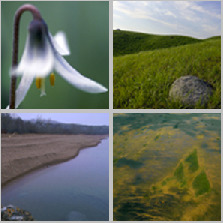
- Undisturbed plant communities, such as prairie or peatlands
- Rare or endangered species habitat, such as the sunny rock outcrops needed for the five-lined skink
- Seasonal habitat for bird or animal concentrations, such as herons, egrets and the endangered piping plover
- Natural geologic formations and features, such as eskers and rock outcrops
- Plant communities undergoing succession as a result of natural processes, such as old-growth forests
Goals
- Primary — Ensure that Minnesota's natural heritage is not lost from any ecological region of the state.
- Secondary — Provide compatible nature-based recreation, education and scientific research opportunities.
History
In the mid-1960s concerned citizens urged Minnesota to become one of the first states to create state-owned and managed Natural Areas. In 1965, a 15-member panel of experts in biology and geology called the Commissioner's Natural Heritage Advisory Committee was formed to advise the DNR Commissioner on Natural Areas and to encourage the legislature to establish a program.
State-administered Scientific and Natural Areas were initially authorized by the Minnesota Legislature in 1969 (M.S. 84.033). The first Scientific and Natural Area, Rush Lake Island, was acquired in 1974 to preserve a heron rookery.
 In 1980, an incentive for private landowners to preserve their prairies was added to the program. Native Prairie Tax Exemption allows for exempting eligible lands from property taxes.
Natural Areas Registry recognizes public land containing exceptional natural features. Since 1982 the SNA program has developed agreements with land managers for ecological management of these areas.
In 1987, Native Prairie Bank conservation easements on private lands were added to the Scientific and Natural Area Program tool box (M.S. 84.96).
Today, over 160 SNAs and 120 Native Prairie Bank easements form the backbone of protected areas in the Program. These sites represent a diverse set of natural habitats across the state.
Iona's Beach SNA
This SNA was acquired to protect one of the largest and least disturbed Lake Superior beaches in Lake County.
Iona's Beach curves in a salmon-colored crescent for over 300 yards along Superior's North Shore. It is bound to the north by a roughly 30' high cliff of pink rhyolite and felsite bedrock—source for the stones that make up the beach—and on the south by a headland of grey basalt.
Even when no one is here, this is an active place. Some days Superior's waves play the beach, rhythmically lifting and then dropping the flattened stones so that they fall together with a high-pitched, ringing chime that listeners have likened to singing. Meanwhile, the exposed basalt headland booms and shudders as the lake surges into crevices in the rock, steadily hollowing it out from the inside.
Walk the beach in any season, passing through a stand of pines into the open sky. Consider how the bright orange crustose lichen survives on the bare rock, exposed to the elements. Watch for one of the thirteen species of warblers sighted here, gleaning insects from the fringe of woodland with its alder, paper birch, balsam poplar, mountain ash, currant and dogwood. As late as November, see dragonflies tracing their patterns out over the water. Find the big lake at work, steadily remaking the land.