This is an Earthcache – as such, there is no physical cache. Instead after examining the granite of the De Vries Monument at the posted coordinates you will answer 4 questions and message me the answers. This granite memorial is located in at a roadside pull off Pilottown Road in Lewes. Please be respectful and visit during daylight hours.
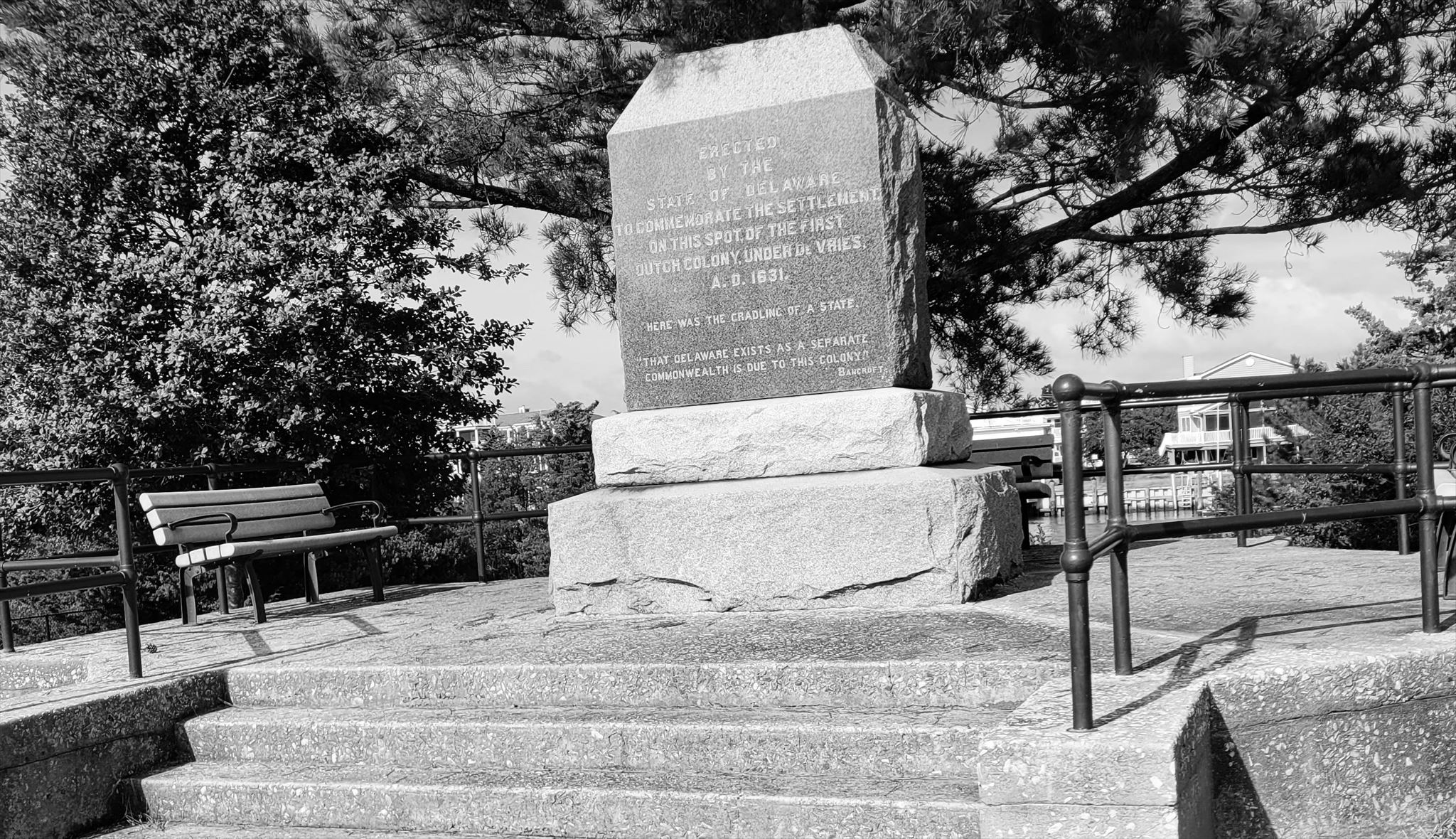
THE DE VRIES MONUMENT
Lewes, (pronounced Loo-iss) is known as “The First Town in the First State.” It was first settled by the Dutch in 1631 in a settlement that was called “Zwaanendael” (meaning the Valley of the Swans). It only lasted 2 years before being destroyed by Native Americans, but it was rebuilt again and became a permanent settlement in 1658. It was given its current name of Lewes by William Penn when he received the land in 1682.
The De Vries Monument commemorates the establishment of the first permanent European presence in Delaware. Due to a delay at the quarry in Quincy, this ten-foot-tall granite monument was erected the day before the dedication ceremony. In fact, it was so late arriving here that after it was erected there wasn’t any time permitted to have the inscription cut into it. When this granite marker was dedicated in front of several thousand people on September 22, 1909 it was blank.
QUINCY GRANITE
The Quincy Granite that you see here formed over 450 million years ago. It was quarried from the Blue Hills, just 10 miles south of Boston in Nelson County, Massachusetts. These hills are mostly made up of granite reach up to the 640 foot levels. They range from about 10 miles from east to west, and range from a half a mile to 2 miles from north to south.

It is an igneous rock that begins in a molten liquid state that solidifies when it cools. Granite can be INTRUSIVE or EXTRUSIVE depending on where it cooled. Extrusive igneous rocks form from LAVA that cooled above the Earth’s surface. Intrusive igneous rocks form from MAGMA that cooled below the Earth’s surface. The length of time it takes for lava to cool above the surface is relatively short compared to magma deep underground. Even though magma and lava may have the same chemical structure, the rock that is formed when they cool has very different properties.

Lava can sometimes solidify in minutes, while magma insulated by the earth can take centuries to form a rock. It is the slow cooling of the magma that gives the distinct ELEMENTS and MINERALS in the ROCK time to consolidate into large crystals.
ROCKS: Rocks are a composed of one or more minerals. A rock can be made up of only one mineral or, as shown in the figure, a rock can be made up of a number of different minerals.
MINERALS: : Elements often are stacked together with other elements to form minerals. Minerals are simply a collection of one or more elements that are stacked neatly together in a form called a crystal structure.
ELEMENTS: Elements are atoms, the smallest piece that we can split matter into. Different elements have different properties.

Quincy granite is a riebeckite-aegirite granite, with both the blue-black riebeckite minerals and green-black aegirite minerals being intergrown in the rock. Riebeckite minerals tend to be blue-black, and aegirite minerals tend to be green-black. Here in Quincy granite both of these minerals in many specimens intergrown. These granites are both rich in soda (8% to 10%), and in iron sesquioxide (about 28%) while being poor in alumina, lime, and magnesia.
LOGGING REQUIREMENTS:
To log this Earthcache: Read the geology lesson above. Answer all four questions posted below. Answers can be sent via e-mail or messenger contacts on my Geocaching profile within a reasonable time. Group answers are fine, but do not post the answers to the questions in your logs.
QUESTION 1. Is this granite formed from MAGMA or LAVA?
QUESTION 2. Touch and Observe the Quincy Granite. Describe the texture?
A) Pegmatitic - A pegmatitic texture is one in which the rocks crystals are about 1” long to larger.
B) Phaneritic - A rock with phaneritic texture has crystal grains large enough to be distinguished with the eye.
C) Aphanitic -Aphanitic texture consists of extremely small crystals.
QUESTION 3. Knowing riebeckite-aegirite granites can be blue, green or both. What colors minerals are more previlant?
A) The blue-black riebeckite minerals
B) The green-black aegirite minerals.
C) The minerals appear to be evenly green, blue, and black.
QUESTION 4. Look at the block bases of the monument. Do you believe these blocks are also Quincy Granite? Why or why not?
OPTIONAL PHOTO: Posting a photo that readily indicates that you (and anyone else logging the find) are at the location.

 Awesnap has earned GSA's highest level:

REFERENCES:
1. Unviel Monument at Lewes to Settler DeVries, The Evening Journal, Wednesday September 22, 1909, Pages A1 & A7, Newspaper, newspapers.com
2. THE PEGMATITES OF THE RIEBECKITE-AEGIRITE GRANITE OF QUINCY, MASS., U. S. A. ; THEIR STRUCTURE, MINERALS, AND ORIGIN, Charles H. Warren and Charles Palach, Proceedings of the American Academy of Arts and Sciences, July 1911, Vol. 47, No. 4, pages 125-168, jstor.org
3. The Commercial Granites of New England, T. Nelson Dale, Department of the Interior, pages 315-319, 1923, pubs.usgs.gov
4. Quincy Granite, Earthcache by brcross95, January, 16, 2016, geocaching.com
5. America’s First Commercial Railroad – Quincy Granite, David B. Williams, Geology Writer, blog, June 8, 2009, geologywriter.com
6. Work underway to showcase DeVries Monument in Lewes, Nick Roth, The Cape Gazzette, January 6, 2017, capegazette.com