
What are Scientific and Natural Areas?
The Scientific and Natural Areas Program preserves Minnesota's natural heritage (ecological and geological diversity maintained for present and future generations) for scientific study and public understanding.
Characteristics that distinguish Natural Areas include: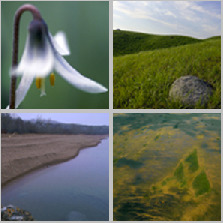
- Undisturbed plant communities, such as prairie or peatlands
- Rare or endangered species habitat, such as the sunny rock outcrops needed for the five-lined skink
- Seasonal habitat for bird or animal concentrations, such as herons, egrets and the endangered piping plover
- Natural geologic formations and features, such as eskers and rock outcrops
- Plant communities undergoing succession as a result of natural processes, such as old-growth forests
Goals
- Primary — Ensure that Minnesota's natural heritage is not lost from any ecological region of the state.
- Secondary — Provide compatible nature-based recreation, education and scientific research opportunities.
History
In the mid-1960s concerned citizens urged Minnesota to become one of the first states to create state-owned and managed Natural Areas. In 1965, a 15-member panel of experts in biology and geology called the Commissioner's Natural Heritage Advisory Committee was formed to advise the DNR Commissioner on Natural Areas and to encourage the legislature to establish a program.
State-administered Scientific and Natural Areas were initially authorized by the Minnesota Legislature in 1969 (M.S. 84.033). The first Scientific and Natural Area, Rush Lake Island, was acquired in 1974 to preserve a heron rookery.
 In 1980, an incentive for private landowners to preserve their prairies was added to the program. Native Prairie Tax Exemption allows for exempting eligible lands from property taxes.
Natural Areas Registry recognizes public land containing exceptional natural features. Since 1982 the SNA program has developed agreements with land managers for ecological management of these areas.
In 1987, Native Prairie Bank conservation easements on private lands were added to the Scientific and Natural Area Program tool box (M.S. 84.96).
Today, over 160 SNAs and 120 Native Prairie Bank easements form the backbone of protected areas in the Program. These sites represent a diverse set of natural habitats across the state.
Crystal Spring SNA
Made by water—an apt description of the pine-rimmed, rock-walled gorge that defines this site. For brief periods during the year, heavy rain and seasonal snowmelt enter from above, coursing through ravines and dropping over a sandstone ledge into the gorge. But the real action here is less about this fleeting waterfall than about what happens year-round at the foot of the ledge, where a perennial spring seeps from between layers of Jordan sandstone. These springs feed a creek that flows a short distance to the St. Croix.
Overall, the dominant plant community within the SNA has been mapped by the Minnesota Biological Survey as an excellent (A-rank) red oak – basswood forest, with steep slopes hosting sugar maple and white pine. Portions exhibit old-growth characteristics, with large diameter trees.
Three formations from the Upper Cambrian period are exposed here—Jordan Sandstone, St. Lawrence and Tunnel City Group (Mazomanie Formation) —laid down between 495 to 490 million years ago. The springs emerging from these rock layers support abundant life: from tiny shrimp-like amphipods in small ledge pools, to in the undisturbed stream beds, to brook trout in the creek's lower reaches, to rare mussels in the St. Croix.
Crystal Spring or Miniboha—this is a truly fragile site, where clambering on wet rock and slopes would quickly translate to loss of delicate mosses and water quality, the unraveling of ecological relationships long in the making. Enjoy gently.