spiromania #56
What? Yet another puzzle cache. This one only requires elementary arithmetic, +, -, x, /, but a calculator would be very helpful./p>
Where? The cache is at
XYxy = 2083323002871490
where XYxy is the location in yet another coordinate system.
Why? To introduce XYxy, which is the underlying coordinate system used by what.three.words (w3w).
How? First, some explanation is needed. Then an example will help to understand this new system
In some ways XYxy is similar to UTM. It uses meters. More precisely, it uses "squares" which as a linear measure is about three meters. As a two-dimensional unit, a square is about 3m by 3m to give approximately 9 square meters. Confusing? Think of the way in a city that we use "block" as both a one- and a two-dimensional unit. The whole world is divided up into these squares. And then, in w3w, a unique 3-word triple is assigned to each square. The triple for the posted coordinate is womanly.diplomacy.visit. If you had to remember that, you might make up a little story as a memory device, which would be easier to remember than all the digits. Like UTM, the globe is divided up into latitudinal bands and then longitudinal cells within those bands. Then each cell is divided up into the squares. The XYxy bands are only 2.5 minutes latitude high (compared to several degrees high in UTM). Likewise the cells are 2.5 minutes longitude wide; thus the cells are 2.5 min by 2.5 min.
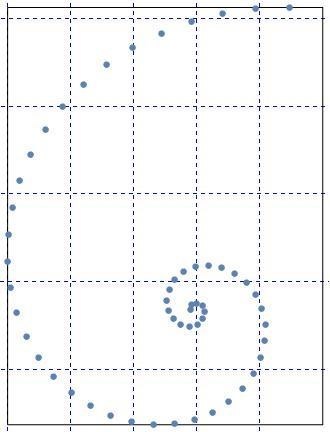
Consider the map shown above of the spiral of caches in this series so far. The cells are separated by the dashed lines. The cells are not square because 2.5 minutes longitude is not equal to 2.5 minutes latitude. The given point for this cache is at the tail of the spiral in the upper right corner.
Because XYxy is derived from lat/lon, it is easier to convert between XYxy and lat/lon than between XYxy and UTM. We'll use our given coordinates N 44° 37.829' W 93° 11.324' as an example. Whereas X and x measure longitude, Y and y measure latitude. The X and Y are for the big cells and the x and y for squares within the cells.
Since Y is the easiest to compute, let's determine it first. From the south pole to the north pole there are 4320 bands. Why? There are 180 degrees from pole to pole, and 24 2.5 minute cells per degree. Hence 24 x 180 = 4320. The bands are numbered beginning at 0 at the south pole up to 4319 near the north pole. There are 2160 bands in the southern hemisphere. The 44° in the posted N 44° 37.829' gives us 24 x 44 = 1056 more. And 15 x 2.5 brings us up to 37.5' just short of 37.829' which gives us 15 more. So the given coordinates are in band Y = 2160 + 1056 + 15 = 3231. (If one started numbering the bands at 1 rather than 0 we'd be in band 3232.
While we're at it let's get the y-part of the latitude, that's the rest of the way from N 44° 37.500' to N 44° 37.829', which is a mere 0.329'. Each band height is always divided into 1546 squares. So the portion of that needed is (0.329'/2.5') 1546 = (.1316) 1546 = 203.454 which truncated gives us y = 0203. So far XYxy = X 3231 x 0203.
Before getting X and x let's repeat and generalize the process for Y and y but just working with degrees rather than degrees and minutes. Let the latitude be denoted by LatInDegrees (44.63048 in our example), LatOffset = 90, CellsPerDegree = 24, and SquaresPerCellLat = 1546. Then the latitude in cells, and subsequently Y and y are:
LatInCells = (LatOffset + LatInDegrees ) times CellsPerDegree = 3231.1316
Y = the integer part of LatInCells = 3231
y = truncate (SquaresPerCellLat times the decimal part of LatInCells) = 0203
The longitudional cells are numbered west to east beginning at -180° with the -180° to -179 57.5' cell given the index 0. For our W 93° 11.324' = -93.188733, we get (-93.188733 - (-180)) x 24 = 2083.4704. to put us in cell X = 2082 and x is 0.4704 of the way across cell 2083, however wide that cell is. Degrees longitude are not as big as degrees latitude. A little bit of trigonometry shows that they're only Cosine of the latitude as wide. Taking that into account shows us that at our latitude the cell width is, say, 1100 squares. Using that value yields x = 0517.
In summary
Let the longitude be denoted by LonInDegrees ( -93.188733 in our example), LonOffset = 180, CellsPerDegree = 24, and SquaresPerCellLon = 1100. Then the longitude in cells, and subsequently X and x are:
LonInCells = (LonOffset + LonInDegrees ) times CellsPerDegree = 2083.47048
X = integer part of LonInCells = 2083
x = truncate (SquaresPerCellLon times the decimal part of LonInCells) = 0517
Therefore the posted coordinates convert to XYxy = 2083 3231 0517 0203 (spaces added for clarity}. That slim cell in the upper right of the figure above is for cell X = 2083, Y = 3231. The point within it is at square x = 0517, y = 0203. That number 2083323105170203 is somehow parsed into three integers to determine the locations of the three words in a dictionary to be used to obtain the w3w coordinate, viz. womanly.diplomacy.visit for the posted coordinates N 44° 37.829' W 93° 11.324'. From either the geocaching toolbox or the w3w website one can get those w3w words. The toolbox's precision seems to be less that that at w3w although it's probably easier to use for those familiar with it.
There are two solutions corresponding to XYxy = 2083323002871490 - the lat/lon solution and the w3w solution. Use the form N 44° MM.mmm' W 93° MM.mmm' for the geocaching.com coordinate checker at the left far below. For the certitude keyword checker immediately below, use the format word7.word8.word7. It's very easy to get off by one for several reasons including lack of precision. As a hint to the w3w solution, the lengths of the three words are 7, 8 and 7, resp.

You can validate your puzzle solution with certitude.
Endnotes: More than you need to know. More explanations. Disclaimers. Apologies. References
- First of all, we should explain that the what.three.words system is not open. As such, the owners are not compelled to reveal exactly how it works. However that has not prevented interested parties from trying to reverse engineer their methods. Much of the information for this cache was obtained from the second reference listed below. Some is due to my own investigations. Corrections and definitive sources would be appreciated.
- How many w3w 3m by 3m squares does it take to cover the earth? The surface area of the earth is approximately 510 million square kms, i.e. 510 x 10^12 square meters. Dividing that by 9 gives 56.66 x 10^12 squares. To see how large a dictionary is needed we need the cube root which gives about 38,000, which is less than most peoples' vocabularies. So it's small enough to enable w3w to cover the earth in more than 50 languages.
- Let's check out the reasonableness of that the number of squares per cell latitudinally = 1546. (1546 squares/cell) x (3 meters/cell) x (2160 cells/quarter of the circumference) yields 10,018,080 meters for the distance from the equator to the north pole compared to the 10 million in the original definition of the meter. Wikipedia lists that distance at 10,001,965 meters. Thus XYxy's "meters" are short by about 0.16%.
- SquaresPerCellLon, the number of squares per cell longitudinally, varies with the latitude. Near the north pole it's only one. By the equator it's 1545. A bit of trigonometry, assuming a spherical earth, show that it would vary with the cosine of the latitude. The product of 1546 and the cosine of 44° 37.5' is 1100.32. At 44° 35' that product is 1101.11 and at 44° 40' it's 1099.53. A little searching of the w3w map in the vicinity of 44° 37.5' does show that SquaresPerCellLon does change there. So let's take it as 1100 for the cell above 44° 37.5' and 1101 for the cell just below that. At the worst, using 1100 for 1101 could cause an off-by-one error in x.
- To ascertain that there is a transition at the border N 44 37.500', go to the map at w3w and scroll down along Essex Ave to punks.tank.highlights just north of the border and trying.harmonica.downsizing to the south. Notice that the squares do not line up there. Now scroll to the east along the border until they do line up. Note that the top squares caught up with the bottom ones indicating that indeed there are fewer of them in the top cell.
- To round or truncate? All of the formulas above use truncation, i.e. they take the integer part of a number, rather than rounding. That makes sense for the cell numbers, X and Y, considering that the increase doesn't come until the next integer is reached. One might think that numbers for the squares, i.e. x an y, should be rounded. However, a bit of experimentation indicates the measurement assigned to a square is in its center not at its lower left corner; that is there's already an offset of 1.5 meters in each direction, so truncating is more likely to be accurate than rounding.
- Pictures: In the gallery, besides "XY cells", is a figure titled "The Peak". It shows the locations for spiromanias #s 54,55,56,57,and 58. #56 is our current one and it's at the peak. #57 and #58 are in the future. Y = 3231 for all three cells, and X = 2082, 2083 and 2084 for the three cells from left to right.
- References:
What.three.words
w3w, the algorithm
Thanks to early corrections by Pack-a-Dad and Salsman. Congrats to the early solvers including Bunganotor, who got the FTF:
- 1. kcmcacher Thu, 26 May 2022 16:27:29
- 2. sparkyfry Thu, 26 May 2022 18:55:44
- 3. toolrep1 Thu, 26 May 2022 19:30:16
- 4. salsman Thu, 26 May 2022 20:05:29
- 5. Hügh Fri, 27 May 2022 11:45:07
- 6. Boreal Walker Fri, 27 May 2022 16:59:52
- 7. PackADad Sat, 28 May 2022 15:57:42
- 8. pfalstad Sun, 29 May 2022 13:43:18
- 9. foundinthewild Sun, 29 May 2022 15:17:30
- 10. XZQ&Dad Thu, 2 Jun 2022 18:52:15