In the tradition of old fashioned letterboxing form before GPS was available, you must follow these directions to find the letterbox/geocache:
Easier Path: From the Virtual Coordinates at the Rock, look north towards the woods. Just to the left edge of the woods is a tree. Goto the tree. From the tree, you see a long green path forward. Walk down the path approximately 470 feet. At that point stop and turn towards the woods. Proceed 4 Score feet (80 ft) at an Easterly bearing (directly facing and into the woods). There you'll see a large double trunked tree nearby, much bigger than any other tree around. Once you arrive use your geosenses to locate the cache. Please be careful opening the letterbox.
The Road less traveled, More challenging: From the rock, look north towards the woods and goto the edge of the path right before you go into the woods. You will travel down the path into the woods approximately 250 feet (at a bearing of 356 degrees). At that point, there will be an opening/path into the woods in front of you or slight to your left. Procced approximately another 240 feet (at a bearing of 323 degrees). There you'll see a large double trunked tree nearby, much bigger than any other tree around. Once you arrive use your geosenses to locate the cache. Please be careful opening the letterbox.
See the History below behind Letterboxing which was born in Dartmoor England, almost 170 years ago:.
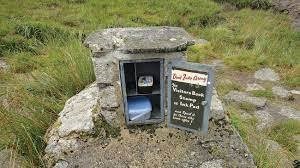
The year was 1854, and a Victorian guide named James Perrott placed a bottle in the wildest, most inaccessible area on Dartmoor, England, along the banks of Cranmere Pool. In it, he included his calling card so future visitors could contact him and leave their own calling cards. Little did anyone know, this small act would be become the hobby we now know as letterboxing. A hike to Cranmere Pool in 1854 was anything but a simple walk in the woods. This area regularly receives over 100 inches of rain each year, and the peat acts as a sponge making travel through the soft, wet ground a severe challenge. The easiest access point required a nine mile, one-way hike through this difficult terrain, and the low, undistinguished profile of Cranmere Pool meant that hikers could easily miss the pool even if they found themselves within a few hundred feet of it.
Those who made it to Cranmere Pool were justifiably proud of their accomplishment and recorded their accomplishment by including their own calling cards in the bottle. Needless to say, not many people picked up James Perrott’s calling cards in those early years. In 1888, a small tin box replaced the original bottle. Visitors left self-addressed postcards and the next person to visit the letterbox (except if it was a same-day visitor) would retrieve the postcards and mail them back from their hometown. By April 1905, another upgrade was in order—particularly a means by which the increasing number of visitors could record their attendance. For the first time, it included a logbook, and a zinc box replaced the tin box.
The first suggestion for a rubber stamp appeared in the logbook on July 22, 1907 by John H. Strother who wrote, "Reached the pool at 7.10pm, misty day with cool breeze, and would suggest that a rubber stamp, something like the post office stamps for postmarking letters or rubber stamp for putting the address at the top of a piece of notepaper be provided and kept here. If this were done it would be proof that cards posted had really come from Cranmere." The letterbox finally reached the point as we largely know it today as a box containing a logbook and a rubber stamp.
Letterboxing is perhaps the slowest growing hobby of all time. Forty years would pass from when that first letterbox was planted by James Perrott until a second one made its way into letterboxing history at Belstone Tor. Another 44 years would pass before a third letterbox was planted at Ducks Pool. After 122 years, fifteen letterboxes dotted Dartmoor. In 1976, Tom Gant created a guide map pinpointing the fifteen letterboxes in existence, at which point letterboxing began to boom in a big way. The number of letterboxes tripled the next year and in the 1980s grew into the thousands. Letterboxing became a full-fledged hobby in its own right, and letterboxers who wanted to distinguish themselves started to create descriptive names for themselves and personal stamps to mark the letterboxes they found. Unfortunately, this wild west of letterboxing did not work out very well. Letterboxers started pulling apart historic rock walls, painting graffiti marking the location of letterboxes, and so forth, and Dartmoor National Park wanted to crack down by removing all but the Cranmere Pool and Ducks Pool letterboxes, both of which at this point had permanent structures to house the contents.
This is when another man, Godfrey Swinscow—affectionately known as God—swooped in and rescued letterboxing from extinction. He met with officials from Dartmoor concerned about the impact of letterboxing, wined and dined them, and hammered out a code of conduct still in use to this day: Cranmere Pool Letterbox The Cranmere Pool letterbox, as it stands today 1. Boxes should not be sited in any kind of antiquity, in or near stonerows, circles, cists, cairns, buildings, walls, ruins, peatcutters’ or tinners’ huts, etc. 2. Boxes should not be sited in any potentially dangerous situations where injuries could be caused. 3. Boxes should not be sited as a fixture. Cement or any other building material is not to be used. As the number of letterboxes exploded on Dartmoor, a loose confederation of letterboxers formed the 100 Club—formed when there were just 100 letterboxes on the moor!—to recognize the achievements of those who found at least 100 letterboxes.