This is the Twentieth cache in my (and now others) Chorus Cabinet Art Series. This series is placed to highlight the local artistic talent that Chorus has commissioned to brighten up their otherwise boring Public Utility Boxes, (PUBs). This is another piece of cabinet art created by Gynelle Blake in her New Zealand native bird series and was painted in Augst 2018. Gynelle dedicated this artwork to Cindy Low who passed away in the Thunder River Rapids ride accident at Dreamworld.
To find the cache go to S41 32.UVW E 173 57.XYZ
To work out the missing letters, you will notice there are four black letters on a yellow background in the top lefthand corner of the cabinet. Using the values of the letters where A=1, B=2, C=3 etc, carry out the following calculations:
U Multiply the value of the top left letter by two, then add the value of the top right letter, then subtract the value of the bottom right letter.
V Bottom left letter.
W Add the values of the letters in the left hand column together, then multiply the result by two, finally subtract that result from the value of the bottom right hand letter.
X Subtract the value of the top right letter from the value of the bottom right letter.
Y Multiply the value of the bottom left letter by two, then add the result to the value of the top left letter.
Z Subtract the value of the top right letter from that of the bottom right letter, then multiply the result by two.
Should any of you answers for the above calculations come to more than a single digit (i.e. 0 to 9), then use the second digit from your answer (i.e. 17 = 7).
Checksum If you got U+V+W+X+Y+Z=30, well done, go and find the cache.

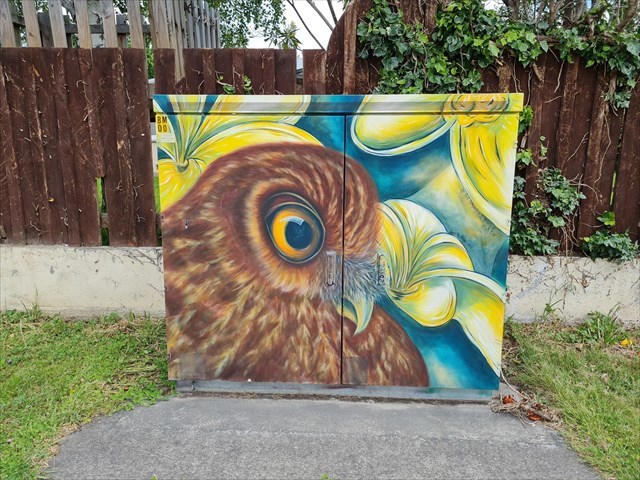
The morepork (Ninox novaeseelandiae), also called the ruru or Tasmanian spotted owl, is a small brown owl found throughout New Zealand and Tasmania. Described by Johann Friedrich Gmelin in 1788, it was for many years considered to be the same species as the Australian boobook of mainland Australia until 1999. Its name is derived from its two-tone call. Four subspecies of the morepork are recognized, one of which is extinct and another that exists only as a hybrid population. The bird has almost 20 alternative common names, including mopoke and boobook—many of these names are omomatopoeic, as they emulate the bird's distinctive two-pitched call.
It has dark brown plumage with prominent pale spots, and golden-yellow eyes. It is generally nocturnal, though sometimes active at dawn and dusk, retiring to roost in secluded spots in the foliage of trees. The morepork feeds on insects and small vertebrates, hunting by pouncing on them from tree perches. The International Union for Conservation of Nature has assessed the morepork as being of least concer on account of its large range and apparently stable population
English naturalist John Latham wrote of the New Zealand owl in his 1782 work A General Synopsis of Birds, but did not give it a binomial name. German naturalist Johann Friedrich Gmelin described the morepork in 1788.
"Morepork" has been designated the official name by the International Ornithological Committee.
Description
The morepork is 26 to 29 cm (10 to 11.5 in) long, with the female slightly larger than the male. Females are slightly heavier at 170–216 g (6.0 to 7.6oz) compared with the male's 140–156 g (4.9–5.5 oz). The morepork has generally dark brown head and upperparts, with pale brown spots on head and neck and white markings on the rest of the upperparts, with a pale yellow-white supercilium (eyebrow), dark brown ear coverts, and buff cheeks. The eyes are yellow to golden-yellow. The feathers of the chin and throat are buff with dark brown shafts. The feathers of the underparts are mostly dark brown with buff and white spots and streaks, with the larger markings on the belly making it look paler overall. The upper tail is dark brown with lighter brown bars. The cere and bill is pale blue-grey with a black cutting edge. The feet are orange or yellow with blackish claws.
Young moreporks do not attain adult plumage properly until their third or fourth year. The tips of juvenile's feathers are white and fluffy, remnants of the nestlings' down. These are worn away over time, persisting longest on the head. The feathers of the head, neck, and underparts are fluffier overall. Their plumage is a darker and more greyish brown overall than that of adults.
Distribution and habitat
In New Zealand's North Island, it is common from Rangaunu Harbour south to southern Taranaki and west of Tauranga, Lake Taupo, and Whanganui, as well as between Murupara and Hangaroa in the northeast, and southern Manawatu, Wellington and Wairarapa in the south, and uncommon outside these areas. In the South Island, it is more common west of the Southern Alps / Kā Tiritiri o te Moana, around Marlborough and in Southland. It is common on Rakiura/Stewart Island and offshore islands.
It occurs in most habitats with trees in New Zealand forests dominated by Podocarpus, Nothfagus, Metrosideros, and other hardwoods, up to the alpine tree line.
Behaviour
They are usually seen singly, in pairs, or in small family groups of an adult pair and up to three young.
Swamp harriers could feasibly prey on young moreporks.
During the day, moreporks sleep in roosts. Although mainly nocturnal, they are sometimes active at dawn and dusk. The main hunting times are evenings and mornings, with brief bursts of activity through the night. On dark nights, they often perch through the middle hours, and particularly if the weather is bad, may hunt by daylight, instead.
Breeding
Moreporks nest anywhere the trees are large enough to have hollows.
Feeding
Although their main hunting technique is perch-and-pounce, they are agile birds with a swift, goshawk-like wing action and the ability to maneuver rapidly when pursuing prey or hawking for insects.
They hunt a variety of animals – mainly large invertebrates including scarab and huhu beetles, moths and caterpillars, spiders, grasshoppers, and in New Zealand, weta. They also take almost any suitably sized prey, particularly small birds, rats, and mice. They can find suitable food in pine forests as well as native forest.