
Getting to ground zero: “From Interstate 5, exit La Jolla Village Drive. Turn left onto La Jolla Shores Drive. Continue down the hill and park anywhere along the street near the beach, or in the La Jolla Shores beach parking lot. Dike Rock is located North of the Scripps Pier. If you park near Scripps Institute of Oceanography there are two staircases just south of the pier leading down to the beach” (From Limpets.org).
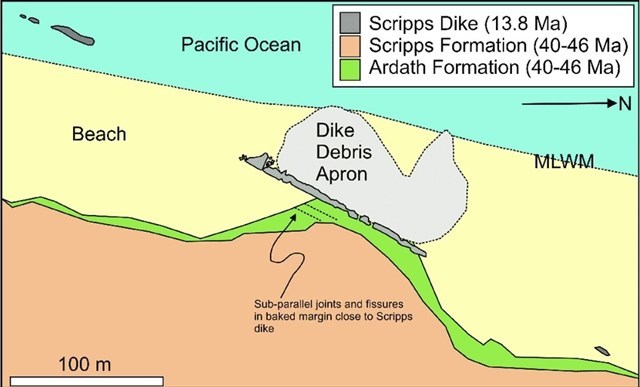
Dike Rock is a rocky intertidal zone that includes a sea wall and is bordered to the north and south by sandy beach. The visible rock and sea wall we see here is part of the Scripps Dike, which is a volcanic feature comprised of basaltic-andesite. This rock is black, which provides a stark contrast to the tan, picturesque beaches that surround it. Additionally, the dike is igneous rock, compared to the sedimentary sandstone found all around it. Scripps Dike formed roughly 13 million years ago when a magma flow from beneath the surface flowed upward through older cracks in the sandstone. This sediment that surrounds the dike is from the Eocene age, meaning it is much older than the igneous rock protruding forth. The cracks in the sandstone through which the magma flowed are in a fracture zone, which is a consequence of plate tectonics.
To log this earthcache, navigate to the dike and make some observations. Note the difference in rock types around you, and enjoy the wide variety of sea life that can be found in the tide pools! Then, send me a note with the answers to the following:
- The name of this earthcache and the number of people in your group
- Estimate the length of the sea wall that extends into the water. Do you this is the full length of the dike?
- Does the black igneous rock extend all the way back to the base of the sandstone cliff?
- What does this imply about the size of the formation?
Sources:
https://limpets.org/sites/dike-rock/
https://gotbooks.miracosta.edu/fieldtrips/index.html
https://en.m.wikipedia.org/wiki/Fracture_zone
https://www.researchgate.net/publication/337047776_The_Scripps_Dike_and_Its_Implications_For_Mid-Miocene_Volcanism_And_Tectonics_of_the_California_Continental_Borderland