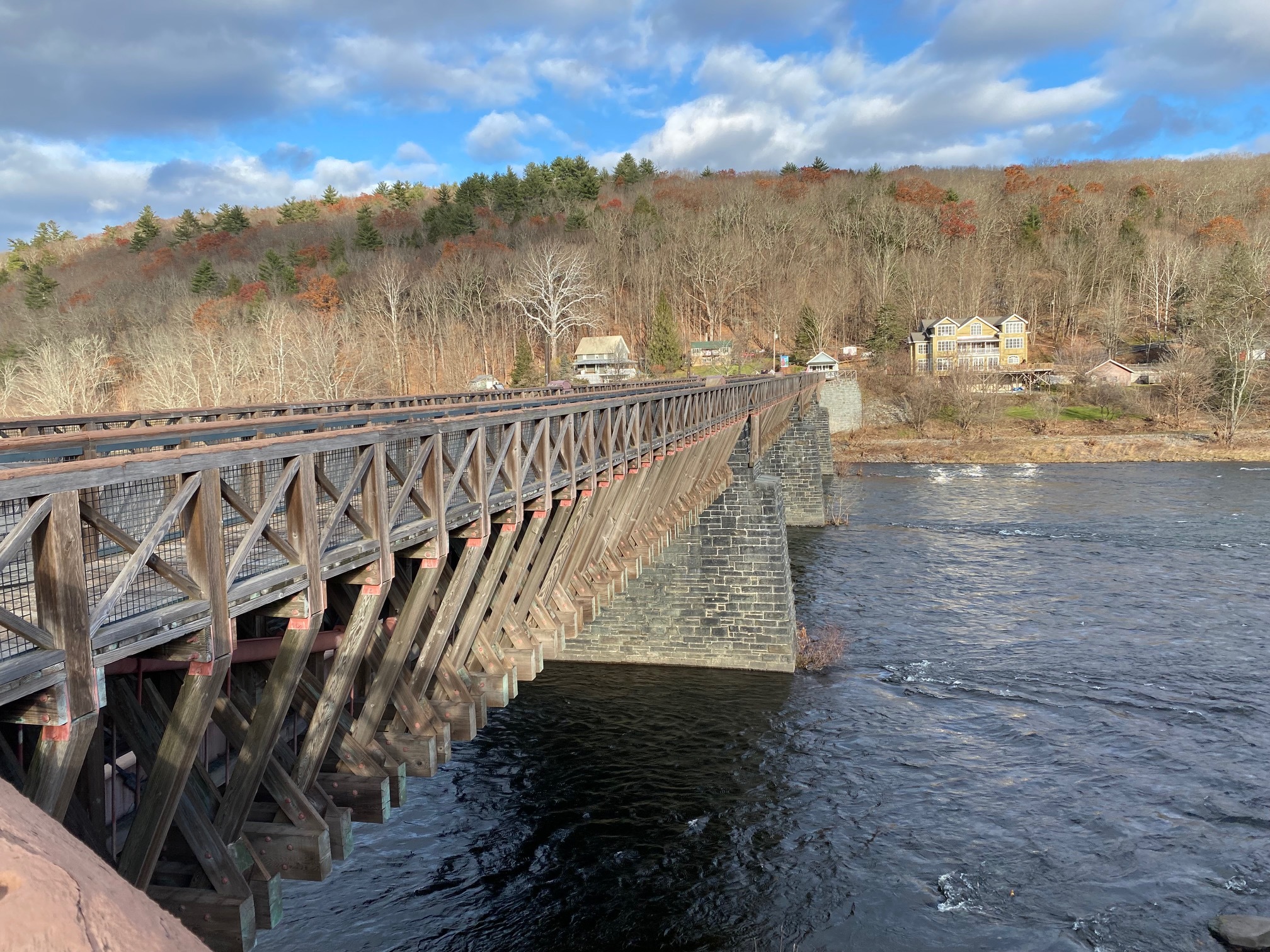
Roebling's Delaware Aqueduct is the oldest existing wire suspension bridge in the United States. The aqueduct was constructed in 1847 by engineer John A. Roebling as part of the Delaware and Hudson Canal Canal, which connected the coal fields of northeast Pennsylvania with the Hudson River. After the aqueduct closed in 1898, the aqueduct was drained and converted into a vehicular bridge. The bridge crosses the Delaware River which flows 330 miles from the confluence of the East and West Branches at Hancock, NY south into Delaware Bay. While walking across the bridge on the pedestrian walkway (or even driving here), you may have noticed a lot of rafts in the river. The Delaware River is a popular destination for whitewater rafting and is known for its rapids. Rapids are kind of mix between a run (a section of smooth flowing river) and a cascade. They are formed when a river cuts downwards through a bed of hard and soft rocks. The soft rock gets eroded more easily, leaving behind the hard rocks which can be exposed above the water surface. An important thing to keep in mind is that the bedrock needs to be very resistant to the erosional power of the river, otherwise the bedrock would be eroded and the rapids would disappear over time.
After looking at the river, proceed to the Tollhouse, which is located adjacent to the bridge on the east side of the Delaware River. In front you will notice a small stone wall, which is constructed of Pennsylvania Bluestone, which is a unique sand stone found only in Northeastern Pennsylvania. Some common colors include: blue, green, earthtone, and lilac or any combination of those. Pennsylvania Bluestone is a strong, stable stone that resists cracking and won’t discolor. It can easily be separated into slabs of different sizes which makes it highly prized as a building material. More than 400 million years ago during the Devonian Period (416 to 57 mya), this area was an ancient sea, with several different rivers draining here and forming tidal flats. At the time, there was a mountain range called the Acadian Mountains which was being uplifted along the east coast of North America. Ancient rivers had carved out valleys and carried away the sediments and where the rivers met the sea, the currents slowed, and the sand gravel and clay were deposited. This area was known as the Catskill Delta. More layers of sediments were deposited and the pressure from the overlying rock layers caused the particles to glue together to form sedimentary rock. The entire formation is known as the Catskill Delta Formation and is up to 10,000 feet thick and it covers parts of eastern Pennsylvania and southern New York. The Catskill Formation includes black shales, thick beds of coarse red sandstone, occasional limestones, and bluestone. The bluestones were formed from sandy deposits in river channels and river banks. Bluestone was not laid down in a continuous blanket, which is why usually you can find layers of shale and siltstone above or below the bluestone layers. Instead, rivers and deltas left behind pockets of sand. As rivers shifted across the landscape, the sandy layers did too. As a result, bluestones are found in small, discontinuous layers scattered throughout the region.
Please do not touch or move any of the rocks so that future generations will be able to enjoy this landscape.
Logging Requirements:
- Looking at the Pennsylvania Bluestone, describe the color and the texture of the rock. Is the color consistent or are there slight variations within each stone?
- Is the Pennsylvania Bluestone foliated (contains layering) or non-foliated (does not contain layering)?
- Do you think all of the stone used to construct the wall came from the same quarry or different sources? Why or why not?
- Upload a photo with the Roebling Aqueduct. You do not need to be in the photo, though it is strongly encouraged.