Miller’s Point #5: Keystone Kelp
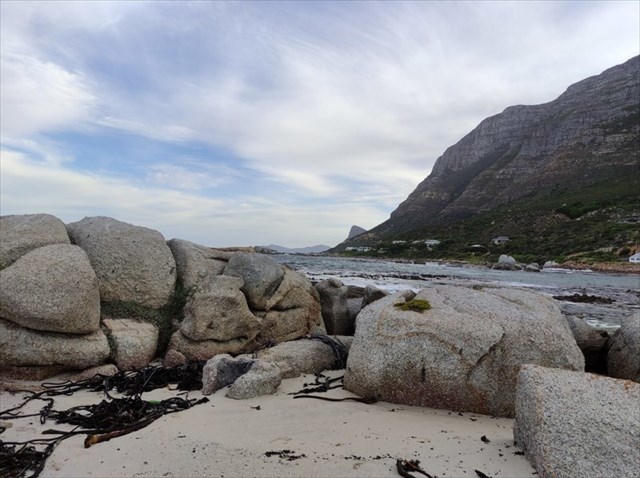
This is the last in a series of 5 caches (including 2 earlier hides now incorporated) hidden at Miller’s Point – a popular recreational area – especially on fine holidays and weekends.
The cache, a small flip-topped dispensing pot, is hidden at the rocky SE corner of the Miller’s Point Resort in an area with numerous granite outcrops and boulders, surrounded by and strewn with this large and distinctive plant.
To obtain the final coordinates – and a helpful hint – click on the image above and complete the jigsaw puzzle.
"The link to the website has not been checked by Groundspeak nor by the reviewer for possible malicious content and access to the site is therefore at your own risk"
To Reach the Cache Location:
Park @ or near S 34 13.954 E 18 28.487 at the edge of the main car park and make your way along the upper main path or along the beach and across the low granite outcrops to the cache location. If the car park is full you should be able to find an alternative parking spot nearby or further along the slipway road.

Kelp is a marvellous organism. It may ‘just be algae’, but it gives the ocean life, has become an icon of marine conservation, and is even edible!
All dripping in tangles green, Cast up by a lonely sea;
If purer for that, O Weed, Bitterer, too, are ye?
- Herman Melville, The Tuft of Kelp (1888)
Kelp is the largest and fastest-growing marine algae or seaweed, and belongs to the brown algae group known as Phaeophyta - so although it resembles an underwater plant, it is in fact a protist, the same family of organisms as moulds and amoebas. Some species grow up to 50cm/day and up to 80m long!
 In most species, the thallus (or body) consists of flat or leaf-like structures known as blades which are covered with a layer of mucilage and originate from elongated stem-like structures, the stipes. The holdfast, a root-like structure, anchors the kelp to the substrate of the ocean. Gas-filled bladders (pneumatocysts) form at the base of blades some species to hold the blades close to the surface.
Kelp forests are found in the temperate and polar coastal regions. 4 species are found around the South African coast, with Ecklonia maxima being the most familiar, often washed up on beaches after heavy seas.
The forests provide a source of food and shelter to a many species including fish, crayfish, sea cucumbers, limpets and filter feeders. The slimy mucus on kelp is rich in organic compounds that encourage the growth of bacteria, which in turn forms the building blocks of the food chain within the kelp forest ecosystem.
Although several kelp species have a wide distribution, most grow in large groups or ‘kelp forests’ typically found in temperate and sub-polar regions with good water clarity and abundant nutrients. The most notable kelp forests are found on the coasts of Southern Africa, the US West Coast, Argentina, Chile, southern Australia and several northern European coasts.
There is an impressive 800,000 L kelp forest exhibit at the aquarium in Cape Town (see here). South Africa is one of only a few countries in the world with natural kelp forests on its coast, and with Namibia, these are only countries in Africa with such forests. The 4 species found here are:
Sea bamboo (Ecklonia maxima): the largest species growing up to 12m tall and the most common on the SA West Coast and in Namibia. Its stipe (algal stalk) is hollow and full of gas to help it float. Thick, straplike fronds grow from a bulb near the surface.
Bladder (or Giant) kelp (Macrocystis pyrifera): a delicate kelp up to 12m long. Its fronds are rippled, with spines on the edges. The base of each frond has a small gas-filled bladder to help it float. It only occurs on the Western Cape coast from Cape Point to Saldanha.
Spiny kelp (Ecklonia radiata): the smallest species rarely growing >1m tall. Its stipe is short and solid with no gas pockets. Its fronds are oddly shaped and covered in spines. It is the only SA kelp not found on the West Coast, instead being found in rocky pools on the Southern Coast from Cape Point to KwaZulu-Natal.
Split-fan kelp (Laminaria pallida): the most common species, but prefers deeper water. Its stipe is stiff, solid, up to 5m long which ends in a single large fan-shaped frond. The frond is so long that it can hang down and touch the ground, enabling it to sweep away herbivores in the swell.
Like plants, kelp needs sunlight to photosynthesise and convert carbon dioxide into sugars. But unlike plants, it does not use roots to extract nutrients from the soil – it extracts them directly from the seawater. So, instead of a "root system", it has a modified anchoring system known as a holdfast.

Like forests on land, kelp forests are vital habitats for 1,000s of unique species. Their rapid growth and conversion of carbon dioxide into energy is a vital source of food for animals like abalone and urchins. The sheltered environments amongst the kelp serve are refuges and nurseries for countless species of fish. Even shore habitats, such as human settlements and bird nesting sites are often protected by offshore kelp forests that dampen the effects of waves and prevent coastal erosion.
Uses: kelp and kelp-based products are edible but this does not mean you can simply pick up a piece of kelp and eat it! Local foraging organisations use kelp in recipes. It is touted as a ‘superfood’ as it contains numerous vitamins and minerals, including vitamin B, zinc, copper, calcium, iodine and iron.
 The oldest kelp recipe known is for Japanese Kombu where the local kelp is shredded and dried or pickled, and later used as a base for other meals. Boiling kombu with fish sauce and water makes dashi - the base for Japanese soup dishes like miso.
Its name comes from one of its earliest uses - being burnt to make soda ash, a component in glass. Because the ash produced by this brown seaweed contained lots of iodine, it tends to produce undesirable colour tints in the glass - so it was called ‘faulty’ or the Latin culpe. This name morphed into ‘kelp’ and spread to name the seaweed too. Kelp was the major source of soda ash until industrial-scale production techniques were invented in the 19th Century.
Kelp and other brown algae are rich in a carbohydrate called alginate which is extracted and used to make a variety of food products requiring thickeners such as jam, ice cream, sauces, salad dressings, pet food and toothpaste.
Overall kelp is ecologically critical because:
- It is a keystone organism, as its role in the ecosystem is so vital, that without it the ecosystem would collapse.
- Kelp forests are among the most productive ecosystems in the world
- Due to climate change and elevated sea temperatures, the environment for kelp to successfully grow in is at risk. This poses a huge threat to biodiversity within the ocean
- It purifies water and removes waste products produced by the animals living within the forests
- Underwater forests provide shelter, food and the ideal habitat for various species
- Commercially, it is used in many products, including salad dressings, cosmetics, food, vitamin supplements, skincare products, fertiliser, soil conditioner, plant growth stimulants (eg. a liquid concentrate made in Simon’s Town) and paint. In South Africa, the seaweed industry uses mainly Ecklonia maxima and to a lesser extent Laminara pallida as well as 3 species of red seaweed. See here for a detailed paper on the kelp resource and related industry.

See here for more info on this fascinating plant.
See here for a richly illustrated and interactive presentation on the False Bay reefs and the associated issues and here for a fine short video on the ‘Forest below the waves’.
See also here (snokelling at MP), here (guide to diving at Miller’s Point), here (freediving at MP), here and here (kelp forest snorkel near Seaforth, Simon’s Town).
Looking directly south from GZ, the area some 350m away is dive site Shark Alley and to the left another 200m beyond to the SE you should be able to see the white of waves breaking around a rock pinnacle - dive site Pyramid Rock.
Miller’s Point is also used to access several other notable dive sites. For comprehensive info on these see Miller's Point, Caravan Reef and Boat Rock.
