
The Huntington Library gardens cost $25 to enter on weekdays, and $29 on weekends. Often, reservations are required. The Library will occasionally offer “Free Days,” but reservations are still required for those special days.
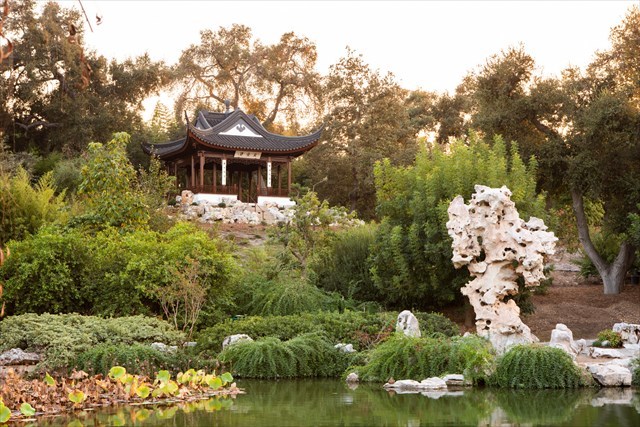
The Huntington Library is a gem in the greater LA area, boasting impressive botanical gardens with over 14,000 plant species, and museums full of special books and art.
In the Chinese garden section, a favorite spot for many, you’ll notice a vast collection and display of strange looking rock formations. These rocks are impressive specimens of what are known as Taihu stones. These stones are a unique type of formation found primarily in Lake Tai in China. “During the Qing dynasty, other sites occasionally produced Taihu-like stones, including Zhaoqing, in Guangdong province and Guangde, in Anhui province” (Mowry, 1997). These stones became coveted for their unique and ornate appearance, being regarded as natural works of art.
The Taihu stones showcase an impressive feat of geologic power. The specimens are limestone that has been eroded away over time. The heavily water-worn pieces are formed from millions of years of wave action in the relatively shallow Lake Tai. Lake Tai is the third-largest freshwater lake in China. The wave action in this lake helps erode the softer parts of the stones, resulting in a very abstract shaped piece. The rocks with a lot of holes and channels are often slender and typically vertically oriented, with a wrinkled surface. Additionally, the edges of Taihu stones are almost always rounded and worn instead of sharp. This is once again explained by the slow and gradual erosion by constant wave mechanics over time. These rocks only clock in at around a 3-4 on the Mohs scale of hardness, meaning that they are more susceptible to erosion than other bedrock that may be present in the lake. The color of Taihu stones very greatly, from the commonly seen cream, to light gray and rarer yellow, blue, red, or black.
These rocks are traditionally thought of as embodying special energy and aura, called qi.
The coordinates will first bring you to a specimen of Taihu stone here at the Huntington Chinese Garden called “Patching Up the Sky.”
To log this earthcache, please send me a note with the following:
- Name of this earthcache and the number of people in your group (even non-cachers).
- Why do you think the stones only erode in certain places, forming holes and channels?
- Locate another Taihu stone in the garden (they are all around). What color is it?
- Observe the “Patching Up the Sky” stone. Does it appear smooth or rough? How does this compare with some of the other stones you’ve located around the garden?
Sources:
https://artmuseum.princeton.edu/collections/objects/55543
https://www.huntington.org/chinese-garden
https://www.vsana.org/newpage0b2a1951
Hay, Hu 2002, pp. 25-29; Mowry 1997, pp. 26-27
http://substancejournal.sites.lmu.edu/petriverse/media/taihu-huntington