Rothenburg
Nirgendwo sonst ist so viel Mittelalter erhalten geblieben wie in Rothenburg ob der Tauber. Ob die Zeit stehen geblieben ist? Wer durch die Altstadt schlendert, mit ihren lauschigen Plätzen und Winkeln, mit Türmen, Brunnen, Toren und Weinstuben, könnte es wohl glauben.
So klein Rothenburg auch ist, so unübersehbar ist die Fülle historischer Stätten, Museen, Kirchen, Klöster und Denkmäler. Etwas Zeit sollten Sie also einplanen. Vielleicht auch, um von Rothenburg aus die Romantische Straße zu erkunden, Deutschlands bekannteste – und wohl auch schönste – Ferienstraße. Hier erweist sich Deutschland wie ein Märchen aus königlichen Schlössern, herrlichen Landschaften und nicht zuletzt kulinarischen Köstlichkeiten. Zurück in Rothenburg, können sich nostalgische Gefühle auch bei einem Besuch im Weihnachtsdorf Käthe Wohlfahrt einstellen: In Europas größtem ganzjährig geöffnetem Weihnachtsgeschäft gibt es einfach alles, was zu einem stimmungsvollen Weihnachtsfest gehört.
Oder man schlendert durchs Spitalviertel, passiert eines der erhaltenen mittelalterlichen Stadttore oder besucht die wunderbaren Kirchen. Die St. Jakobskirche beispielsweise, mit dem schönen Steinbild, das Christus und die schlafenden Apostel darstellt. Oder die bemerkenswerte, kunstvoll ausgestattete Kirche St. Wolfgang am Klingentor. Aber es spielt eigentlich gar keine Rolle, wohin man seine Schritte lenkt: Es gibt so vieles in Rothenburg ob der Tauber, worauf und worüber jeder Besucher sich freuen kann. Und was auch besichtigt und bestaunt wird: Immer wartet hinterher ein gemütliches Gasthaus, um Hunger und Durst zu stillen.
Plönlein
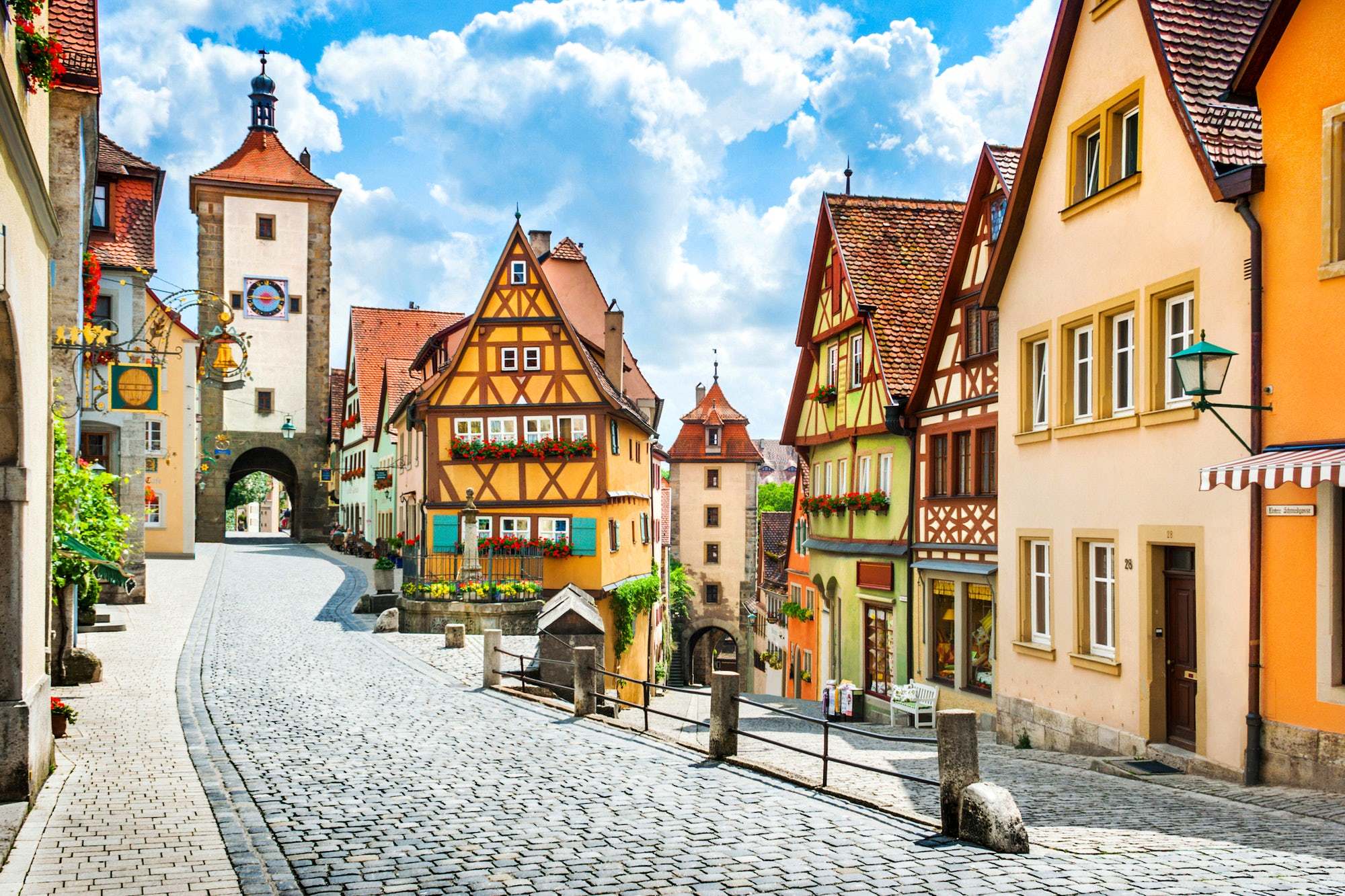
Eines der bekanntesten Postkartenbilder aus Rothenburg ob der Tauber ist sicherlich das Plönlein. Ein schmaler Fachwerkbau mit einem kleinen Brunnen davor, eingerahmt vom Kobolzeller-Turm und dem höheren Siebers-Turm, mit liebevoll restaurierten Stadthäusern rechts und links, die einen reizvollen malerischen Effekt erzeugen. Das Wort "Plönlein" stammt aus dem Lateinischen "planum" und bedeutet "flaches Quadrat" oder „Kleiner Platz am Brunnen“.
Viele meinen, ein gelbes Fachwerkhaus vor dem Eingang zum Spitalviertel sei mit dem Begriff Plönlein gemeint. Das schiefe, krumme Haus steht tatsächlich im Zentrum des Plönleins. Zum Ensemble des Plönleins gehören folglich der Brunnen vor dem Fachwerksolitär sowie die beiden Türme der alten Stadtmauer, die links und rechts davon hochragen – links der Siebersturm, der ins Spitalviertel führt, rechts der Turm des Kobolzeller Tores aus dem Jahr 1360, der den Weg ins Taubertal weist.
Dank dreier Uhren bleibt in der Ratstrinkstube die Zeit nie stehen
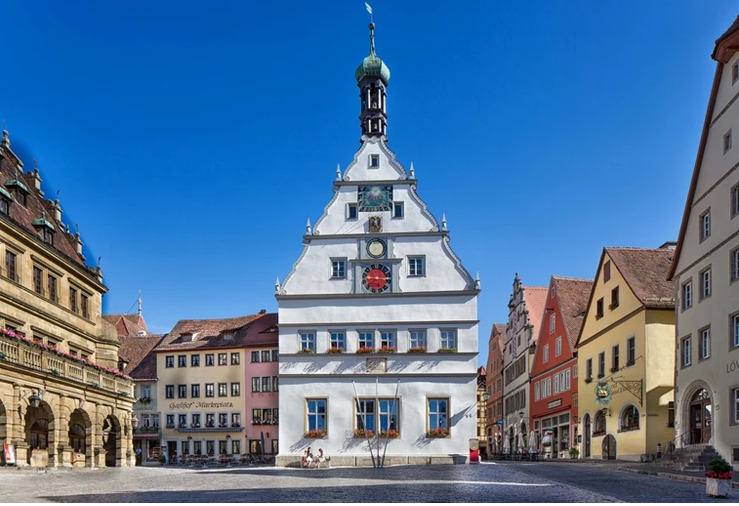
Den Giebel der Ratstrinkstube schmückt neben der großen Stadtuhr von 1683 und der Datumsanzeige auch eine anno 1768 montierte Sonnenuhr sowie das bekannte reichsstädtische Wappen. Wo früher ausschließlich nur Ratsherren verkehren durften, befindet sich heute in dem Gebäude mit dem Rothenburg Tourismus Service die erste Anlaufstelle für alle Besucher der Stadt. Bemerkenswert ist auch die Kunstuhr an der Fassade des Hauses, die seit 1910 den legendären Meistertrunk von 1631 darstellt. Sie öffnet ihre Fensterläden zwischen 10 und 22 Uhr immer zur vollen Stunde und zeigt die berühmte Szene, in der Altbürgermeister Nusch lauf Befehl des Grafen Tilly einen 3,25-Liter-Humpen mit köstlichem Frankenwein in einem Zug leerte und damit Rothenburg vor der Zerstörung durch die katholischen Truppen bewahrte.
There are very few places elsewhere in the world with such a wealth of original buildings dating from the Middle Ages as there are here. You can't help but ask yourself whether time has stood still in Rothenburg ob der Tauber, as you amble through the Old Town with its secluded squares and tucked-away corners with towers, fountains, gates and wine taverns.
Rothenburg may be small, but it has a remarkable wealth of historical sights, museums, churches, abbeys and monuments. So be sure to allow plenty of time for your visit. Rothenburg is also a great place to explore the Romantic Road, Germany's most famous and possibly most beautiful scenic route, where the country looks like something straight out of a fairytale, with royal palaces, beautiful countryside and, last but not least, delicious food. Back in Rothenburg, another nostalgic spot is the Käthe Wohlfahrt Christmas Village. The largest Christmas shop in Europe open all-year round, it stocks everything that makes the festive season special.
It is also well worth strolling through Rothenburg's Spitalviertel district, passing through one of the preserved Medieval town gates or visiting the wonderful churches. St. James' Church, for example, has a beautiful stone carving depicting Christ and the sleeping apostles. Also special is the beautifully decorated St. Wolfgang's Church at the Klingentor gate. It doesn't really matter where you go in Rothenburg ob der Tauber, as a different delightful sight will appear at every turn. And whatever you choose to visit and marvel at, there is always a cosy inn waiting afterwards, where you can satisfy your hunger and quench your thirst.
Plönlein
One of the most famous postcard images from Rothenburg ob der Tauber is definitely the Plönlein. A narrow half-timbered building with a small fountain in front, it is framed by the Kobolzeller tower and the higher Siebers Tower, with lovingly restored townhouses to the right and left, creating a charmingly picturesque effect. The word “Plönlein” derives from the Latin “planum” meaning “flat square” or “small square at a fountain”. Many think that the name Plönlein refers to a yellow timber-frame house at the entrance of the Spital quarter. It’s true that the tilted, crooked house is in the center of the Plönlein. Ensemble at the Plönlein includes the fountain in front of the lone timber-frame house and the two towers of the old city wall that rise to its left and right – on the left the Siebersturm leading to Spital quarter, on the right the tower for the Kobolzeller Tor from 1360, which opens towards the Tauber Valley.
Thanks to three watches the time never stops in the Ratstrinkstube
The gable of Ratstrinkstube adorns the next big town clock dating from 1683 with a date display and a sundial mounted anno 1768 and the famous imperial city crest. Once only councilors were allowed to operate, but now the Rothenburg tourist service is now in the building and is the first stop for anyone visiting the city. Also noteworthy is the astronomical clock on the facade of the building , which represents the legendary Master Draught of 1631 through to 1910. She opens her shutters from 10.00a.m 10.00p.m every hour on the hour and shows the famous scene, whereby the former mayor Nusch at the command of Count Tilly drank a 3.25 -liter tankard with delicious Franconian wine in one gulp and thus Rothenburg was saved from destruction by the Catholic troops.
This Virtual Cache is part of a limited release of Virtuals created between March 1, 2022 and March 1, 2023. Only 4,000 cache owners were given the opportunity to hide a Virtual Cache. Learn more about Virtual Rewards 3.0 on the Geocaching Blog.