The cemetery is open dawn to dusk. Please be respectful while on the property. Burials still occur here. Church services begin at 10:00 AM Sundays.
This short multi will introduce you to two historic Washington County sheriffs, and show you two interesting, though unrelated, memorials. You can park at the posted coordinates. You'll walk about 1000 feet over bumpy grass to gather the answers and get the final.
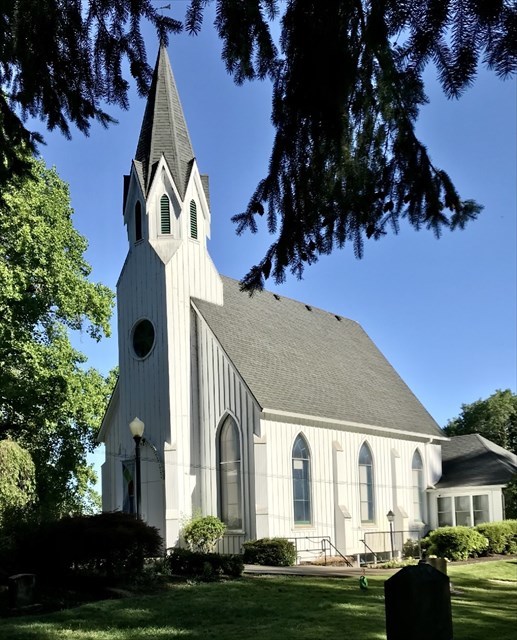
Welcome to the Tualatin Plains Presbyterian Church, better known as the Old Scotch Church. This historic church, organized in 1873 by twelve Scottish settlers from Aberdeenshire, Scotland, is one of the oldest continuously used churches in Oregon.
The eight sided steeple is architecturally unique, and the church is one of the most photographed in Oregon. It is a popular site for many weddings. In 1974, the church was honored by being listed in the National Register of Historic Places.
Although not the oldest cemetery in the area, the Old Scotch Church Cemetery contains the remains of many of Washington County’s most well-known names.
Two of them are mentioned in this ”Hidden Cemeteries of Washington County - Sheriffs” video I discovered on YouTube. This is one of a series of videos that aren't so much about “hidden cemeteries'' but rather about the hidden histories of some of the cemetery residents.
You’ll find the final at N 45° 34.ABC W 122° 59.DEF. Checksum (total) of the digits A thru F = 38
Waypoint A is the information sign at the posted coordinates. There is a map titled “THE OREGON COUNTRY”, with a year. If the year is:
- 1838, A = 0
- 1843, A = 3
- 1856, A = 6
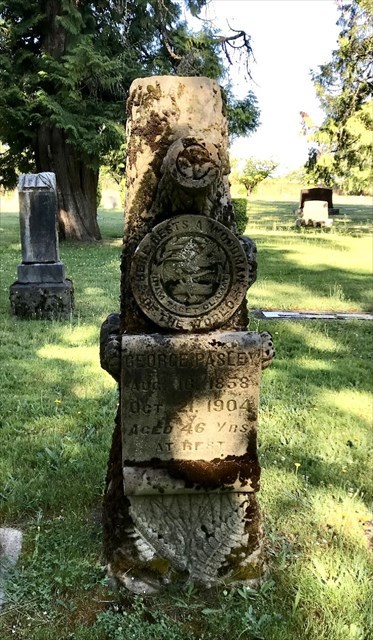
Waypoint B is the distinctive headstone for a Woodman of the World. There are a few different styles of Woodman of the World headstones and, despite looking like tree stumps or logs, they have nothing to do with forestry.
These headstones were a benefit available between 1890 and 1920 from Woodmen of the World, a fraternal organization whose purpose was to make life insurance affordable to everyone. The organization was founded in 1890 in Omaha, Nebraska, by Joseph Cullen Root after he heard a sermon about "pioneer woodsmen clearing away the forest to provide for their families". He wanted to start a society that "would clear away problems of financial security for its members"
For Waypoint B: Look at the black double headstone immediately left (south) of the Woodman headstone. There is an image in the middle of it. If the image is a:
- Cross, B = 2
- Clasped hands, B = 6
- Tree, B = 9
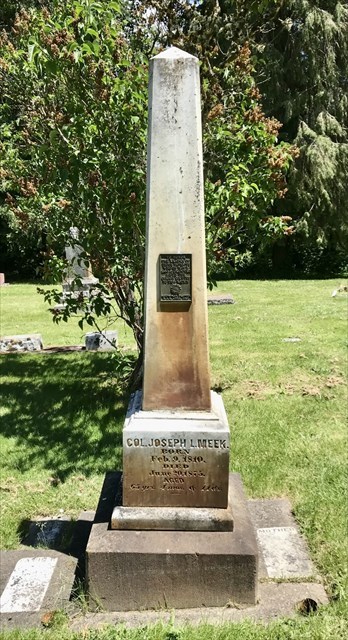
Waypoint C is Joseph Meek’s headstone. Meek is often called the Father of Oregon. He was not originally buried here. He was buried on his donation land claim nearby, but his grave had to be moved when Highway 26 was constructed. There is a historical marker at the site, and there is a geocache there:
GC15XH1 - Oregon History - Joseph Meek
Meek came here first as a mountain man and, later, on an expedition with Marcus Whitman, who established a mission in Walla Walla, WA. Meek settled in Washington County, but he and Marcus remained good friends and, in fact, Joseph sent his 10 year old daughter to Whitman’s mission in Walla Walla
Tragically, there was an Indian uprising at Whitman’s mission and Meek’s daughter was killed, along with Whitman, his wife Narcissa, and ten other people.
That politicized Meek, and he became one of the 102 people who met at Champoeg to establish a provisional government for the territory of Oregon. He was, in many ways, the leader of this movement.
When Oregon voted to go become a part of the United States, the U.S. government offered Meek his choice of jobs. It didn’t hurt that Meek’s cousin was First Lady of the U.S. married to President Polk. Rather than choosing to be governor, he chose to be the territory’s first marshall. One of his first acts was to go to Walla Walla to avenge the deaths of his daughter and Marcus Whitman.
He served as sheriff of Oregon’s newly formed government in 1843. In 1847, he traveled to the nation’s capital to speak with President James Polk, advocating for Oregon Country to become a federal territory. When Polk agreed, Meek was named the Territory Federal Marshal.
For Waypoint C: From Meek’s headstone, look at the next headstone to the right (south) - a black headstone for Justin Allen Meek. There is a quote on the back of it. If the author of the quote is:
- Johnny Cash, C = 1
- Henry David Thoreau, C = 5
- Abraham Lincoln, C = 8
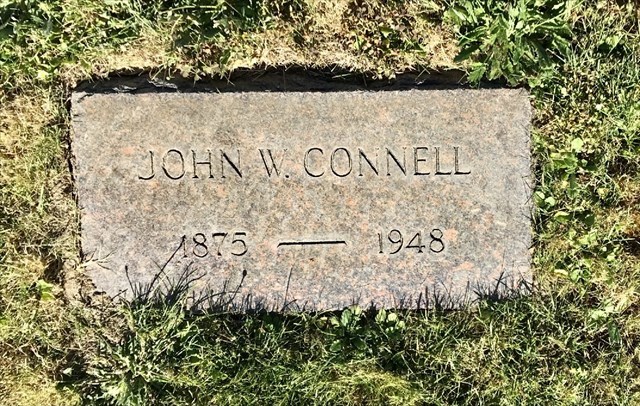
Waypoint D is the headstone for JOHN W. CONNELL 1875 - 1948 Connell was first elected sheriff in 1904 and served one term. He then decided it wasn’t for him and became a successful farmer and merchant in Hillsboro.
Twenty years later, then a well-known, respected businessman, he ran again and was elected in 1928. He was sheriff for many years, including some of Washington Counties toughest times. One incident occurred during the Great Depression, a time of much labor strife. In 1935 the governor at the time, Charles H. Martin, wanted the strikes broken and ordered the state’s sheriffs to break them.
Most sheriffs refused but John Connell obliged. Stimpson Mill, outside Gaston, was the pride of the state - the largest and most modern in the state at that time. John Connell formed a posse that used physical violence to break up the strike. He then marched the strikers at gunpoint to the Forest Grove jail, about 8 miles away.
He continued being sheriff until 1948.
For Waypoint D: Look at the headstone immediately left (south) of JOHN W. CONNELL 1875 - 1948. If the headstone is for:
- EMILY LOUISE, D = 7
- VIRGINIA “GINNY” JACKSON, D = 3
- JANET COOK, D = 0
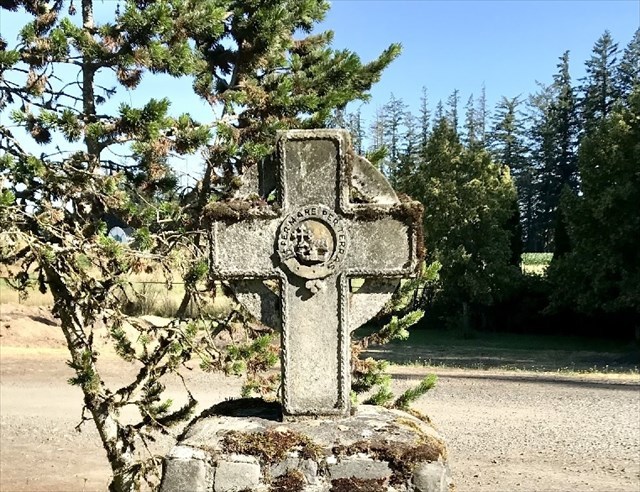
Waypoint EF is a tall stone memorial. If it is in memory of:
- THE MOUNTAIN MEN WHO SETTLED AND DEVELOPED OUR COMMUNITY, EF = 29
- THE MEN, WOMEN, AND CHILDREN WHO DIED ON THE OREGON EMIGRANT TRAIL, EF = 47
- THE SCOTTISH PIONEERS OF THE OREGON TERRITORY, EF = 56