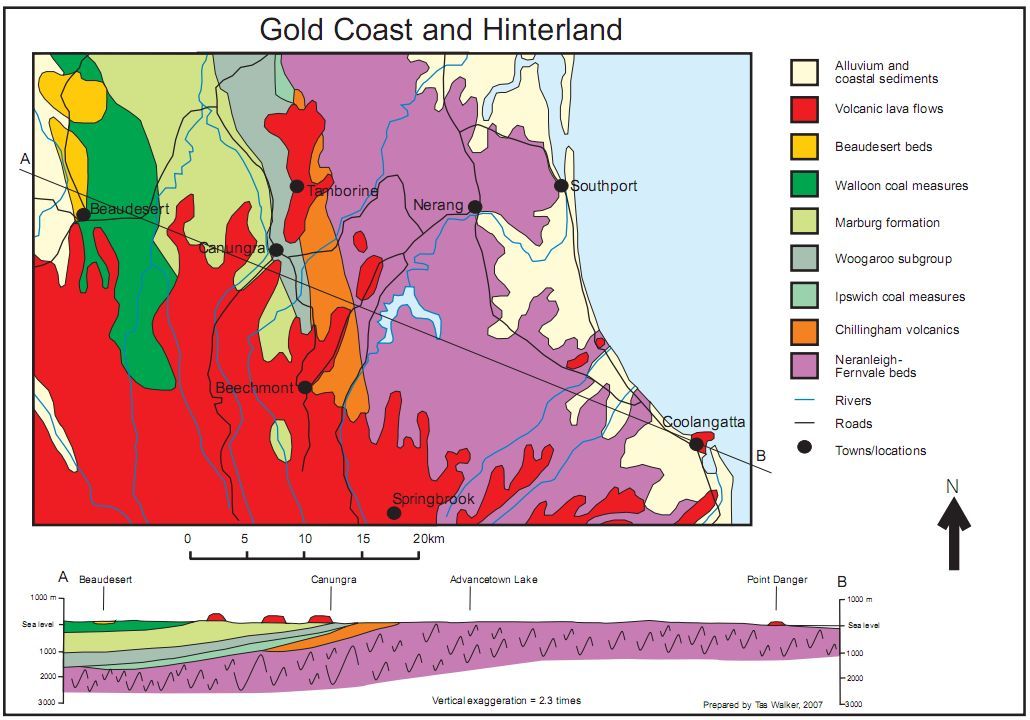
About 360 to 310 million years ago, the geography of the continent’s eastern side was very different. A volcanic mountain chain extended down its length, flanked by a shallow continental shelf to the east, and a deep water trench off its edge. This configuration resulted from an oceanic crustal plate to the east, colliding with and being “subducted” beneath a continental plate to the west. Sediments were eroded off the volcanic chain and deposited on the continental shelf. Some became unstable, and slumped down submarine canyons into the deep trench and ocean floor as dense “turbidity” currents to settle on the sea floor as beds of dirty, coarse sands and finer silts and muds. The coarser sands were deposited first near the foot of the slope, and the finer materials were carried farther to the east. Basalt lavas were also erupted onto the deep ocean floor, and in places patches of siliceous ooze built up from the accumulation of innumerable siliceous skeletons of microscopic animals called radiolaria.
About 310 to 300 million years ago, the subduction process stopped and the crustal plates squeezed together. The sediments in the trench were compressed, deformed, and pushed up above sea level to form mountainous terrain. The strata became steeply inclined and cut by numerous faults, and the sediments hardened and partially recrystallised to new minerals. The coarse dirty sands became meta-greywacke, the finer material argillite, the basalt lavas greenstone, and the siliceous ooze quartzite. These rocks are now the Neranleigh-Fernvale beds.
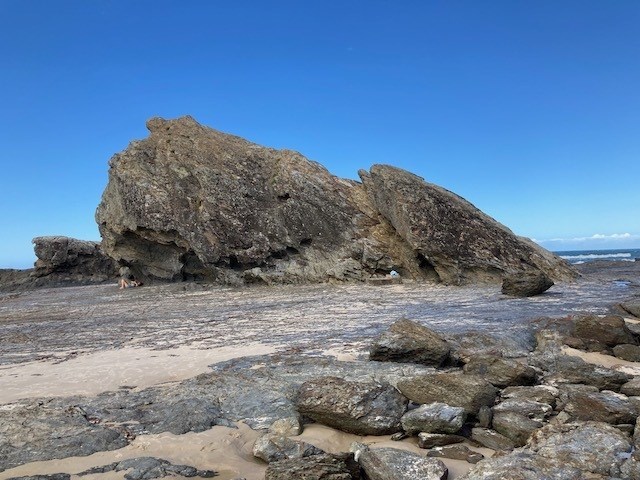
Currumbin Rock, is made of steeply inclined and well-bedded argillite and fine-grained greywacke of the Neranleigh-Fernvale beds. The rocks are older than the basalt boulders on Currumbin headland the boulders of basalt imported and placed around the car park and rock groyne.
Currumbin Rock sits on a wave cut platform that is formed where the sea erodes into the land. Because surf erosion cannot dig down to the base of the surf zone, a fairly level surface results made up of the wave cut bench at the cliff base and the abrasion platform further offshore. Currumbin Rock is good examples of a wave-cut platform in this area. The rocks will eventually erode into the sea leaving the platforms.
Tasks
To claim this Earthcache please send me the answers to the following questions
1. How old is Currumbin Rock?
2. At GZ if you leave the sand, how wide is the wave-cut platform?
Photographs with your log are welcome