"Almost every pioneer community, especially those in the Willamette Valley, was tied to the rest of the territory by roads or trails crossing at least one waterway on a ferry, so ferries were essential facts of life."
- Charles F. Query, "A History of Oregon Ferries since 1826"
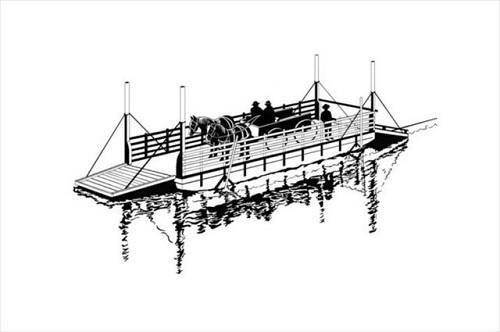
I recently discovered a series of “Hidden Cemeteries of Washington County'' videos on YouTube. Most of them aren’t so much about “hidden cemeteries” but more about the hidden histories of some of the cemetery residents.
One of the videos is ”Hidden Cemeteries of Washington County - Tigard, Scholl's Ferry and Boone's Ferry”.
Ferries played critical roles for Willamette valley early pioneers. One of my other caches already covers Peter Scholls and his ferry: ”GC9F1HG - Hidden Cemeteries and Ferry Tales - Scholl’s”
This cache introduces you to Alphonso Boone’s and John A. Taylor’s ferries. This will also introduce you to the city of Tigard, through which the roads to Boone’s, Taylor’s, and Scholl’s ferries passed. The city was named after early settler Wilson Tigard.
The cache isn’t at the posted coordinates, but that is a good place to start. The final is closest to waypoint F, the most northern waypoint. You’ll drive about 30 miles, and it might take you 2.5 hours or more, depending on traffic. Hence the 4-star terrain rating. The terrain rating for each waypoint and the final is no worse than 1.5.
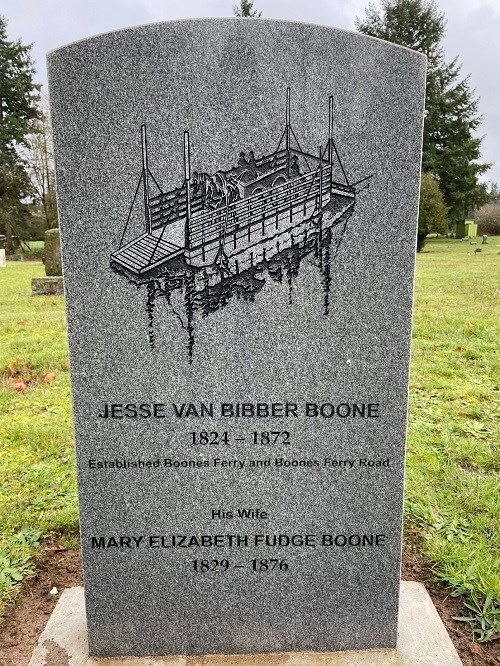
Waypoint A is at the posted coordinates - the Boone family memorial in the Butteville Cemetery.
Alphonso Boone was the grandson of famous Kentucky frontiersman and Revolutionary War hero Daniel Boone. Alphonso trekked to Oregon via the Applegate wilderness trail in 1846.
A pause for a side note of historical trivia: The Boones were joined on their overland journey by the ill-fated Donner party, who split off from them in Wyoming to take an untested cutoff to California. They went on to face catastrophe in California’s Sierra Nevada mountains.
A year later, Alphonso's enterprising son, Jesse, began operating a ferry across the Willamette, just west of the current site of the Interstate 5 Boone Bridge at Wilsonville. After he built the ferry, the community of Boones Landing was established, which grew into what became Wilsonville. Jesse also extended plank roads south to Salem and north to Portland, following ancient trails of the indigenous Kalapuya people. Boones Ferry Road still exists today.
It is thought that Jesse and some of his children are buried here in the Butteville Cemetery in unmarked graves. This memorial was erected in their honor in 2020.
For Waypoint A: Look at the headstone about 7-8 feet to the left (north) of the Boone memorial. This person died in 1918. There is an inscription at the bottom of it. If it says:
- Beloved husband and father, A = 0
- A precious one from us has gone, A = 4
- Faithful unto the end, A = 6
- Here rests a Woodman of the World, A = 8
Waypoint B is in Boones Ferry Park.
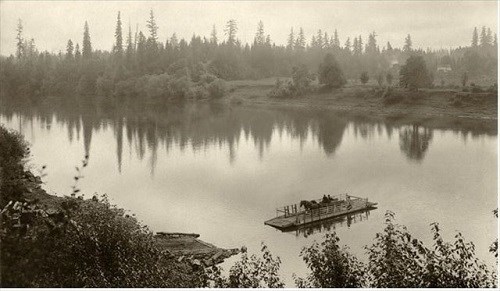
Historic photo of Boone’s Ferry
This was the site of the northern terminal for Boone’s Ferry, which crossed the Willamette River beginning in 1847. The ferry operated for 107 years, until 1954. It finally closed after completion of the nearby I-5 bridge. In its heyday, it made up to 300 crossings a day.
Boones Ferry Road is one of the oldest roads in the region, forming part of a major land-based thoroughfare in pioneer times linking fledgling Portland with the pre-territorial government at Champoeg, and later Salem.
For Waypoint B: Look on the telephone pole for a yellow tag with the letters VZ and a 6-digit number.
B is the first digit minus 3.
Waypoint C: Taylors Ferry Crossing.
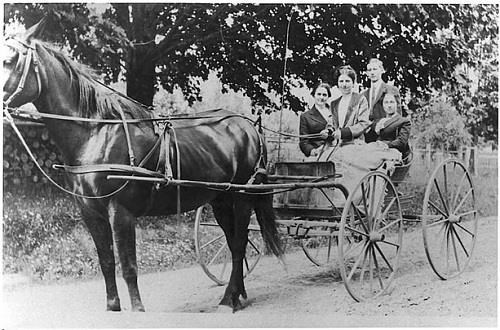
Historic photo of family traveling by buggy on Taylors Ferry Road.
Modern concrete bridges span the Tualatin River at this crossing today, but during the mid-1850s, a ferry operated by John A. Taylor provided the only safe crossing. Taylor trekked the Oregon Trail from Wisconsin in 1852 with his wife and three small children. Securing a donation land claim of 320 acres along this stretch of the river, he quickly installed a ferry.
Taylor operated the ferry for several years before building a toll bridge in the late 1860s. He cut and planked a road from the ferry to Portland called Taylors Ferry Road, much of which was eventually incorporated into Highway 99W.
Waypoint C is a large sign labeled "Guide to the Lower Tualatin River" Look for two red words at the top left corner of the sign. If the words say:
- LIMITED PARKING, C = 37
- SHALLOW WATER, C = 59
- PROTECTED AREA, C = 96
- NO PORTAGE, C = 63
Waypoint D: John Tigard House:
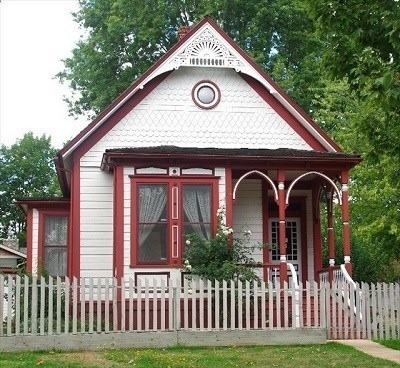
The Tigard area has always been a crossroads, first for Indian trails, then pioneers using the roads to Taylor’s, Boone’s, and Scholl’s ferries, then for railroads, and later for highways.
This house was built in 1880 by Wilson Tigard as a wedding gift for one of his sons. It was first built beside what is now Hwy 99 and was scheduled to be razed to make way for a strip mall. In 1978 the Tigard Historical Association had it moved here and restored. It now houses the Tigard Historical Association. Its present location is on East Butte, the butte for which the town was originally named.
Here is a link to a Virtual Tour of the Tigard House.
You’ll learn a little more about Wilson Tigard at waypoint E.
For Waypoint D: Look at the telephone pole at the street corner by the Tigard House. There are several tags on it. Look at the lower one, a faded grayish-greenish tag with the letters VZ and a 6-digit number that starts with “5”.
D is the third digit.
Waypoint E: Crescent Grove Cemetery and Wilson Tigard grave site.
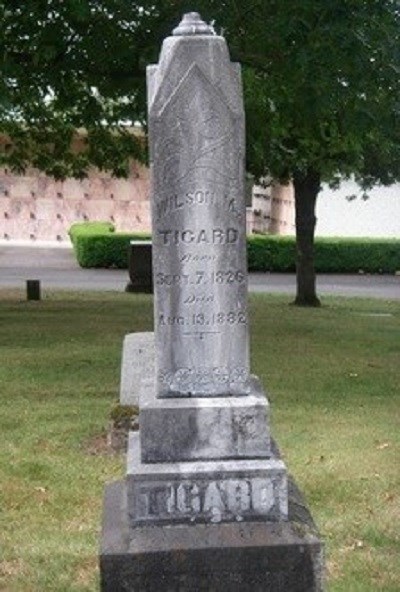
This is one of the most historic cemeteries in Washington County. If you walk around you’ll see many famous names, including Allen, Greenburg, and the town’s namesake Wilson Tigard.
Wilson Tigard came to Oregon in 1852 from Arkansas. He was looking for a healthier place for his family, away from Arkansas’s rampant diphtheria, tuberculosis, and other diseases. He originally settled in Milwaukie, but decided he could find better hunting and trapping opportunities further west. On his way to the Tualatin plains, he stopped in East Butte for the night.
… and stayed. His family, which included eleven children, became prominent citizens. They opened a store that later housed East Butte’s first post office. The post office was run by one of Tigard’s descendents, who disliked having it called “East Butte” and had the name changed to “Tigardville”, which later became simply “Tigard”.
For Waypoint E: Look at the grave site of Wilson Tigard. There is an inscription on the north side of the base of the headstone. If it says:
- Pioneers of ‘52, E = 8
- Founder and Patriarch, E = 7
- Beloved ones farewell, E = 6
- Here rests a Woodman of the World, E = 5
Waypoint F: Jesse Boone Memorial Marker.
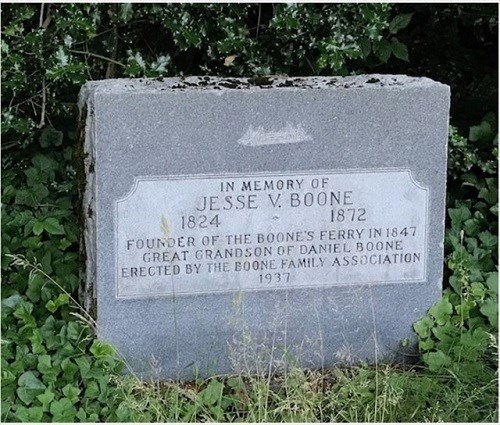
This large but mostly forgotten historical marker is near the intersection of Southwest Boones Ferry and Southwest Taylor's Ferry roads. It is dedicated to the memory of Boones Ferry founder Jesse Boone and was installed by the Boone Family Association in October 1937. Jesse's 78-year-old son, Van Daniel Boone, unveiled the marker during a ceremony.
This was the only known memorial to the founder of Boone’s Ferry until the Waypoint A memorial in Butteville Cemetery was installed in 2020.
There is no convenient way to visit the marker itself, but you can see it from waypoint F if you cross to the downhill side of SW 3rd Ave. and look south across Taylors Ferry Rd to the woodline west of (to the right of) the triangular island in the intersection.
Waypoint F is at the corner of SW Taylors Ferry Rd and SW 3rd Ave. There is a telephone pole with a square tag labeled “Pole Inventory #”. F = the second to the last number minus the last.
You’ll find the final at N 45 2A.BC W 122 4D.EFF
The checksum (sum of the individual digits) of ABCDEFF = 39.
It took you a couple hours to complete this, but it would have taken pioneers a day or two to cover the same path. As you cruise along Hwy 99 through Tigard and over the Tualatin River, or speed down I-5 past Wilsonville and over the Willamette River, think of these enterprising pioneers and their important contributions to our cities.
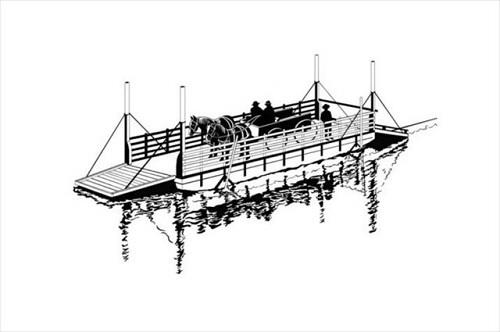
Ferries still play an important role today. These three ferries are still active on the Willamette River:
Canby Ferry
Wheatland Ferry
Buena Vista Ferry