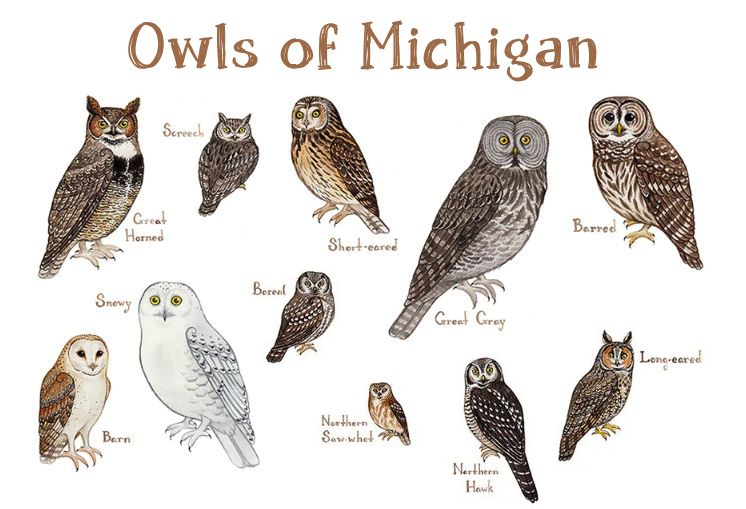
Owls of Michigan
Michigan, with more than half of the state forested, is home to eleven species of owls. Spotting owls can be tricky since most species are inactive during the day. And owls, by nature, are shy and elusive creatures.
Here are some tips for successful owling:
- Learn – Find out about the species of owls in the area you are looking for.
- Listen – Familiarize yourself with the calls of different owls you can come across and listen actively. You are more likely to hear them before seeing them.
- Look carefully – Owls have excellent camouflage, and their plumages are adapted to blend into the night.
- Signs – Also look out for their pellets which are oblong or spherical and brown or grey in color. A large number of pellets indicates a nearby nesting or roosting owl.
- Be respectful – Be still and silent, and refrain from using bright lights, so as not to disturb or frighten them away.
This cache is one of twelve that were published for the 2022 Autumn in Oakwoods event. Each cache will focus on one of the owls that you will find in the state, many of which can be found right here in Oakwoods. A link to all 12 of the caches may be found HERE.
Great Gray Owl
- Scientific name – Strix nebulosa
- Lifespan – 18 years
- Size – 24 – 33 in
- Weight – 25 – 60 oz
- Wingspan – 54 – 60 in
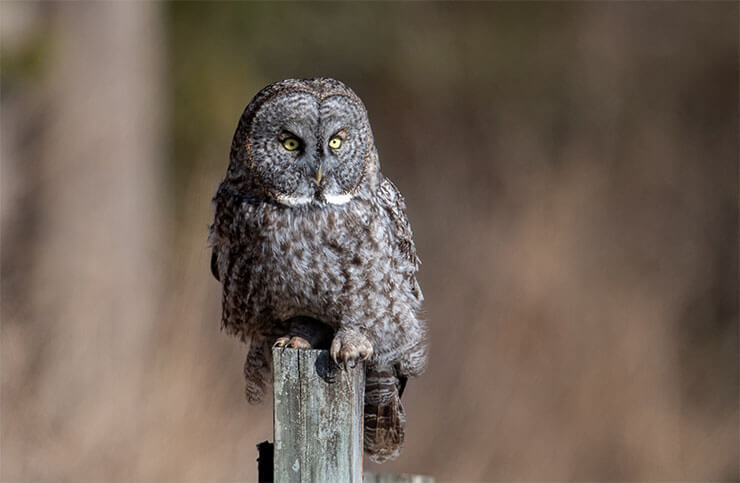
The great gray owl is the world’s largest owls by length and one of the most peculiar-looking owls. It is gray above with pale bars and pale below with dark streaks. It has a large, rounded head with a gray face and yellow eyes ringed with dark circles.
They breed in dense, coniferous forests and mixed woodlands and hunt in nearby open areas. They do not build nests but rather use the discarded nests of other birds. The common call is a deep, sonorous whoo. They may also hiss and chatter. If you are lucky, you may spot a great gray owl, but these owls offer few and rare sightings.
Great gray owls have exceptional hearing and hunt nocturnally from a perch that may be a tree or post. Gray owls swoop down at their prey with immense strength and are capable of plunging through snow to grab their prey. Their diet comprises mainly rodents.
The greatest threat to great gray owls is habitat destruction due to timber harvesting, which impacts their nesting, roosting, fledging, and hunting activities. They are also affected by rodenticides, collisions with vehicles, and the West Nile Virus. Source: https://avibirds.com/owls-of-michigan/
The Cache: The cache is a medium-sized lock & lock hidden along a connector to the Yellow Horse Trail.
| This cache is located within Oakwoods Metropark, a part of the Huron-Clinton Metropolitan Authority park system. A Metropark Vehicle Entry Permit is required: Annual Permit $40. Senior(62+) Permit $29. Daily Permit $10.
For general information please call 810-227-2752 or 800-47-PARKS. Or visit our website at www.metroparks.com.
All park rules and regulations apply. Park in parking lots only. Check the Metroparks website for park hours.
|
The permit for this cache has been submitted and approved by the Southern District Interpretive Services Supervisor of the Huron-Clinton Metroparks