
What are Scientific and Natural Areas?
The Scientific and Natural Areas Program preserves Minnesota's natural heritage (ecological and geological diversity maintained for present and future generations) for scientific study and public understanding.
Characteristics that distinguish Natural Areas include: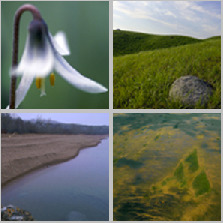
- Undisturbed plant communities, such as prairie or peatlands
- Rare or endangered species habitat, such as the sunny rock outcrops needed for the five-lined skink
- Seasonal habitat for bird or animal concentrations, such as herons, egrets and the endangered piping plover
- Natural geologic formations and features, such as eskers and rock outcrops
- Plant communities undergoing succession as a result of natural processes, such as old-growth forests
Goals
- Primary — Ensure that Minnesota's natural heritage is not lost from any ecological region of the state.
- Secondary — Provide compatible nature-based recreation, education and scientific research opportunities.
History
In the mid-1960s concerned citizens urged Minnesota to become one of the first states to create state-owned and managed Natural Areas. In 1965, a 15-member panel of experts in biology and geology called the Commissioner's Natural Heritage Advisory Committee was formed to advise the DNR Commissioner on Natural Areas and to encourage the legislature to establish a program.
State-administered Scientific and Natural Areas were initially authorized by the Minnesota Legislature in 1969 (M.S. 84.033). The first Scientific and Natural Area, Rush Lake Island, was acquired in 1974 to preserve a heron rookery.
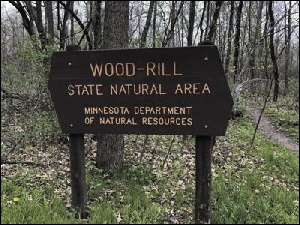 In 1980, an incentive for private landowners to preserve their prairies was added to the program. Native Prairie Tax Exemption allows for exempting eligible lands from property taxes.
Natural Areas Registry recognizes public land containing exceptional natural features. Since 1982 the SNA program has developed agreements with land managers for ecological management of these areas.
In 1987, Native Prairie Bank conservation easements on private lands were added to the Scientific and Natural Area Program tool box (M.S. 84.96).
Today, over 160 SNAs and 120 Native Prairie Bank easements form the backbone of protected areas in the Program. These sites represent a diverse set of natural habitats across the state.
Chimney Rock SNA
This site is one of relatively few SNAs in which preservation of a significant geologic feature was the primary reason for a site's designation. Chimney Rock is described in Minnesota's Geology, as "an erosional remnant of the St. Peter Sandstone standing like a kingpin ready to be bowled over by the next glacial advance."
Nearly 30' tall and 10' at the base, the shape of this so-called "castellated" bedrock pillar suggests the turret or spire of a castle. It is composed of St. Peter Sandstone, originating during the middle Ordovician period roughly 458 – 453 million years ago. While most of the spire is poorly cemented sandstone, its cap is harder and more resistant to weathering, thanks to calcite that percolated down in water from overlying limestone of the Platteville Formation, now gone.
The fact that this delicate structure still stands is "clear evidence that the area has not been touched by glacial ice for over 100,000 years," according to geologists and professors Charles Matsch and John Green, who prepared a background report* on the site's landforms. As they describe, two different ice lobes associated with the last glacial advance in the region (16,000 – 14,000 years before present) stopped just short of this area.
The glacial era did leave a legacy of sediments carried in meltwater and windblown silt which, in time, eroded away to leave the bedrock exposed. Whittled by wind and water, it has been a local landmark for generations.
Chimney Rock knows no season: a visit any time of year is worthwhile to view this evidence of the region's Quaternary geologic history. Still, it is hard to rival the period from late summer through October, when the blazing stars and goldenrod are in bloom, the big and little bluestem grasses hang heavy with seed, and the leaves on the oak begin to turn.