
 Alanya'ya Kloepatra Plajı'nda Hoş Geldiniz

Welcome to Alanya on the Turkish Mediterranean coast.
Welcome to Cleopatra Beach.
We already spent several vacations in this beautiful country and city.
We were thrilled, among many other great things, the old city, the archeology and the beach.
This has brought me to the idea here an EC to this topic.
So I hope to be able to offer here an instructive EC that makes you fun.
Here now some general information about this part of the coast.
Alanya is a town in the district of the same name in the Turkish province of Antalya and at the same time a municipality of Büyükşehir belediyesi Antalya (metropolitan municipality/metropolitan province), which was created in 1993. The seaside resort, located on the Turkish Riviera, is about 135 km east of Antalya.
The name of the city dates back to the 13th century, from Ala-iye, "City of Ala". Since the city was used as the winter residence of the Seljuk Sultan of Rum, Alaeddin Kai Kobad I, in the 13th century, the city was named Alaiye after the Sultan. In Latin sources, the city is usually called Alaya. The present name Alanya was given to the city by Kemal Atatürk in 1933.
( Source: wikipedia )
Here now some general information about this area.
You are here on the Cleopatra beach.
The two kilometers long fine sandy beach owes its name to the Egyptian queen Cleopatra.
Fascinated by the beauty of the beach, Cleopatra is said to have once bathed here.
Grain size
Grain size is the equivalent diameter of particles (grains) of clastic sediments (products of weathering and mechanical rearrangement) and soil particles. The particle size classification according to DIN 4022 distinguishes between clay, silt, sand, gravel and stones. The grain size classification according to Udden & Wenthworth, modified after Doeglas, includes clay, silt, sand, granules, pebbles, cobbles and boulders. Both of the above scales use millimeters as the unit. An arithmetic scale is the grain size division according to Phi as a logarithmic transformation of the Udden-Wenthworth scale.
where d = grain size in millimeters. Grain sizes can be determined by different methods, such as sieve analysis, sedimentation analysis or optical methods. It should always be borne in mind that when determining from thin sections, only a two-dimensional section is recorded, which can cause considerable problems with more complicated grain shapes. The standard method for determining grain sizes in thin sections is the chordal section method. The following classification according to mean grain size has become widely accepted internationally for terrain analysis: fine-grained: 1 mm, medium-grained: 1-5 mm, coarse-grained >5 mm. In Germany, the grain size classification for crystalline rocks according to Teuscher is also commonly used.
But now to the sand, and its classification
YOUR TASK FOR THE CACHE:
1.) How many types of sediments do you find?
Please sort the sediments according to the Wentworth scale.
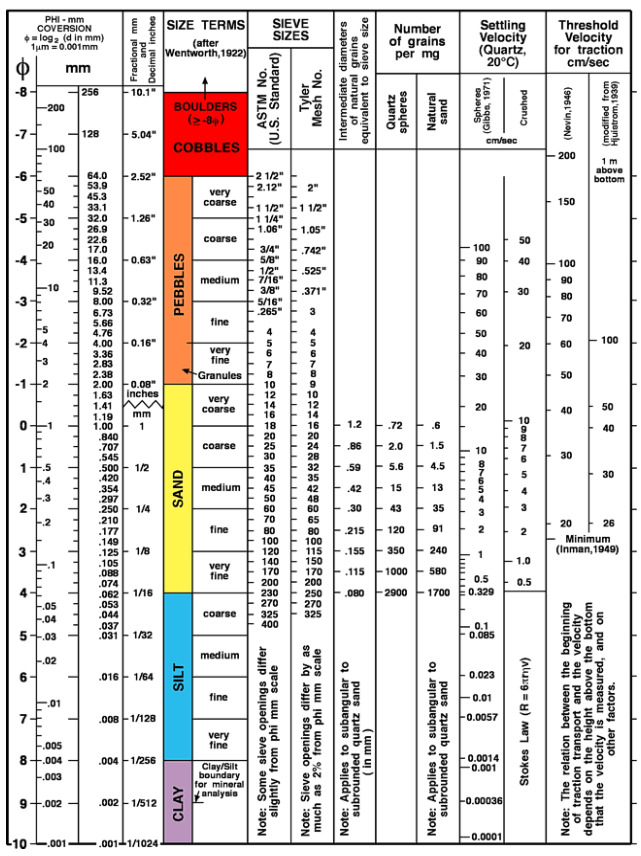
2.) Examine each of the sediments very carefully and check which mineral it is.
A.) Monomineral (consisting of only one type of material)
B.) Polyminerals (consisting of several types of material)
3.) Let dry sand trickle through your hands, then pat hands. What feeling remains on the skin?
A) The feeling as if the hands were roughened by sandpaper.
B) The feeling of powdered sugar between the fingers.
C) The feeling of moisture, although the hands were dry before.
Describe in your own words why it is like that.
4.) Create a log photo for the log with you in front of the Cleopatra statue on the promenade.
and, if you want Optionally also a heart in the sand incl. the date.
Sample:

Of course, I am happy about every other posted photo to spark the travel fever.
I wish you a lot of fun with this EC & a nice time in the city & the beach on the Mediterranean coast.
Send me your four answers and include the log photos
Then you may log immediately, if the answers are not correct I will contact you.
If I do not receive any answers or the log photo is missing, I will have to delete your logs.
.........................

Willkommen an der türkischen Mittelmeerküste.
Willkommen in Alanya am Kleopatra Strand.
Wir verbrachten schon mehrere Urlaube in diesem schönen Land und auch in dieser Stadt.
Uns begeisterte, neben vielen tollen Dingen, die alte Stadt, die Archäologie & der Strand.
Das hat mich zu der Idee gebracht hier einen EC zu diesem Thema auszulegen.
So hoffe ich hier einen lehrreichen EC anzubieten zu können der Euch Spaß macht.
Hier nun einige allgemeine Informationen zu diesem Küstenbereich.
Alanya ist eine Stadt im gleichnamigen Landkreis der türkischen Provinz Antalya und gleichzeitig ein Stadtbezirk der 1993 geschaffenen Büyükşehir belediyesi Antalya (Großstadtgemeinde/Metropolprovinz). Der Badeort, der an der türkischen Riviera liegt, befindet sich etwa 135 km östlich von Antalya.
Der Name der Stadt stammt aus dem 13. Jahrhundert, von Ala-iye, „Stadt des Ala“. Da die Stadt im 13. Jahrhundert als Winterresidenz des seldschukischen Sultans von Rum, Alaeddin Kai Kobad I., benutzt wurde, hieß die Stadt nach dem Sultan Alaiye. In lateinischen Quellen heißt die Stadt meist Alaya. Den heutigen Namen Alanya erhielt die Stadt 1933 von Kemal Atatürk.
QUELLE: wikipedia
Ihr befindet Euch hier am Kleopatra Strand.
Der 2 km lange, feine Sandstrand verdankt seinen Namen der ägyptischen Königin Kleopatra.
Fasziniert von der Schönheit des Strandes soll Kleopatra hier einst gebadet haben.
Korngröße
Korngröße, bezeichnetden Äquivalentdurchmesser von Teilchen (Körnern) klastischer Sedimente (Produkte von Verwitterung und mechanischer Umlagerung) und Bodenpartikeln.Es werden verschiedene Korngrößeneinteilungen verwendet. Die Korngrößeneinteilung nach DIN 4022 unterscheidet Ton, Schluff (Silt), Sand, Kies und Steine. Die Korngrößeneinteilungnach Udden & Wenthworth, modifiziert nach Doeglas, beinhaltet clay (Ton), silt (Silt), sand (Sand), granules, pebbles, cobbles (Kies) und boulders (Steine). Die beiden genannten Skalen benutzen als Einheit Millimeter. Eine arithmetische Skala ist die Korngrößeneinteilung nach Phi als logarithmische Transformation der Udden-Wenthworth-Skala.
wobei d = Korngröße in Millimetern. Korngrößen können mit unterschiedlichen Methoden bestimmt werden, wie z.B. durch Siebanalyse, Sedimentationsanalysen oder optische Verfahren. Zu bedenken ist stets, daß bei der Bestimmung aus Dünnschliffen nur ein zweidimensionaler Anschnitt erfaßt wird, was bei komplizierteren Kornformen erhebliche Probleme erzeugen kann. Standardverfahren zur Bestimmung von Korngrößen im Dünnschliff ist das Sehnenschnittverfahren. Folgende Einteilung nach der mittleren Korngröße hat sich für die Geländeansprache international weitgehend durchgesetzt: feinkörnig: 1 mm, mittelkörnig: 1-5 mm, grobkörnig >5 mm. In Deutschland auch gebräuchlich ist die Korngrößeneinteilung für Kristallingesteine nach Teuscher.
Doch nun zum Sand und seiner Klassifizierung
EURE AUFGABE ZUM CACHE:
1.) Wie viele Arten von Sedimenten findest Du?
Sortiere bitte die Sedimente anhand der Wentworth-Skala.
2.) Untersuche jedes der Sedimente sehr genau und prüfe um welches Mineral es sich handelt.
A) Monominerale (bestehend aus nur einer Materialart)
B) Polyminerale (bestehend aus mehreren Materialarten)
3.) Lass trocken Sand durch die Hande rieseln, nun Hände abklopfen. Welches Hautgefühl bleibt ?
A) Das Gefühl als wären die Hande wie von Schleifpapier aufgeraut.
B) Das Gefühl von Puderzucker zwischen den Fingern
C) Das Gefühl von Feuchtigkeit obwohl die Hände vorher trocken waren.
Beschreibe in eigenen Worten warum dieses so ist.
4.) Erstelle für den Log ein Logfoto mit Dir vor der schönen Kleopatra Statue an der Promenade.
und wenn Du möchtest Optional auch ein Herz im Sand inkl. Datum.
Beispiel:
Natürlich freuen ich mich über jedes weitere eingestellte Foto um das Reisefieber zu entfachen.
Ich wünsche euch viel Spaß bei diesem EC und einen schöne Zeit an diesem Strand am Mittelmeer.
Schickt mir Eure drei Antworten und stellt das/die Logfoto/s mit ein.
Dann dürft ihr sofort loggen, sollten die Antworten nicht stimmen werde ich mich bei Euch melden.
Sollte ich keine Antworten erhalten oder das Logfoto fehlen, werde ich leider Eure logs löschen müssen.
.........................
Wer möchte kann das Banner in sein Profil einbauen.
Whoever wants to can add the banners to their own profile.

Füge dazu einfach folgenden Code in Dein Profil ein: / Just add the following code to your profile:
<a href="http://coord.info/GC9RFHF" target="_blank"><img src="https://img.geocaching.com/cache/large/f4562b05-6434-49c0-9125-cc4e28b48656.jpg?rnd=0.1200342?rnd=0.9922389?rnd=0.2523569?rnd=0.7346961" border="0" /></a>
Für die ersten drei Finder gibt es eine kleine Tabelle! / For the first three finders there is a small table!
1.) Triinuu
2.) KaTepi
3.) Orscher1959
