 Bienvenido a la playa de Calpe y al Ifach
Bienvenido a la Costa Blanca del Mediterráneo español
Bienvenido a Calpe en la playa con vistas al Ifach.
Ya hemos pasado varias vacaciones en este hermoso país y también en esta ciudad.
Entre otras cosas, nos encantó la ciudad, el paisaje cambiante y la playa.
Esto me dio la idea de crear una CE sobre este tema.
Así que espero poder ofrecerles una CE instructiva que les guste.
A continuación se ofrece información general sobre esta zona costera.
Calpe es una ciudad de la costa mediterránea española y es conocida por sus playas, como la del Arenal Bol. Cerca de allí se encuentra el yacimiento romano de Baños de la Reina, con piscinas marinas excavadas en las rocas. En una península al este se encuentra el Penyal d'Ifach, un enorme peñón de piedra caliza habitado por numerosas especies de aves. Debajo se encuentran las ruinas de la Pobla de Ifac, un pueblo medieval amurallado. La Muralla Roja es un famoso edificio con forma de castillo, obra del moderno arquitecto español Ricardo Bofill.
FUENTE: google
Se encuentra en una playa de arena de la Costa Blanca con vistas al Peñón de Ifach.
El Peñón de Ifach, símbolo de la Costa Blanca, surge del mar como una roca caliza con una superficie de 50.000 m⊃2;, una altura de 332 m y una longitud de 1 km. Está unido a tierra por un estrecho istmo y fue creado por un desprendimiento de la vecina Sierra de Oltà, formando un relieve de excepcional belleza, único en todo el Mediterráneo. Desde las 2 largas playas de arena clara de la ciudad siempre se puede disfrutar de una vista espectacular de la gigantesca formación rocosa.
Pero aquí, en esta CE, se trata de lo que estás pisando en este momento, ¡la hermosa arena clara!
Tamaño del grano
La granulometría designa el diámetro equivalente de las partículas (granos) de los sedimentos clásticos (productos de la meteorización y de la reordenación mecánica) y de las partículas del suelo. La clasificación granulométrica según la norma DIN 4022 distingue entre arcilla, limo, arena, grava y piedras. La clasificación granulométrica según Udden & Wenthworth, modificada según Doeglas, incluye arcilla, limo, arena, gránulos, guijarros, cantos rodados y cantos rodados. Las dos escalas mencionadas utilizan milímetros como unidad. Una escala aritmética es la división del tamaño de los granos según Phi como una transformación logarítmica de la Udden-Wenthworth-Skala.
donde d = tamaño de grano en milímetros. El tamaño de los granos puede determinarse por diferentes métodos, como el análisis por tamizado, el análisis por sedimentación o los métodos ópticos. Siempre hay que tener en cuenta que, al determinar a partir de secciones finas, sólo se registra una sección bidimensional, lo que puede causar problemas considerables con formas de grano más complicadas. El método estándar para determinar el tamaño de los granos en secciones delgadas es el método de la sección cordal. La siguiente clasificación según el tamaño medio del grano ha sido aceptada internacionalmente para el análisis del terreno: de grano fino: 1 mm, de grano medio: 1-5 mm, de grano grueso >5 mm. En Alemania también se utiliza habitualmente la clasificación granulométrica de las rocas cristalinas según Teuscher.
Pero ahora a la arena y su clasificación
SU TAREA A LA CACHÉ:
1.) ¿Cuántos tipos de sedimentos se encuentran?
Por favor, clasifique los sedimentos utilizando la escala de Wentworth.
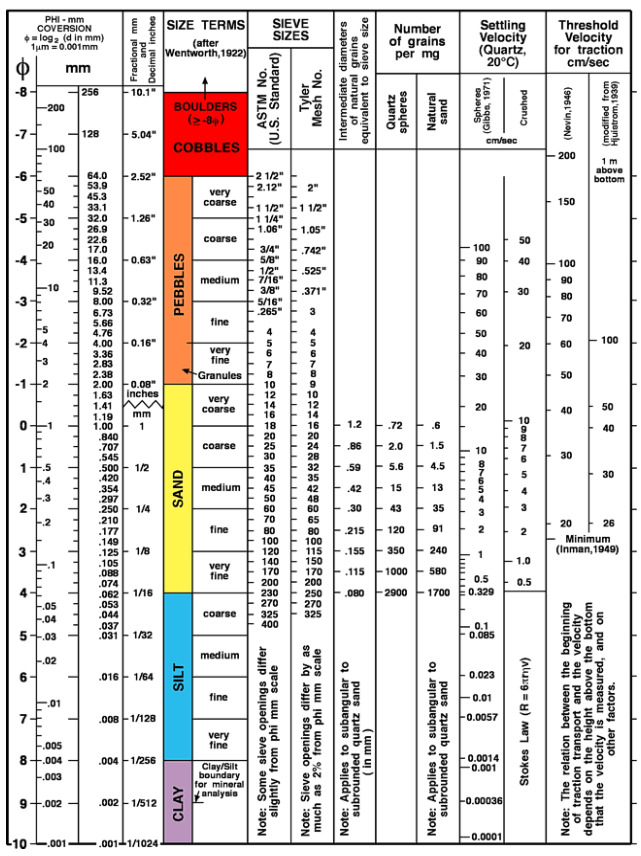
2.) Examina cada uno de los sedimentos con mucho cuidado y comprueba de qué mineral se trata.
A) Monominerales (formados por un solo tipo de material).
B) Poliminerales (formados por varios tipos de materiales).
3.) Deja que la arena seca se deslice por tus manos, ahora golpea tus manos. ¿Qué sensación de piel queda?
A) La sensación de que las manos se han puesto ásperas con papel de lija.
B) La sensación de azúcar glas entre los dedos.
C) La sensación de humedad a pesar de que las manos estaban secas antes.
Describa con sus propias palabras el motivo.
4.) Cree una foto de la bitácora con usted y el Peñón de Ifach de fondo.
y si lo desea Opcionalmente, también un corazón en la arena incl. la fecha.
Ejemplo:

Por supuesto, me alegro de cualquier otra foto publicada para encender la fiebre de los viajes.
Te deseo que te diviertas mucho con esta CE y que pases un buen rato en esta playa de la costa blanca.
Envíame tus tres respuestas e incluye la(s) foto(s) del registro.
Entonces puedes registrarte inmediatamente, si las respuestas no son correctas me pondré en contacto contigo.
Si no recibo ninguna respuesta o falta la foto del registro, lamentablemente tendré que borrar sus registros.
.........................

Willkommen an der span.Mittelmeerküste Costa Blanca
Willkommen in Calpe am Strand mit Blick zum Ifach.
Wir verbrachten schon mehrere Urlaube in diesem schönen Land und auch in dieser Stadt.
Uns begeisterte, neben vielen Dingen, die Stadt, die wechselnde Landschaft & der Strand.
Das hat mich zu der Idee gebracht hier einen EC zu diesem Thema auszulegen.
So hoffe ich hier einen lehrreichen EC anzubieten zu können der Euch Spaß macht.
Hier nun einige allgemeine Informationen zu diesem Küstenbereich.
Calpe ist eine Stadt an der spanischen Mittelmeerküste und für ihre Strände wie den sandigen Arenal-Bol bekannt. In der Nähe liegt die römische Stätte Baños de la Reina mit aus den Felsen gehauenen Meeresbecken. Auf einer Halbinsel im Osten befindet sich der Penyal d’Ifach, ein gewaltiger Fels aus Kalkstein, der von zahlreichen Vogelarten bewohnt wird. Unterhalb davon liegen die Ruinen von Pobla de Ifac, einem mittelalterlichen, ummauerten Dorf. La Muralla Roja ist ein berühmtes schlossähnliches Gebäude des modernen spanischen Architekten Ricardo Bofill
QUELLE: google
Ihr befindet Euch hier an einem Sand-Strand der Costa Blanca mit Blick auf den Peñón de Ifach
Der Peñón de Ifach, Symbol der Costa Blanca, erhebt sich wie ein kalkartiger Fels mit einer Fläche von 50.000 m⊃2;, einer Höhe von 332 m und einer Länge von 1 km aus dem Meer. Er ist mit dem Land durch eine schmale Landenge verbunden und entstand durch einen Erdrutsch in der benachbarten Sierra de Oltà und bildet eine im ganzen Mittelmeerraum einmalige Landform mit außergwöhnlicher Schönheit. Von den 2 langen hellen Sandstränden der Stadt genießt man stets einen spektakulären Blick auf die gigantische Felsformation.
Hier bei diesem EC geht es aber um das worauf ihr gerade steht, dem schönen hellen Sand!
Korngröße
Korngröße, bezeichnetden Äquivalentdurchmesser von Teilchen (Körnern) klastischer Sedimente (Produkte von Verwitterung und mechanischer Umlagerung) und Bodenpartikeln.Es werden verschiedene Korngrößeneinteilungen verwendet. Die Korngrößeneinteilung nach DIN 4022 unterscheidet Ton, Schluff (Silt), Sand, Kies und Steine. Die Korngrößeneinteilungnach Udden & Wenthworth, modifiziert nach Doeglas, beinhaltet clay (Ton), silt (Silt), sand (Sand), granules, pebbles, cobbles (Kies) und boulders (Steine). Die beiden genannten Skalen benutzen als Einheit Millimeter. Eine arithmetische Skala ist die Korngrößeneinteilung nach Phi als logarithmische Transformation der Udden-Wenthworth-Skala.
wobei d = Korngröße in Millimetern. Korngrößen können mit unterschiedlichen Methoden bestimmt werden, wie z.B. durch Siebanalyse, Sedimentationsanalysen oder optische Verfahren. Zu bedenken ist stets, daß bei der Bestimmung aus Dünnschliffen nur ein zweidimensionaler Anschnitt erfaßt wird, was bei komplizierteren Kornformen erhebliche Probleme erzeugen kann. Standardverfahren zur Bestimmung von Korngrößen im Dünnschliff ist das Sehnenschnittverfahren. Folgende Einteilung nach der mittleren Korngröße hat sich für die Geländeansprache international weitgehend durchgesetzt: feinkörnig: 1 mm, mittelkörnig: 1-5 mm, grobkörnig >5 mm. In Deutschland auch gebräuchlich ist die Korngrößeneinteilung für Kristallingesteine nach Teuscher.
Doch nun zum Sand und seiner Klassifizierung
EURE AUFGABE ZUM CACHE:
1.) Wie viele Arten von Sedimenten findest Du?
Sortiere bitte die Sedimente anhand der Wentworth-Skala.
2.) Untersuche jedes der Sedimente sehr genau und prüfe um welches Mineral es sich handelt.
A) Monominerale (bestehend aus nur einer Materialart)
B) Polyminerale (bestehend aus mehreren Materialarten)
3.) Lass trocken Sand durch die Hande rieseln, nun Hände abklopfen. Welches Hautgefühl bleibt ?
A) Das Gefühl als wären die Hande wie von Schleifpapier aufgeraut.
B) Das Gefühl von Puderzucker zwischen den Fingern
C) Das Gefühl von Feuchtigkeit obwohl die Hände vorher trocken waren.
Beschreibe in eigenen Worten warum dieses so ist.
4.) Erstelle für den Log ein Logfoto mit Dir & dem Peñón de Ifach im Hintergrund
und wenn Du möchtest Optional auch ein Herz im Sand inkl. Datum.
Beispiel:
Natürlich freuen ich mich über jedes weitere eingestellte Foto um das Reisefieber zu entfachen.
Ich wünsche euch viel Spaß bei diesem EC und einen schöne Zeit an diesem Strand der costa blanca.
Schickt mir Eure drei Antworten und stellt das/die Logfoto/s mit ein.
Dann dürft ihr sofort loggen, sollten die Antworten nicht stimmen werde ich mich bei Euch melden.
Sollte ich keine Antworten erhalten oder das Logfoto fehlen, werde ich leider Eure logs löschen müssen.
.........................

Welcome to the span. Mediterranean coast costa blanca.
Welcome to Calpe an the beach, with views to ifach.
We already spent several vacations in this beautiful country and city.
We were thrilled, among many other great things, the city, the Ivac and the beach.
This has brought me to the idea here an EC to this topic.
So I hope to be able to offer here an instructive EC that makes you fun.
Here now some general information about this part of the coast.
Calpe is a town on Spain's Mediterranean coast, known for its beaches such as the sandy Arenal-Bol. Nearby is the Roman site of Baños de la Reina, with sea pools carved out of the rocks. On a peninsula to the east is the Penyal d'Ifach, a huge rock of limestone inhabited by numerous species of birds. Below it are the ruins of Pobla de Ifac, a medieval walled village. La Muralla Roja is a famous castle-like building designed by the modern Spanish architect Ricardo Bofill
( Source: google )
You are here on a beautiful sandy beach of the Costa Blanca with view to the Peñón de Ifach.
The Peñón de Ifach, symbol of the Costa Blanca, rises from the sea like a limestone rock with an area of 50,000 m⊃2;, a height of 332 m and a length of 1 km. It is connected to the land by a narrow isthmus and was formed by a landslide in the neighboring Sierra de Oltà, forming a landform of exceptional beauty, unique in the whole Mediterranean. From the 2 long light sandy beaches of the town you always enjoy a spectacular view of the gigantic rock formation.
But here at this EC it's all about what you're standing on right now. The bright sand!
Grain size
Grain size is the equivalent diameter of particles (grains) of clastic sediments (products of weathering and mechanical rearrangement) and soil particles. The particle size classification according to DIN 4022 distinguishes between clay, silt, sand, gravel and stones. The grain size classification according to Udden & Wenthworth, modified after Doeglas, includes clay, silt, sand, granules, pebbles, cobbles and boulders. Both of the above scales use millimeters as the unit. An arithmetic scale is the grain size division according to Phi as a logarithmic transformation of the Udden-Wenthworth scale.
where d = grain size in millimeters. Grain sizes can be determined by different methods, such as sieve analysis, sedimentation analysis or optical methods. It should always be borne in mind that when determining from thin sections, only a two-dimensional section is recorded, which can cause considerable problems with more complicated grain shapes. The standard method for determining grain sizes in thin sections is the chordal section method. The following classification according to mean grain size has become widely accepted internationally for terrain analysis: fine-grained: 1 mm, medium-grained: 1-5 mm, coarse-grained >5 mm. In Germany, the grain size classification for crystalline rocks according to Teuscher is also commonly used.
But now to the sand, and its classification
YOUR TASK FOR THE CACHE:
1.) How many types of sediments do you find?
Please sort the sediments according to the Wentworth scale.
2.) Examine each of the sediments very carefully and check which mineral it is.
A.) Monomineral (consisting of only one type of material)
B.) Polyminerals (consisting of several types of material)
3.) Let dry sand trickle through your hands, then pat hands. What feeling remains on the skin?
A) The feeling as if the hands were roughened by sandpaper.
B) The feeling of powdered sugar between the fingers.
C) The feeling of moisture, although the hands were dry before.
Describe in your own words why it is like that.
4.) Create a log photo for the log with you, and the Peñón de Ifach in the background
and, if you want Optionally also a heart in the sand incl. the date.
Sample:
Of course, I am happy about every other posted photo to spark the travel fever.
II wish you a lot of fun with this EC and a nice time in the city & on this beach of the costa blanca.
Send me your four answers and include the log photo/s
Then you may log immediately, if the answers are not correct I will contact you.
If I do not receive any answers or the log photo is missing, I will have to delete your logs.
.........................
Si quieres, puedes añadir el banner a tu perfil.
Wer möchte kann das Banner in sein Profil einbauen.
Whoever wants to can add the banners to their own profile.

Simplemente añada el siguiente código a su perfil:
Füge dazu einfach folgenden Code in Dein Profil ein: / Just add the following code to your profile:
<a href="http://coord.info/GC9RH3X" target="_blank"><img src="https://img.geocaching.com/cache/large/edd1c862-4113-4dda-8b08-b9b1382685f6.jpg?rnd=0.281606?rnd=0.1200342?rnd=0.9922389?rnd=0.2523569?rnd=0.7346961" border="0" /></a>
Hay una pequeña mesa para los tres primeros que encuentren.
Für die ersten drei Finder gibt es eine kleine Tabelle! / For the first three finders there is a small table!
1.) Pe&Danny
2.) TiggerOnTor
3.) macdiegisc
