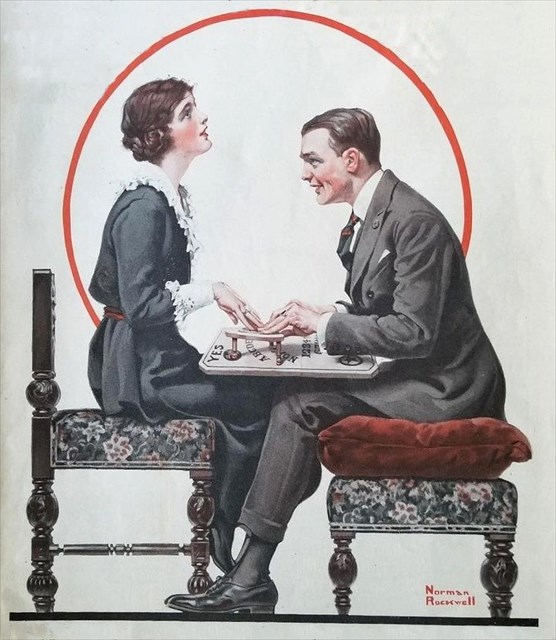
The ouija, also known as a spirit board or talking board, is a flat board marked with the letters of the alphabet, the numbers 0–9, the words "yes", "no", occasionally "hello" and "goodbye", along with various symbols and graphics. It uses a planchette (small heart-shaped piece of wood or plastic) as a movable indicator to spell out messages during a séance. Participants place their fingers on the planchette, and it is moved about the board to spell out words.
One of the first mentions of the automatic writing method used in the ouija board is found in China around 1100 AD, in historical documents of the Song Dynasty. The method was known as fuji "planchette writing". The use of planchette writing as an ostensible means of necromancy and communion with the spirit-world continued, and, albeit under special rituals and supervisions, was a central practice of the Quanzhen School, until it was forbidden by the Qing Dynasty.
Businessman Elijah Bond had the idea to patent a planchette sold with a board on which the alphabet was printed, much like the previously existing talking boards. Bond filed on 28 May 1890 for patent protection and thus is credited with the invention of the Ouija board. Issue date on the patent was 10 February 1891. He received U.S. Patent 446,054. Bond was an attorney and was an inventor of other objects in addition to this device.
An employee of Elijah Bond, William Fuld, took over the talking board production. In 1901, Fuld started production of his own boards under the name "Ouija". Charles Kennard, founder of Kennard Novelty Company which manufactured Fuld's talking boards and where Fuld had worked as a varnisher, claimed he learned the name "Ouija" from using the board and that it was an ancient Egyptian word meaning "good luck". When Fuld took over production of the boards, he popularized the more widely accepted etymology: that the name came from a combination of the French and German words for "yes".
The Fuld name became synonymous with the Ouija board, as Fuld reinvented its history, claiming that he himself had invented it. The strange talk about the boards from Fuld's competitors flooded the market, and all these boards enjoyed a heyday from the 1920s.
Norman Rockwell painted a cover, on the May 1, 1920 issue of The Saturday Evening Post, showing a Ouija board in use.