
These specimens of petrified wood are on display outside the Emerald Town Hall and are available to view 24 hours a day. They are in a good all weather location as well.
What is petrified wood.
Petrified wood (from the Greek word Petro meaning "rock" or "stone"; literally "wood turned into stone") is the name given to a special type of fossilized remains of terrestrial vegetation. It is the result of a tree having turned completely into stone by the process of per mineralization. Groundwater rich in dissolved Minerals flows through the cells of the tree, replacing the original plant material until the organic materials have been replaced with minerals (most often a silicate, such as quartz ), while retaining the original structure of the wood. Unlike other types of fossils which are typically impressions or compressions, petrified wood is a three dimensional representation of the original organic material.
The petrifaction process occurs underground, when wood becomes buried under sediment and is initially preserved due to a lack of oxygen which inhibits aerobic decomposition.
Groundwater rich in dissolved Minerals flows through the sediment, replacing the original plant material with trace elements. The result is a fossil of the original woody material that often exhibits preserved details of the bark, wood, and cellular structures.
This process takes millions of years for the cells of a piece of wood to be replaced by minerals and turned into stone called Fossilised or petrified wood.
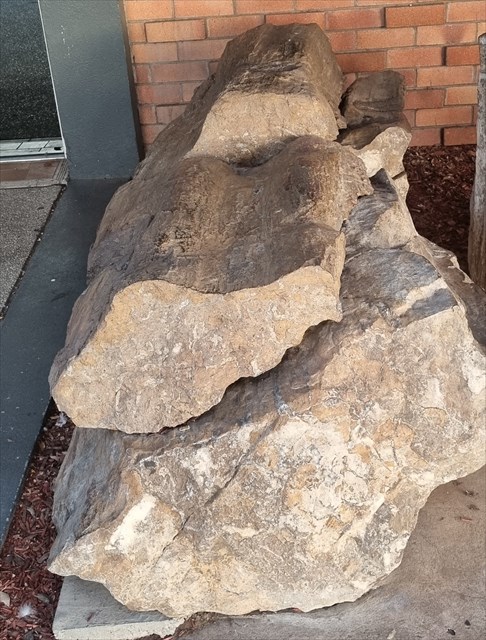
Some specimens of petrified wood are such accurate preservations that people do not realize they are fossils until they pick them up and are shocked by their weight. These specimens with near-perfect preservation are unusual; however, specimens that exhibit clearly recognizable bark and woody structures including knot holes and scars and growth rings (except for Tropical coniferous trees that often don’t have the growth rings that you see in other trees) are very common.
Why is petrified wood different colours?
This depends on the water or mud it has been laying in, if there are trace elements like iron and copper in the mud or water during the petrification process it can change the colour of the wood.
Hues in petrified wood aren't useful for determining specific minerals or tree species. However, they can be used to determine which trace elements are in your petrified wood. Take note of the colours present in your petrified wood and locate its corresponding element.
• Black often indicates carbon presence.
• Blue or green shades are typically from copper, cobalt, or chromium.
• Yellow and blackish colours are often caused by manganese oxides.
• Orange and pink are due to manganese.
• Red, yellow, and brown shades are created by iron oxides.
At GZ you will be standing in front of some very nice pieces of Petrified wood.
Your Logging tasks are as follows.
Q1/. The name of this earth cache.
Q2/. The biggest laying down log is around 250 million years old. What period of time was this?
Q3/. Looking at the same tree do you think this tree was a tropical conifer, give a reason for your answer.
Q4/. Now looking at the colours in the vertical log what minerals do you think were most present in the formation of this log.
Q5/. Feel one of the trees and tell us what the texture feels like.
We understand teams like to log in order so feel free to log your find after sending the answers to us.
If the answers are not received in a timely manner your log will be deleted.