Belmont station was opened on the other side of this fence and towards the school a bit possibly under the name of Turner's Siding when the second stage of construction was completed to Defence Siding (now Trentham) in December of 1875. However I am not sure how long that name lasted - Scoble is oddly quiet on when name changes occurred here. It was renamed as Belmont and was listed as this in the timetables of 1911. In August 1876, just 8 months after it was open, freight services here were cancelled, except for what could be carried in the brake van, making this a passenger only stop. What is odd is that Andrews station opened just a kilometre north of here in 1938, so I assume this stop was maintained after that date as a stop for school trains only. The station was closed when the line was pulled up in 1954.
So there is not much to say here. Perhaps I should include some East vs West discussion...
As is obvious to you, the main population of the Hutt Valley here lies to the east of the Hutt River, and yet the rail line ran along the west bank. Although the population was considerably smaller in the early 1900s, and despite the flooding risk (before the stop banks were built), even back the majority of the residents and farms were on the eastern side. I do not know why the rail line was put on the west side of the river, but I suspect the regular flooding of the valley was one of the primary reasons. None-the-less, the west side had its problems too. 4000-5000 bags of sand and retaining walls up to 1.5m thick were used to stabilise the railway.
In the 1920s the success of rail and the cheap workman's tickets encouraged more suburban housing in the Hutt Valley. Tawa was disconnected from Johnsonville and given a more direct, tunnelled route to Wellington. And in 1927 a line was completed from Petone Junction to Waterloo. Much of success of this has to put to W.T. Strand, the mayor of Lower Hutt. He suggested that the construction be self financed, funded by the sale of land for new housing. He highlighted cheap land for the government to purchase and the Borough Council had also been quietly securing its own purchase options. With the passing of the 1925 Hutt Valley Lands Settlements Act the Council purchased 283 hectares which it then on sold to the government.
Construction on the Hutt Valley Branch line from Petone Junction to Waterloo was started in 1925 and opened in December of 1927. With some outstanding forethought, the original plan of a single track line was dumped, and dual tracking was installed from the beginning. Completion of the line was followed with a rapid growth of the Hutt Valley population such that by 1940 Lower Hutt was declared to be a city, and trains consisted of up to 12 coaches and carried seven million passengers annually.
By January of 1946 a single track line was laid to Naenae (so much for forward thinking), and to Taita in April 1947. This was doubled shortly after. The bridge across to Haywards was built allowing the single track from Taita to connect to Haywards. A new Silverstream bridge was built that same year, north of the existing one, to bypass a windy section of rail that could not be doubled. That bit of rail still exists and is now a private rail museum. On the 1st of March 1954, the line from Taita to Haywards was opened and on that same day the line through Belmont, between Melling and Haywards on the west bank of the river, was closed.
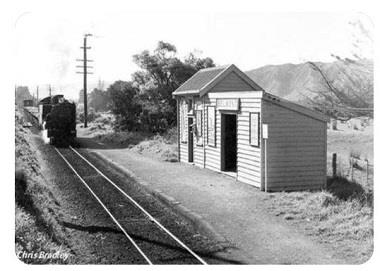
Belmont station, date unknown
References:
"Railway Directory", Hutt Valley Independent, 29 July 1911, page 2
"Belmont railway station, Wellington Region", Wikipedia
Scoble, J: "Names and Opening and Closing Dates of Railway Stations", published by the Rail Heritage Trust of New Zealand, 2010.
Parsons, D: "Wellington's Railways Colonial Steam to Matangi", published by the New Zealand Railway & Locomotive Society, 2010