BP Camp Burman Bush
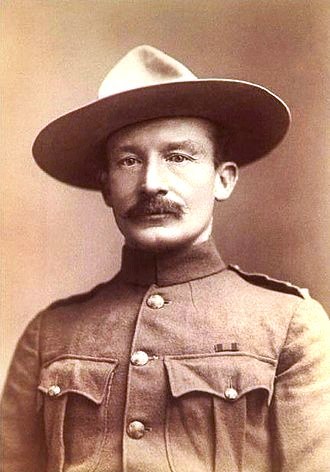
Lord Baden-Powell
Robert Stephenson Smyth Baden-Powell (BP), the founder and father of the world-wide Scout Movement, was a leader of immense proportions, inspiration to many, and a beacon of light to his followers. Perhaps not well-known to the general public, he was a Lieutenant-General in the British Army where he fought many battles in India and Africa, including defending the town during the Siege of Mafeking during the Second Boer War in South Africa
As a writer he authored many books - mainly for military purposes - on themes like reconnaissance and scouting. These books were also read by boys, which was an inspirations to many a young heart wannabe soldier boys. In August 1907, he held a demonstration camp, the Brownsea Island Scout camp, which is now seen as the beginning of Scouting. With this growing interest, BP retired from military service and founded the Scout Movement where he authored the first editions of the seminal work "Scouting for Boys" which became the inspiration of the Movement.
The first Scout Rally was held at The Crystal Palace in 1909. Girls in Scout uniform attended, telling Baden-Powell that they were the "Girl Scouts". In 1910, Baden-Powell and his sister Agnes Baden-Powell started the Girl Guide and Girl Scout organisation. He gave guidance to the Scout and Girl Guide movements until retiring in 1937
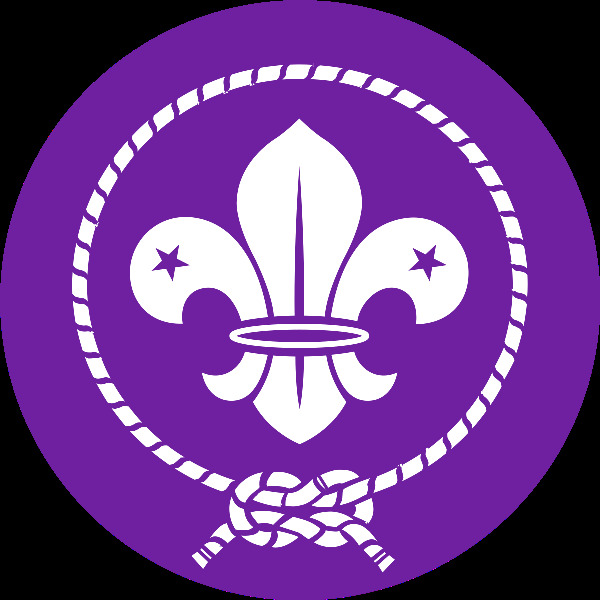
The Logo
The fleur-de-lis is the main element in the logo of most Scouting organizations, representing a major theme in Scouting: the outdoors and wilderness and is represented by the crest in white on a purple background
-
The white represents purity and the purple represents leadership and help given to others
-
The three petals or leaves represent the threefold Scout Promise
-
Duty to God and Country
-
Duty to Self
-
Duty to Others
-
The compass rose because it "points in the right direction (and upwards)
-
The two small five-point stars stand for truth and knowledge
-
Together their ten points represent the ten original Scout laws
-
The reef knot or square knot represents the strength of World Scouting
-
The rope is for the unity of Scouts throughout the world
-
The ring holding the petals together represents the bond of brotherhood
The Camp
BP Camp itself lies in the center of the 50 acre Burman Bush just North of the Durban CBD. It is sub-divided into several camp sites, each with its own theme where visiting Scout Divisions can arrange adventures for specific badges or styles of camping
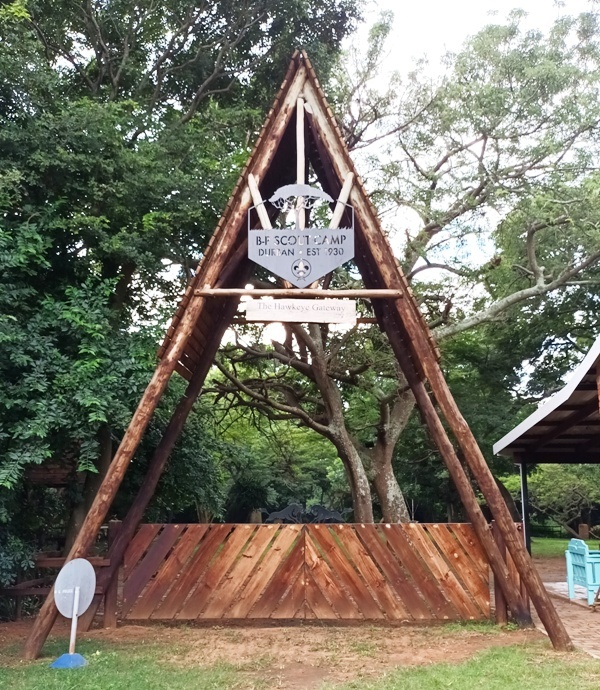
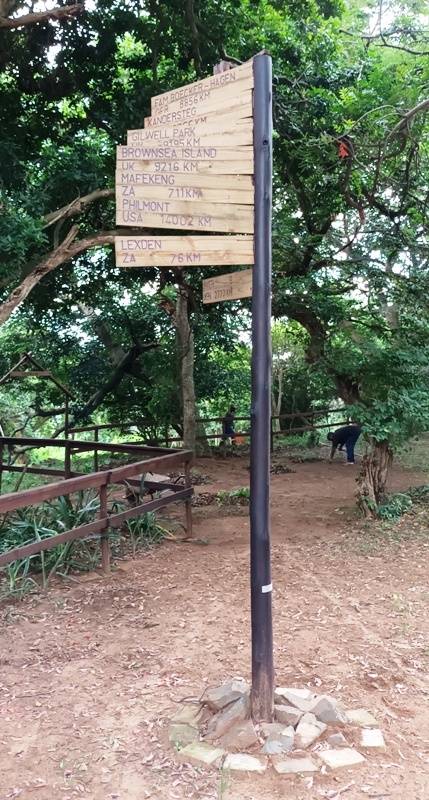
At the entrance to the grounds you will find a triangle shaped gateway representing the threefold Scout Promise. Just beyond that you will see a post with various direction boards indicating distance and direction to other camps, as well as to BP's grave in Kenya. It is here that your coords will take you in search of an element that is in the badge range of Scouts
From the circle where you stand, you will see the entrances to the various camp sites from where Scouts will come together in the evenings around the boma fire for tales, messages, instructions etc. The camp has some buildings as well where campers have their meals prepared from the kitchen, can shower, have access to ablutions, and there are staff quarters and maintenance workshops etc. as well
The Cache
Before you attempt this cache, please phone in advance to let them know of your visit. They are aware of Geocaching and the cache. The contact person is Byrin Glenashley on 076.314.9450. At the Burman Bush access control point, tell the security that you are visiting the Scout Camp, sign in and they let you through. The access is open between 08:00 and 16:00 daily. From there proceed (drive) up through the winding tarred road to the camp entrance. At the entrance, call Byrin and announce your arrival and someone will come to open the gates for you. Proceed to parking your vehicle and walk up to the Triangle in front of you, from where your experience can begin
Compiled from extracts on Wiki and Google
All images used according to their individual copyrights