More Morton Magic #13: The Most Trampled Treasure?
This is the 13th of a 17-cache series which will take you on a wonderful 6km looping trail up the deep Morton valley through Sunnydale and The Glen passing historical farm and residential buildings, industrial ruins, mill ponds and weirs, rich deciduous and pine woodlands, a reservoir, waterfall, low moorland, farm fields and then back down an old track and flower-festooned path into the village.
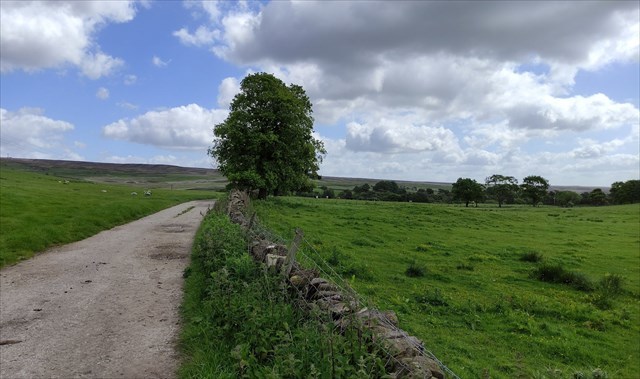
The cache, a camo-taped bison tube, is dangling along the jeep track as it approaches Uplands Farm. At this elevation, there are fine views - especially of moorland to the north towards the top of Rombald's Moor and the Aire Valley down in the distance to the south.
To find the cache, clicking on the image above will take you to a jigsaw puzzle, completion of which will reveal the required coordinates - and a helpful hint.
Please note that the cache description contains an external link above to a jigsaw.
Although it is from a well-known source, it has 'not been checked by Groundspeak nor by the reviewer for possible malicious content and access to the site is therefore at your own risk'.

En route to the cache, you will certainly have passed by many of these delicate, pretty and staunchly resilient little flowers, probably trampled on them without a second thought, and quite likely hadn't (yet!) appreciated their remarkable hardiness, ecological role, cultural significance . . . and edibility.

Perhaps one of our most familiar flowers of all, the humble common daisy flowers (almost) all year-round. It is opportunistic and thrifty, well adapted to heavy vegetation management and difficult soil where most other plants would not survive, 'throwing up their metaphorical white flag and surrendering to a regime of mown grass'.
Its persistent and widespread growth, heralds the arrival of spring to our gardens, and is a key species in the conversion of bare winter fields into beautiful rich wildlife meadows.
 The (common/lawn/English) daisy (Bellis perennis) is a European species of the family Asteraceae, often considered the archetypal species of the 23,000 kinds of daisy in the world. Bellis comes from the Latin bellus ('pretty') and perennis ('everlasting').
Historically, it has also been widely known as bone flower, bruisewort, and occasionally woundwort - in Medieval times, it was commonly known as 'Mary's Rose'. The name 'daisy' is a corruption of 'day's eye' because the whole head closes at night and opens in the morning. Geoffrey Chaucer called it 'eye of the day'. Daisy is used as a girl's name and as a nickname for girls named Margaret, after the French name for the oxeye daisy, marguerite.
Daisies comprise around 10% of all flowering plants and grow everywhere except Antarctica. Their umbrella family, Asteracae, is characterised by its unique form of flower heads, which appear to be single flowers but are actually 100s of tiny ones. In the case of our common daisy, these consist of yellowy orange ‘disc florets’ bunched together and surrounded by white ‘ray florets’.
The common daisy is native to western, central and northern Europe, including remote islands such as the Faroe Islands, but has become widely naturalised in most temperate regions, including the Americas and Australasia.

It is a perennial herbaceous plant with short creeping rhizomes and rosettes of small rounded or spoon-shaped leaves that are from 2-5cm long and grow flat to the ground. It habitually colonises lawns, and is difficult to eradicate by mowing. It exhibits heliotropism where flowers turn to follow the sun.
It blooms from early to midsummer, but under ideal conditions, has a very long flowering season and will even produce a few flowers in the middle of mild winters.
 There are numerous single- and double-flowered cultivars with flat or spherical blooms in a range of sizes (1-6cm) and colours (red, pink and white). They are generally grown from seed as biennial bedding plants, but can also be bought as plugs in Spring.
Ecological Importance: a staple of lawns and amenity grasslands, it provides a vital source of nectar and pollen for small solitary bees, flies and beetles - very important when other flowers are absent. Although it doesn’t have a special relationship with any particular species of insect, it can help improve the overall biodiversity of a grassland or garden.
Historical Use: it is thought to have been first cultivated by early Bronze Age 'gardeners' - probably even earlier once it was realised it had medicinal properties and edible leaves.
Its juice contains astringent compounds. The Romans made use of this herbal medicine by ordering that sackfuls of daisies be collected during war time to make juice which was applied to soldiers’ spear and sword wounds to help close the tissue and stem blood loss. Henry VIII also famously ate daisies to cure stomach ulcers. A useful homemade balm can easily be made from the flowerheads and leaves.
Food: it may be used as a pot herb. Young leaves can be eaten raw in salads or cooked - older leaves are too astringent. Flower buds and petals can be eaten raw in sandwiches, soups and salads. It is also used as a tea and a vitamin supplement.
Culture: it has a long-standing place in European culture, particularly that of childhood as a symbol of innocence and purity. Petal picking ‘he loves me, he loves me not’ games are still played and daisy chains were once an essential part of dressing up for the village May Day, typically worn as crowns. Also - how many cows have been named Daisy?
Over the summer, many gardeners will be trying to eliminate them from their lawns with weed killer, or simply overlooking them as they tend bigger, more exuberant blooms. So, at least next time you spot this 'dainty yet robustly spirited little flower' you may better appreciate its contribution to our world.
See short videos here (in French!), here (description, uses and info on making a balm for bruises), and here (timelapse of flower opening).
