More Morton Magic #15: What Frothy Umbels!
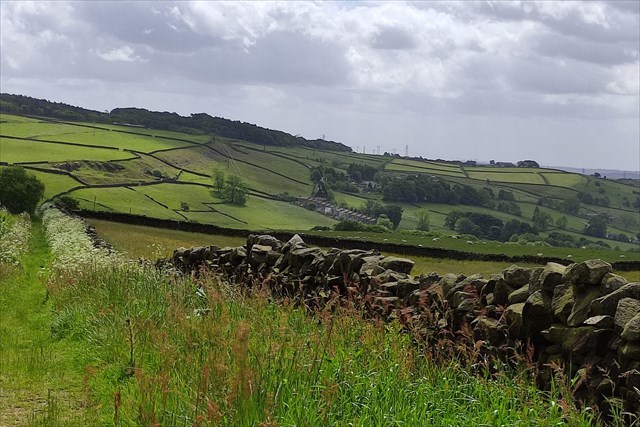
This is the 15th of a 17-cache series which will take you on a wonderful 6km looping trail up the deep Morton valley through Sunnydale and The Glen passing historical farm and residential buildings, industrial ruins, mill ponds and weirs, rich deciduous and pine woodlands, a reservoir, waterfall, low moorland, farm fields and then back down an old track and flower-festooned path into the village.
The cache, a small camo-taped, screw-capped pot, is hidden on the northern side of the grassy Upwood Lane track across a small ditch, which can be - easily but carefully - crossed without getting wet.
To find the cache, clicking on the image above will take you to a jigsaw, completion of which will reveal the required coordinates - and a useful hint.
Please note that the cache description contains an external link above to a jigsaw.
Although it is from a well-known source, it has 'not been checked by Groundspeak nor by the reviewer for possible malicious content and access to the site is therefore at your own risk'.

Another familiar, prolific and ubiquitous flowering plant you will have passed en route, probably without paying much attention to it is the apparently easily recognisable (but see below!) umbels of Cow Parsley (Anthriscus sylvestris). It is aka inter alia as wild chervil, wild-beaked parsley, Queen Anne's lace or keck, and sometimes mother-die (a name also used for the common hawthorn).
It is native to Europe, western Asia and NW Africa and related to other diverse members of the 3,000 species of Apiaceae (formerly Umbelliferae), such as parsley, carrot, hemlock and hogweed. It is a herbaceous biennial or short-lived perennial and the earliest of the white-flowered umbellifers to bloom, especially in the southern UK.

It is a hollow-stemmed, tall, upright herbaceous (non-woody) perennial plant that grows rapidly to 60–170 cm tall in the summer before dying back. It likes shady habitats in particular, and can be found decorating woodland edges, roadside verges and hedgerows with masses of frothy, white flowers. These are arranged in compound umbels (umbrella-like clusters) on short pedicels (<1 cm) with a ring of short, stout hairs at the apex and appear from April until June. Each umbel has lots of little groups of flowers carried on 6-12 stalks or rays 2cm long. Male flowers are in the centre and hermaphrodite flowers around the margins.
 The main stem meets the roots in a single primary taproot which can branch further below the surface. From the roots lateral rhizomes can form.
The leaves set the plant apart from other common and similar species, such as Hogweeds. They are 2-3 pinnate - divided into leaflets, each of which is sub-divided. It gives them a feathery, fern-like appearance. They are usually a muted spring green but can become tinged red or yellow when stressed by drought.
It grows in sunny to semi-shaded locations in meadows and at the edges of hedgerows and woodland. It is a particularly common sight by the roadside. It is so common and fast-growing that it is considered a nuisance weed in gardens. Its ability to grow rapidly through rhizomes and to produce large quantities of seeds in a single growing season has made it an invasive species.

Uses: all above-ground parts are edible, with a flavour sharper than garden chervil and described as grassy parsley with a hint of liquorice or aniseed. The root is deemed toxic by some, edible by others.
It is attractive to many creatures, from orange-tip butterflies (Anthocharis cardamines) to marmalade hoverflies (Episyrphus balteatus), and even rabbits.
Foraging: Although it is foraged in the wild from February to November, extreme caution is necessary because, by inexperienced foragers, it can easily confused with other species of the Apiaceae family, such as the deadly poisonous hemlock (Conium maculatum) (see short video here) , hemlock water-dropwort (Oenanthe crocata) and fool's parsley (Aethusa cynapium). For this reason, because the plant's flavour is unremarkable and the risk is great, such foraging is usually strongly discouraged. See here for a longer video about the comparative ID of cow parsley & hemlock with some good advice on foraging and relating to the wild in general.
