For translation press HERE
 Italiano
Ignimbrit (lat. ignis - fuoco, imber - pioggia) è una roccia vulcanica.
Emergenza
Ignimbriti o correnti dense piroclastiche si verificano preferenzialmente sui vulcani, che promuovono lave ricche di gas e acide, cioè molto silicee, a composizione prevalentemente riolitica (costituita principalmente da quarzo e feldspato). La lava acida è molto viscosa e può quindi ostruire la bocca vulcanica e ad es. B. formano una cupola di lava. Se la pressione del gas del magma esistente diventa troppo grande, si verifica un'eruzione esplosiva. La cupola di lava si rompe e può essere quasi completamente distrutta dall'esplosione, che ad es. T. rocce già semisolidificate e solidificate sono fortemente frammentate e mescolate a frammenti e cristalli di lava vetrificata. Questa miscela particella-aria scorre lungo i fianchi del vulcano; può viaggiare fino a 150 chilometri dal centro dell'esplosione. Gli ignimbriti possono essere molto caldi; sono menzionate temperature superiori a 800 °C.
Strutture
I depositi di correnti di densità piroclastica o ignimbriti sono per lo più strati massicci di frammenti di vetro, lapilli di pomice, cristalli e frammenti di roccia. Sono mal ordinati, frammenti grandi e piccoli appaiono fianco a fianco. Predomina la frazione di ceneri. Gli ignimbriti depositati a basse temperature inferiori a 500-600 °C non sono saldati e formano roccia massiccia non consolidata o roccia solida con successiva cementazione. Se il flusso era più caldo di 500-600 ° C, i componenti piroclastici si cuocevano insieme a fuoco alto per formare una massa solida con un alto contenuto vetroso. Sono saldati o sinterizzati. Frammenti di roccia poco selezionati, cristalli e strisce o scaglie di pomice appiattite, corte (strutture di fiamme), un vetro di roccia schiumoso, sono incorporati in una matrice per lo più a grana fine. In petrografia si parla anche di una struttura ignimbritica o eutassitica. La roccia risultante dalla sinterizzazione o saldatura ricorda maggiormente la roccia lavica per la sua densità.
270 milioni di anni fa, le eruzioni vulcaniche formarono il porfido di quarzo di Bolzano e hanno uno spessore fino a 4000 metri e una dimensione di oltre 2000 chilometri quadrati. Il porfido duro è sopravvissuto anche all'era glaciale, iniziata 115.000 anni fa e durata fino a 12.000 anni fa, poiché era più resistente delle altre rocce della zona. Le abrasioni glaciali sulle superfici rocciose e non ultimi i due laghi di Monticolo e il Lago di Caldaro, situati in ex cavità glaciali, testimoniano l'attività del ghiaccio. Le ignimbriti sono pietre naturali importanti o pietre naturali come il porfido di quarzo di Bolzano, che viene utilizzato nella costruzione di edifici, nell'erezione di monumenti, per la pavimentazione...
Fonti: https://de.wikipedia.org/wiki/Ignimbrit e introduzione alla geologia dell'Alto Adige - V. Stingl e V. Mair)
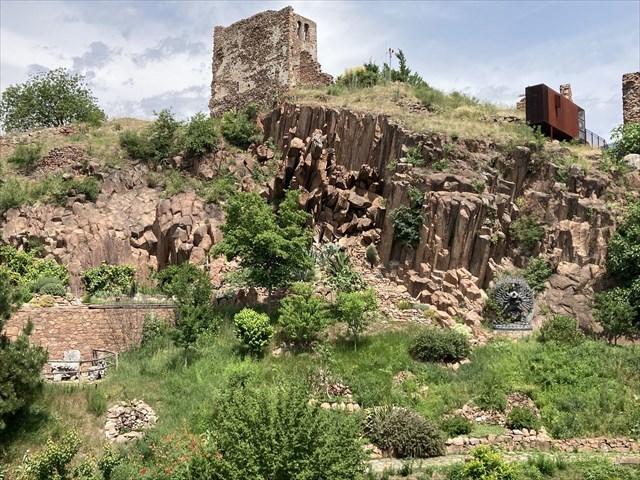
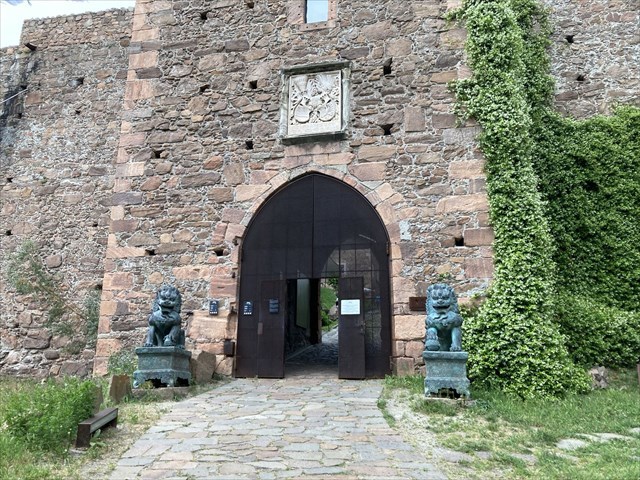
Per registrare la cache, rispondi alle seguenti domande e inviamele tramite il gestore dei messaggi di GC. Quindi puoi accedere immediatamente, non devi aspettare il rilascio. Se ci sono discrepanze, te lo farò sapere. Di fronte all'ingresso del MMM FIRMIAN (Messner Mountain Museum) al castello di Sigmundskron si può vedere un bel muro di ignimbrite.
1. Quanti "pilastri" vedi sotto il lungo muro del castello (a destra dell'ingresso)?
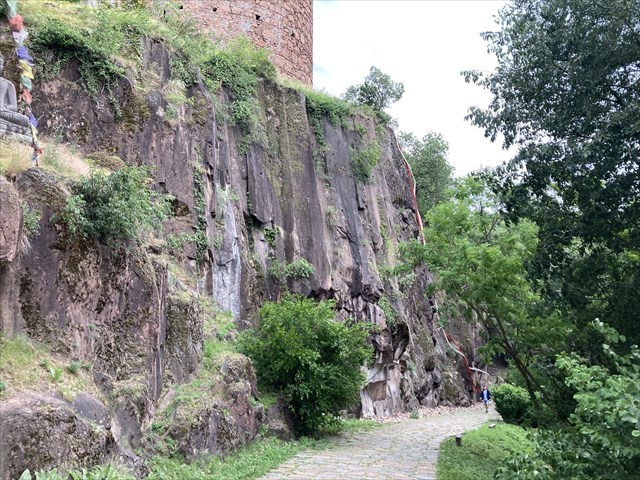
2. Descrivi la roccia (es. colore, granulometria, superficie, strutture speciali, inclusioni...):
3. Quando si è formata l'ignimbrite per attività vulcanica?
Sarei felice (facoltativo) se caricassi una tua foto o il tuo GPS... con il log!
 Deutsch
Ignimbrit (lat. ignis - Feuer, imber - Regen) ist ein vulkanisches Gestein.
Entstehung
Ignimbrite oder Pyroklastische Dichteströme entstehen bevorzugt an Vulkanen, die gasreiche und saure, also sehr kieselsäurehaltige Lava vorwiegend rhyolithischer Zusammensetzung (besteht überwiegend aus Quarz und Feldspat) fördern. Saure Lava ist sehr zähflüssig und kann daher den Vulkanschlot verstopfen und z. B. einen Lavadom bilden. Wird der Gasdruck des anstehenden Magmas zu groß, kommt es zu einem explosiven Ausbruch. Der Lavadom bricht ab und kann durch die Explosion fast völlig zertrümmert werden, die z. T. schon halbverfestigten und verfestigten Gesteine werden stark fragmentiert und mit verglasten Lavafetzen und Kristallen gemischt. Dieses Partikel-Luft-Gemisch fließt die Flanken des Vulkans hinunter; es kann sich bis zu 150 Kilometer weit vom Explosionszentrum fortbewegen. Ignimbrite können sehr heiß sein; es werden Temperaturen bis über 800 °C genannt.
Strukturen
Die Ablagerungen aus pyroklastischen Dichteströmen oder Ignimbrite sind meist massige Lagen von Glasfragmenten, Bimslapilli, Kristallen und Gesteinsfragmenten. Sie sind schlecht sortiert, große und kleine Fragmente kommen nebeneinander vor. Die Aschenfraktion überwiegt. Bei niedrigen Temperaturen unter 500 bis 600 °C abgelagerte Ignimbrite sind nicht verschweißt und bilden massige Lockergesteine, bzw. bei späterer Zementation Festgesteine. War der Strom heißer als 500 bis 600 °C, verbacken in der großen Hitze die pyroklastischen Bestandteile zu einer festen Masse mit einem hohen glasigen Anteil. Sie werden verschweißt oder versintern. In einer meist feinkörnigen Grundmasse (Matrix) sind kaum sortierte Gesteinsbruchstücke, Kristalle und flachgedrückte, kurze Streifen oder Fladen aus Bims (fiamme-Strukturen), einem schaumigen Gesteinsglas eingebettet. In der Petrographie spricht man auch von einem ignimbritischen oder eutaxitischen Gefüge. Das aus der Versinterung bzw. Verschweißung entstehende Gestein erinnert durch seine Dichte eher an Lavagestein.
Vor 270 Millionen Jahren formten Vulkanausbrüche den Bozner Quarzporphyr und haben eine Mächtigkeit von bis zu 4000 Metern und eine Ausdehnung von über 2000 Quadratkilometern. Der harte Porphyr überstand auch die vor 115.000 Jahren einsetzende und bis vor 12.000 Jahren dauernde Eiszeit, da er widerstandsfähiger war als die anderen Gesteine der Umgebung. Gletscherschliffe auf Gesteinsoberflächen und nicht zuletzt die beiden Montiggler Seen und der Kalterer See, in ehemaligen Gletschermulden gelegen, zeugen von der Tätigkeit des Eises.
Ignimbrite sind wichtige Natursteine bzw. Naturwerksteine wie z.B. der Bozner Quarzporphyr der der beim Bau von Gebäuden, der Errichtung von Denkmälern, für Pflasterungen… verwendet wird.
Quellen: https://de.wikipedia.org/wiki/Ignimbrit und Einführung in die Geologie Südtirols - V. Stingl und V. Mair)
Um den Cache loggen zu können, beantwortet bitte folgende Fragen und schickt sie mir per GC-Nachrichtenmanager. Dann kann sofort geloggt werden, es muss nicht auf die Freigabe gewartet werden. Sollte es Unstimmigkeiten geben, melde ich mich.
Vor dem Eingang des MMM FIRMIAN (Messner Mountain Museum) auf Schloss Sigmundskron sieht man eine schöne Wand aus Ignimbrit.
1. Wie viele „Säulen“ kannst du hier unterhalb der langen Burgmauer (rechts vom Eingang) erkennen?
2. Beschreibe das Gestein (z.B. Farbe, Korngröße, Oberfläche, besondere Strukturen, Einschlüsse …):
3. Wann entstand der Ignimbrit durch Vulkanische Tätigkeiten?
Ich würde mich freuen (optional), wenn du ein Foto von dir oder deinem GPS ... mit dem Log hochladen würdest!
 English
Ignimbrite Ignimbrite (lat. ignis - fire, imber - rain) is a volcanic rock.
emergence
Ignimbrites or pyroclastic dense currents occur preferentially on volcanoes, which promote gas-rich and acidic, i.e. very siliceous, lava with a predominantly rhyolitic composition (consists mainly of quartz and feldspar). Acidic lava is very viscous and can therefore clog the volcanic vent and e.g. B. form a lava dome. If the gas pressure of the existing magma becomes too great, an explosive eruption occurs. The lava dome breaks off and can be almost completely shattered by the explosion, which e.g. T. already semi-solidified and solidified rocks are heavily fragmented and mixed with vitrified lava shreds and crystals. This particle-air mixture flows down the flanks of the volcano; it can travel up to 150 kilometers from the center of the explosion. Ignimbrites can be very hot; temperatures of over 800 °C are mentioned.
structures
The deposits of pyroclastic density currents or ignimbrites are mostly massive layers of glass fragments, pumice lapilli, crystals and rock fragments. They are badly sorted, large and small fragments appear side by side. The ash fraction predominates. Ignimbrites deposited at low temperatures below 500 to 600 °C are not welded and form massive unconsolidated rock, or solid rock with later cementation. If the stream was hotter than 500 to 600 °C, the pyroclastic components baked together in the high heat to form a solid mass with a high glassy content. They are welded or sintered. Hardly sorted rock fragments, crystals and flattened, short strips or flakes of pumice (fiamme structures), a foamy rock glass, are embedded in a mostly fine-grained matrix. In petrography one also speaks of an ignimbritic or eutaxitic structure. The rock resulting from the sintering or welding is more reminiscent of lava rock due to its density.
270 million years ago, volcanic eruptions formed the Bolzano quartz porphyry and are up to 4000 meters thick and over 2000 square kilometers in size. The hard porphyry also survived the Ice Age, which began 115,000 years ago and lasted until 12,000 years ago, as it was more resistant than the other rocks in the area. Glacial abrasions on rock surfaces and last but not least the two Monticolo lakes and Lake Caldaro, located in former glacial hollows, bear witness to the activity of the ice.
Ignimbrites are important natural stones or natural stones such as the Bolzano quartz porphyry, which is used in the construction of buildings, the erection of monuments, for paving...
Sources: https://de.wikipedia.org/wiki/Ignimbrit and introduction to the geology of South Tyrol - V. Stingl and V. Mair)
In order to log the cache, please answer the following questions and send them to me via GC message manager. Then you can log immediately, you don't have to wait for the release. If there are any discrepancies, I will let you know.
In front of the entrance of the MMM FIRMIAN (Messner Mountain Museum) at Sigmundskron Castle you can see a beautiful wall of ignimbrite.
1. How many "pillars" can you see below the long castle wall (to the right of the entrance)?
2. Describe the rock (e.g. colour, grain size, surface, special structures, inclusions...):
3. When was the ignimbrite formed by volcanic activity?
I would be happy (optional) if you would upload a photo of yourself or your GPS... with the log!