This multi cache starts at Transit Hill and takes you to another impressive lookout 2 kilometers away. At the given co-ordinates, look for a small item that bears the co-ordinates for GZ where you will find a very well-disguised and hidden cache due to the popularity of the location.
TRANSIT HILL
Named some time after the hill was used in 1882 by William John Macdonald, an amateur astronomer, to observe the transit of Venus.
Sydney Observatory Director H. C. Russell planned the observation of the transit, by arranging six stations on the eastern side of Australia to record the event. They were Sydney Observatory, Port Macquarie, Clarence River, Dromedary, Katoomba and Lord Howe Island.
Macdonald, who had a fully operating observatory at the back of the Bank of NSW – where he lived (he was the bank manager), temporarily set up his 9.3cm refractor telescope to what is now known as “Transit Hill”. However despite all of these preparations, inclement weather throughout New South Wales on 7 December 1882, prevented any observations from being made! This seems to be all “déjà vu”. In 1769 Lt. James Cook after taking 8 months to get to Tahiti to observe the transit, found that due to the “black drop effect” (see image below) his timing of the transit was not accurate. In fact, when all was said and done, the observations of Venus' 1769 transit from 76 points around the globe, including Cook's - none were precise enough to be of any use.
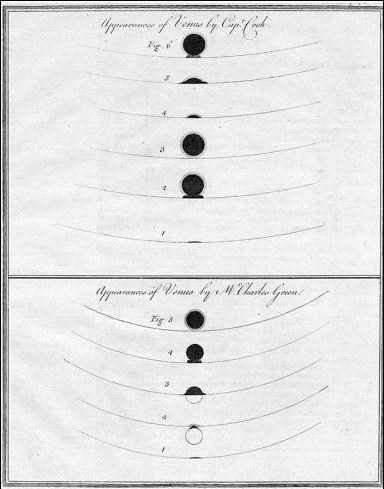
Cook’s and astronomer Charles Green’s recording of the transit – note the differences in the readings and the “black drop” at the bottom of a couple of the stages.
Transit of Venus
So you may ask – why was it is so important to time the passing of Venus across the Sun?
One of the most puzzling questions that 18th century astronomers and other scientists were grappling with was what the size of our solar system was. The distance between the Earth and the Sun had been estimated, with variable degrees of success, since the time of the ancient Greeks, but knowing the size of the solar system was beyond anyone’s capabilities – except for Astronomer Royal, Edmond Halley! He realised in 1716 that Venus occasionally crosses the face of the Sun. It looks like a jet-black disk slowly gliding among the Sun's true sunspots. By noting the start-and stop-times of the transit from widely spaced locations on Earth, Halley reasoned, astronomers could calculate the distance to Venus and the Sun. With that, Kepler's laws of planetary motion (something to do with every planet's orbit is an ellipse, with the Sun at a focus) could be used to calculate the orbits of all the planets out to Saturn, the outermost known planet of the time.
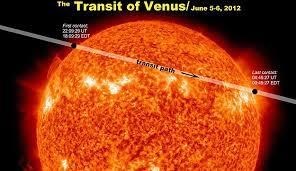
The 2012 recording of the transit.
Note: Once you have found the cache please leave everything in exactly the same way as you found it - including the alignment..