Desert Lake
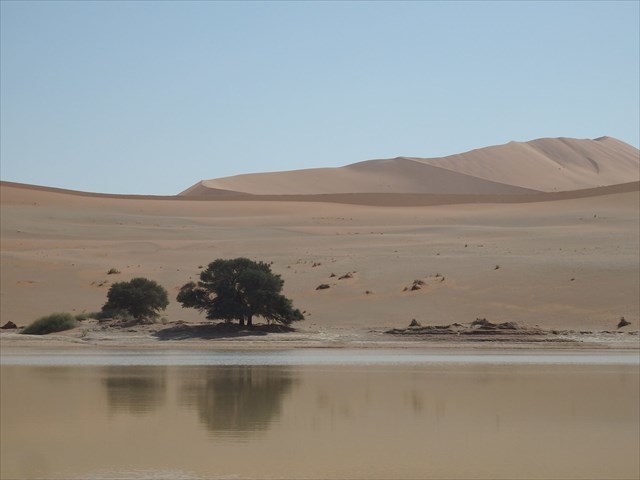
Water deposits in the desert
Water deposits in the desert can - apart from artificially created oases by deep wells or water brought in over longer distances by pipes or tunnels - occur either through escaping groundwater, in the form of an artesian well, or through a river bringing the water from areas with higher precipitation.
Sometimes it also happens that a periodic river course in a so-called dry valley or wadi, which is only occasionally fed by precipitation, ends in a dune depression. One speaks here of a so-called dry lake, since it also dries up in between when there is too little precipitation.
So that a lake can form at the end of the dry valley and the water does not simply seed away into the sand, a waterproof layer is required at the bottom of the depression. This is created over time by suspended matter and clay, which are carried along by the water itself as sediment. If the lake dries up, this layer of clay shows a very typical, torn pattern, which is formed by the tearing forces in the course of drying up.
Dry lake
A dry lake bed, also know as a playa, is a basin or depression that formerly contained a standing surface water body, which disappeared when evaporation processes exceeded recharge. If the floor of a dry lake is covered by deposits of alkaline compounds, it is known as an alkali flat. If coverd with salt, it is known as a salt flat.
A dry lake is formed when water from rain or other sources, like intersection with a water table, flows into a dry depression in the landscape, creating a pond or lake. If the total annual evaporation rate exceeds the total annual inflow, the depression will eventually become dry again, forming a dry lake. A dry lake appears as a flat bed of clay, generally encrusted with precipitated salts. Dry lakes are typically formed in semi-arid to arid regions of the world.
Dry valley or Wadi
Wadi is the Arabic term traditionally referring to a valley. In some instances, it may refer to a wet (ephemeral) riverbed that contains water only when heavy rain occurs. Wadis are located on gently sloping, nearly flat parts of deserts. Water percolates down into the stream bed, causing an abrupt loss of energy and resulting in vast deposition. Wadis may develop dams of sediment that change the stream patterns in the next flash flood. Wadi sediments may contain a range of materials, from gravel to mud, and the sedimentary structures are widely. Thus, wadi sediments are the most diverse of all desert environments. In Spanish, the terminus arroyo, used in North and South America, occurs. An arroyo, also called a wash, is also a dry creek, stream bed or gulch that temporarily or seasonally fills and flows after sufficient rain. Flash floods are common in arroyos following thunderstorms.
Sossusvlei Desert Lake
The Sossusvlei, also Sossus Vlei, is located in Namibia and is a beige salt-clay pan, a location called "vlei" in southwest Africa, surrounded by sand dunes in the Namib, which only has water in rare good rainy years leads. Then, for a short time, a few centimeters to several meters deep lake forms in the vlei at the end of the Tsauchab River.
"Sossus" means "blind river" in the Nama language. "Blind" refers to the fact that the Tsauchab River, which flows towards the Atlantic from a mountainous region inland after heavy rains, ends at Sossusvlei in the sand dunes of the Namib Coastal Desert - or silts up - about 50 km from the sea. The area is part of the Namib-Naukluft National Park.
Sossusvlei has been part of the Namib Sand Sea UNESCO World Heritage Site since June 21, 2013. In the general understanding, the entire area, including the surrounding dune landscapes and vlei, is also referred to as Sossusvlei. It is one of the three areas of the Namib-Naukluft Park.
The surrounding orange-colored dunes are among the highest in the world, with a height difference of up to more than 380 meters compared to the pan. The tallest among them is Big Daddy, also known as Crazy Dune. The orange color of the sand is caused by iron oxide, black areas of the dunes consist of magnetite.
Your task to log the cache:
Answer the following questions via message (not mail!) in English or German via my geocaching profile:
1.) Estimate the water level/surface of the Sossusvlei lake during your visit! Why do you think it is as it is when you visited the area?
2.) Whether there is water or not - describe the surface of the waterproof layer that makes the lake in the desert possible!
3.) Optional: Post a photo with your log, showing you and/or your GPS near the location!
After you've sent me the message with your answers, feel free to log! Only if there's something wrong, I'll contact you via message!
Sources:
Briere, Peter R. (2002): Playa, playa lake, sabkha: Proposed definitions for old terms. In: Journal of Arid Environments 45 (1).
journals.sagepub.com
outback-africa.de
Wellington, J. H. (1955): Southern Africa: a geographical study. Part 1. Physical geography. Cambridge.
wikipedia.org
The pictures were taken by the author.
Enjoy the location!
 The most exciting way to learn about the Earth and its processes is to get into the outdoors and experience it first-hand. Visiting an Earthcache is a great outdoor activity the whole family can enjoy. An Earthcache is a special place that people can visit to learn about a unique geoscience feature or aspect of our Earth. Earthcaches include a set of educational notes and the details about where to find the location (latitude and longitude). Visitors to Earthcaches can see how our planet has been shaped by geological processes, how we manage the resources and how scientists gather evidence to learn about the Earth. To find out more click HERE.