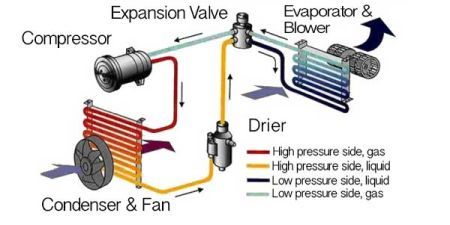
The air-conditioning system in a car works by manipulating refrigerant between a liquid and a gaseous state. As the refrigerant changes states, it absorbs heat and humidity from the vehicle and allows the system to give off cool, dry air.
To change the refrigerant between a liquid and a gaseous state, the air-conditioning system works to control pressure and temperature.

In the past, automotive air condition systems used R-12 as the refrigerant. R-12 (aka Freon) is a very effective CFC-based (chlorofluorocarbon) refrigerant that is not flammable and not poisonous to humans. During the late 1980s, scientists discovered that widespread usage of R-12 was damaging the earth’s ozone layer.
Manufacturers transitioned to R-134a in the mid-1990s. R-134a is an HFC-based (hydrofluorocarbon) refrigerant that does not have the ozone destroying properties of R-12/Freon. The newest refrigerant is R-1234yf, which produces fewer greenhouse gases. Europe requires the use of R-1234yf, and it will likely be the new standard in the United States in the near future.