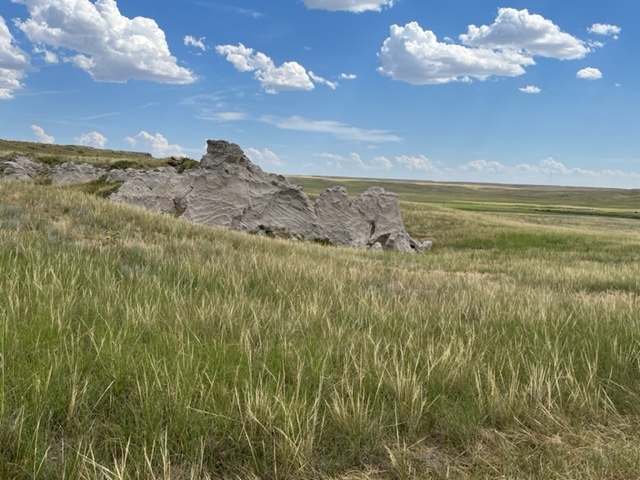
Agate Fossil Beds National Monument is located in western Nebraska and is best known for a large number of well preserved Miocene fossils (which makes it one of the most important paleontological sites in the world), many of which were found on Carnegie and University Hills. Even a short walk offers a glimpse of a wide variety of natural features of the area. While the Daemonelix Trail is best known for the daemonelix, a corkscrew burrow of a small ancient beaver that behaved like modern prairie dogs, there is a lot more geology that can be found here.
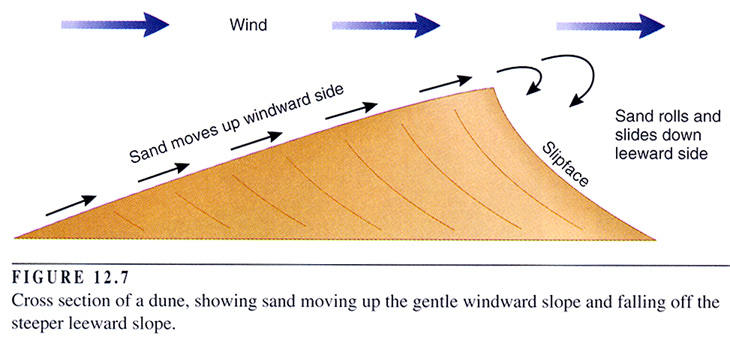
The listed coordinates will bring you to what were ancient sand dunes. These sand dunes were created about 22 million years ago during the Miocene Epoch, and is one of the oldest land forms exposed by the erosion of the Niobrara Valley. The rock you see is a sandstone composed of fine volcanic particles that were transported to this area by wind from volcanoes that were located in Utah, Nevada, and the central Great Plains. The gently sloping beds of sand are the preserved windward side (side facing the wind) of the dune, and the steeply sloping beds are from the sand cascading down the downwind side (side opposite from where wind is blowing from). The sand grains are weakly cemented which makes them susceptible to erosion by wind and rain. The slipface, sometimes called the angle of repose is the steepest angle relative to the horizontal plane that a material can be piled without slumping. Once the slipface would be exceeded, the sand would begin to pile down and this would cause the dune to move forward.
Please remain on the trail at all times to hep preserve the site for future generations to enjoy.
Logging Requirements:
- Describe the ancient sand dune that is in front of you. Estimate the height of the dune.
- Which side (left or right)is the windward side and which is the downwind side?
- Estimate the angle of the slipface.
- Upload a photo taken with the Ancient Dunes.