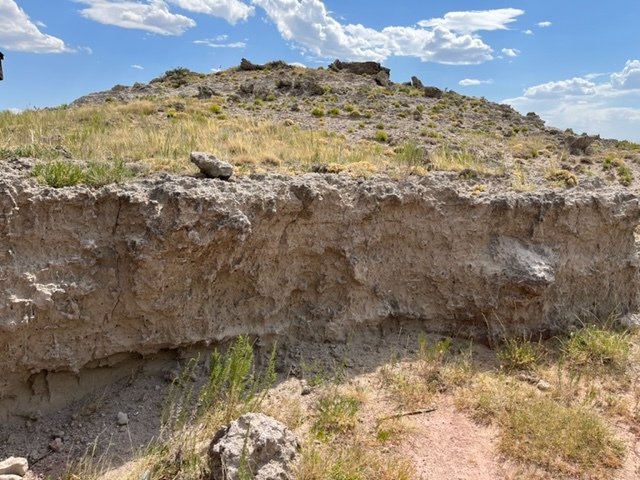
Agate Fossil Beds National Monument is located in western Nebraska and is best known for a large number of well preserved Miocene fossils (which makes it one of the most important paleontological sites in the world), many of which were found on Carnegie and University Hills. Even a short walk offers a glimpse of a wide variety of natural features of the area. While the Daemonelix Trail is best known for the daemonelix, a corkscrew burrow of a small ancient beaver that behaved like modern prairie dogs, there is a lot more geology that can be found here.
The posted coordinates will bring you to a spot where we can examine ancient soils, which can help us construct a picture of a past environment. Fossil soils can be identified by plant roots, animal burrows, and microscopic features of the sediment. Plant roots in these fossil soils are white, tubular structures made of silica; animal burrows often look similar but are filled with gray sand. The fossil soil here has a variety of root diameters, indicating the presence of woody and herbaceous plants. If you look up high on the cliff behind you, the grassland soil there is characterized by a meshwork of uniformly small rootlets, which tells us this was a grassland during the Miocene Epoch, which lasted from 23.03 to 5.3 million years ago. The conditions of mineral grains and small fragments of volcanic glass can also tell us a lot about the climate. The presence of fresh, unweathered grains in the soil supports other evidence of a seasonal semi-arid environment.
Please remain on the trail at all times to hep preserve the site for future generations to enjoy.
Logging Requirements:
- Describe the cliff face in front of you. Are the fossilized plant roots and animal burrows found throughout the entire cliff face or are they limited to just a particular layer? Would you say the number of fossilized plant roots and animal burrows is equally distributed or is one more abundant than the other?
- What do scientists speculate are the flat discs made of tiny fibers of white silica found on the cliff face behind you?
- Upload a photo with the cliff in the background. You do not need to be in the photo, though it is strongly encouraged.