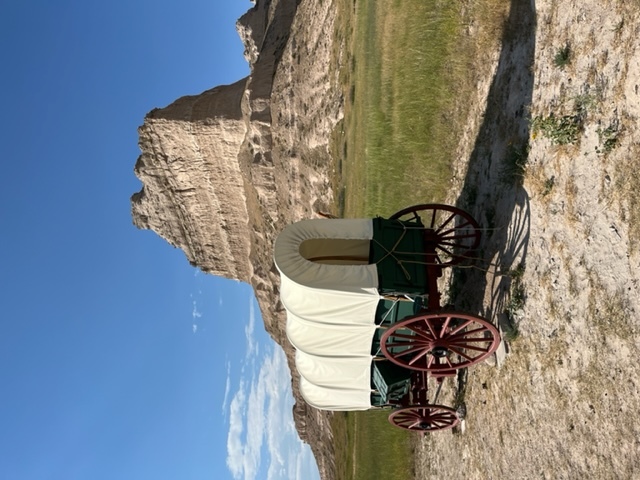
Scotts Bluff is located in western Nebraska and towers more than 800 feet above the North Platte River. The bluff served as an important landmark on the Oregon Trail, California Trail and Pony Express Trail, and was visible at a distance from the Mormon Trail. Over 250,000 westward emigrants passed by Scotts Bluff between 1843 and 1869 and it was the second most referred to landmark in pioneer journals and diaries (after Chimney Rock).
The listed coordinates will bring you to the start of the Saddle Rock Trail. If you look on the north side of the trail, you'll notice some gray colored rocks with some orange lichens on them. These rocks are part of the Monroe Creek Harrison Formations. These rocks are the caprock of Scotts Bluff and are located atop the Gering Formation. They help protect the underlying softer rocks such as sandstones and siltstones from erosion. Here we are able to observe the calcite cemented pipy concretions. Concretions are defined as a hard, compact mass of matter formed by the precipitation of mineral cement within the spaces between particles, found in sedimentary rock or soil. The concretions were formed when calcium carbonate (limestone) precipitated from groundwater and cemented together sand grains. Clasts of these concretions occur in a number of gullies in western Nebraska and indicate that the concretions formed shortly after deposition of the host sand. If you look closely you'll notice small diameter verticle tubules preserved in many of the concretions.
Please remain on the trail at all times to hep preserve the site for future generations to enjoy.
Logging Requirements:
- Describe the pipy concretions in front of you. What texture and color are they?
- Are all the pipy concretions roughly the same size or do they vary? Why do you think this is the case?
- What compass direction are the concretions oriented in?
- Upload a photo taken at the nearby overlook. You do not need to be in the photo though it is strongly encouraged.