Pipestone National Monument is located in southwest Minnesota. For countless generations, American Indians have quarried the red pipestone that is found here. These grounds are considered sacred to many tribal nations and the pipestone quarried here is carved into pipes that are used for prayer. It is believed that the pipe's smoke carries ones prayer to the Great Spirit. During the summer months, there are cultural demonstrations inside the Visitor Center where native craftworkers demonstrate the process of pipemaking using the stone from the quarries.
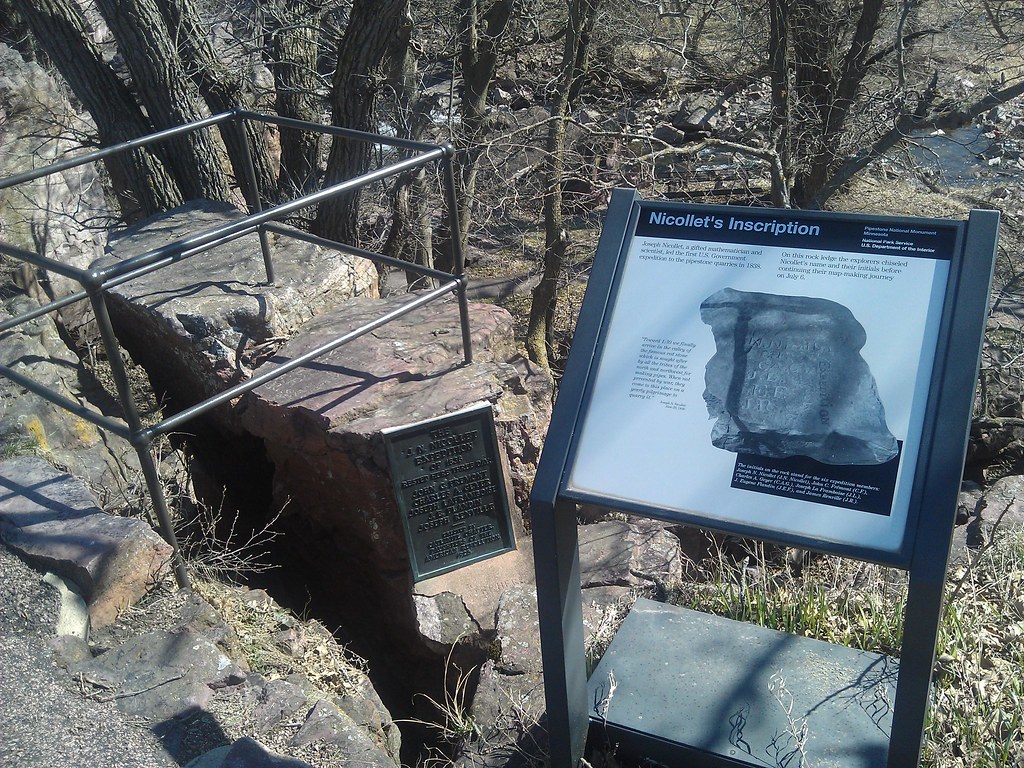
Joseph Nicollet was a gifted mathematician and scientist and he led the first US Government expedition to the pipestone quarries in 1838. On the rock ledge in front of you, the explorers chiseled Nicollet's name and their initials before continuing their map making journey on July 6. While you may be wondering how this relates to geology, there is a lot that can be observed here. The rock you see in front of you is quartzite. Most of the sand grains in quartzite are rounded quartz crystals that were "glued" together by silica, which is commonly found in sand. Due to heat and pressure, the silica was dissolved causing it to act as a cement and the sand then became sandstone, and it was recrystallized into quartzite. The quartzite is so strong that it breaks across the sand grains and the Sioux Quartzite that you see is considered harder than common steel.
Weathering is the process by which rocks, soil, and minerals are broken down through contact with Earth's atmosphere, water, and biologic resources. There are three types of weathering, physical, chemical, and biological. Physical weathering is primarily caused through frost wedging, when water seeps into cracks within the rock, and when the water freezes, it expands. This process continues until eventually a piece of the rock breaks away. Another example of physical weathering is exfoliation. This occurs when cracks develop parallel to land surfaces, and it almost looks like "layers" of the rock are being broken apart. Chemical weathering takes place when rain water reacts with minerals within the rock. In most cases, the water is slightly acidic. Lastly, biological weathering takes place when tree roots grow in between cracks within rocks, and as the root grows, it breaks apart the rock. Algae and lichen that live on rock may also produce chemicals that break down the rock so they can obtain the nutrients needed to survive.
Please remain on the trail at all times to hep preserve the site for future generations to enjoy.
Logging Requirements:
- Look closely at Nicollet's Inscription. Do you see any signs of weathering and if so, what form do you think is present here?
- Describe the color, texture, and grain size of the quarzite. You may notice that the inscription looks in really good shape even though it was carved more than 180 years ago. What properties of the rock do you think are responsible for this?
- Upload a photo taken near Nicollet's Inscription. You don't have to be in the photo though it is strongly encouraged.