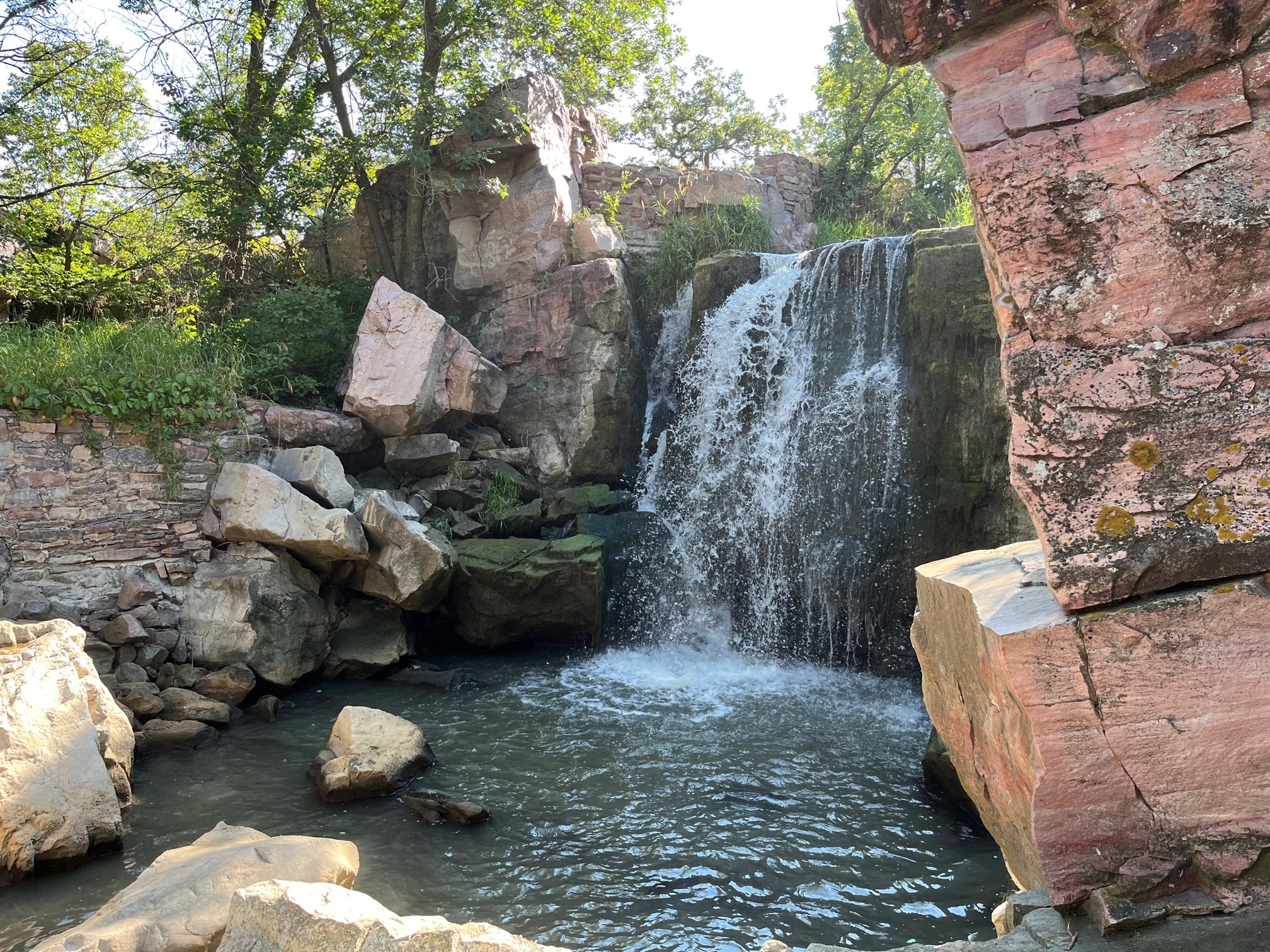
Pipestone National Monument is located in southwest Minnesota. For countless generations, American Indians have quarried the red pipestone that is found here. These grounds are considered sacred to many tribal nations and the pipestone quarried here is carved into pipes that are used for prayer. It is believed that the pipe's smoke carries ones prayer to the Great Spirit. During the summer months, there are cultural demonstrations inside the Visitor Center where native craftworkers demonstrate the process of pipemaking using the stone from the quarries.
The listed coordinates will bring you to Winnewissa Falls, where Pipestone Creek tumbles over the Sioux Quartzite bluff. Winnewissa Falls is a feature known as a knickpoint, a part of a river or channel where there is a sharp change in channel slope, which is seen at all waterfalls. There are two types of knickpoints: stable and mobile. Stable knickpoints can be found where rivers flow over resistant lithologic units or active faults. This may sound complicated but all it really means is that the river flows over a very hard rock that is resistant to erosion. Mobile knickpoints on the other hand are due to some downstream event and move upstream, which indicates erosion throughout a river network. What this means is that the rock that the river flows over is soft and easily eroded, in a way, the falls will "move" upstream. It is also worth mentioning how waterfalls are formed. Waterfalls often form in the upper stages of a river where it flows over different bands of rock. It erodes soft rock more quickly than hard rock and this may lead to the creation of a waterfall. Often times, hard rock such as granite are located atop waterfalls and the soften rocks such as sandstone, which are located below the harder rocks, are eroded making the waterfall steeper beyond the hard rock. With the watercourse continuing to cut into the softer rock, the waterfall gets taller, the plunge pool (where the waterfall lands) gets deeper, and the soft rock directly beneath the hard rock gets undercut. As the undercutting continues, eventually the overhanging hard rock gets unstable and collapses into the base of the waterfall. The net result of this action is that the waterfall retreats further upstream to the remaining lip of the hard rock layer. Another feature commonly found at waterfalls is jointing, which refers to zones of weakness along the rock where it is the weakest and most easily eroded.
Please remain on the trail at all times to hep preserve the site for future generations to enjoy.
Logging Requirements:
- The volume of water flowing over the falls as well as the height of the falls affects the depth of the plunge pool. The greater the volume of water (as well as the taller the falls), the deeper the plunge pool will be. Describe the plunge pool as well as the volume of water flowing over the falls. What can those two pieces of information tell you about the formation of the falls?
- Describe the rock behind the falls. Are there any joints visible? If so, is their spacing consistent or random?
- Would you consider this a stable or mobile knickpoint and why?
- Upload a photo taken with Winnewissa Falls. You do not need to be in the photo though it is strongly encouraged.