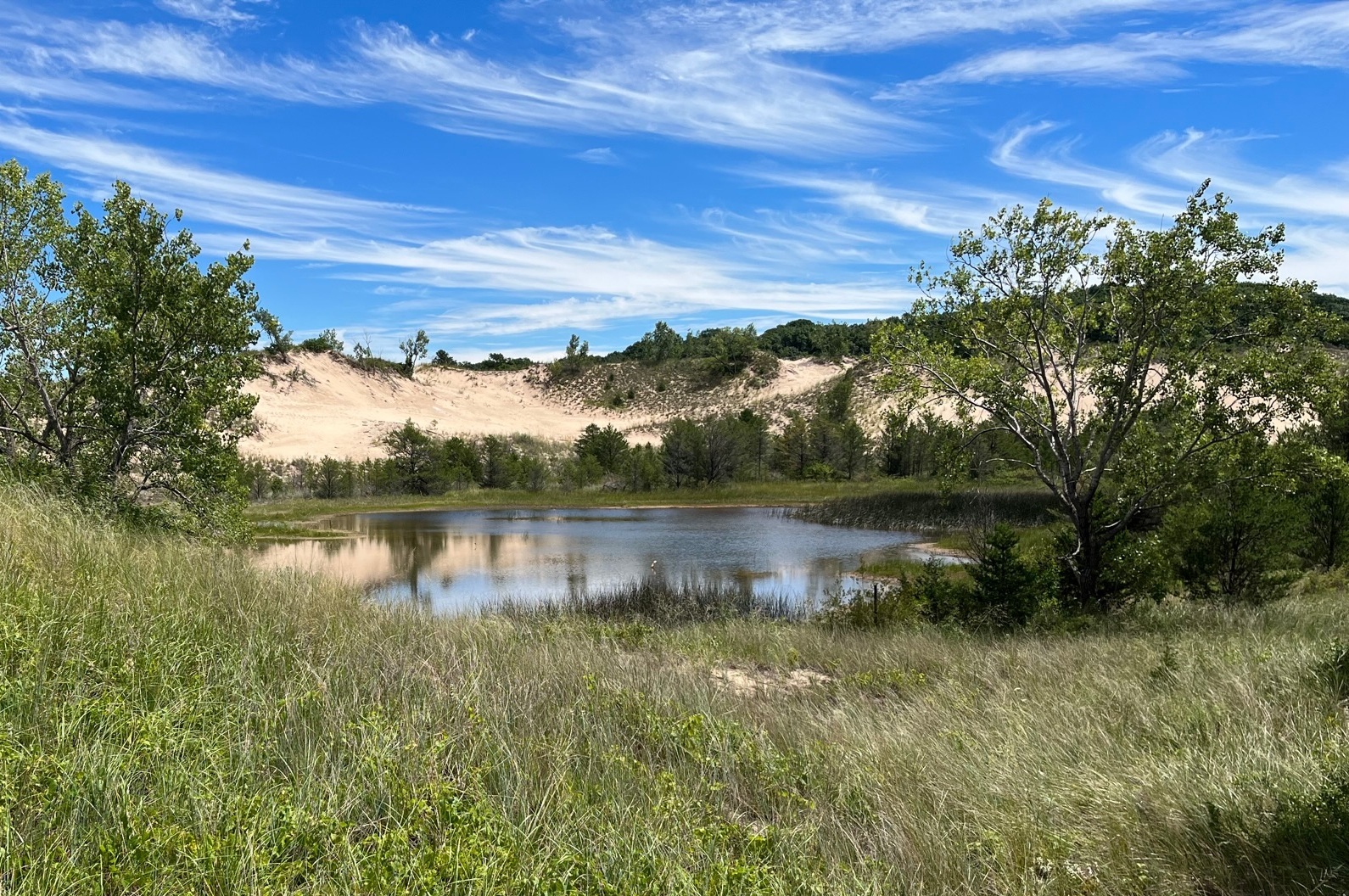
Indiana Dunes National Park is located in northwest Indiana and spans 20 miles on the southern shores of Lake Michigan. The park offers a wide diversity of habitats and contains rugged dunes, mysterious wetlands, sunny prairies, meandering rivers and peaceful forests. The park became a national seashore in 1966 as a result of a grassroots effort to protect the dunes that were being hauled away. In 2019, it was redesignated as the country's 61st National Park.
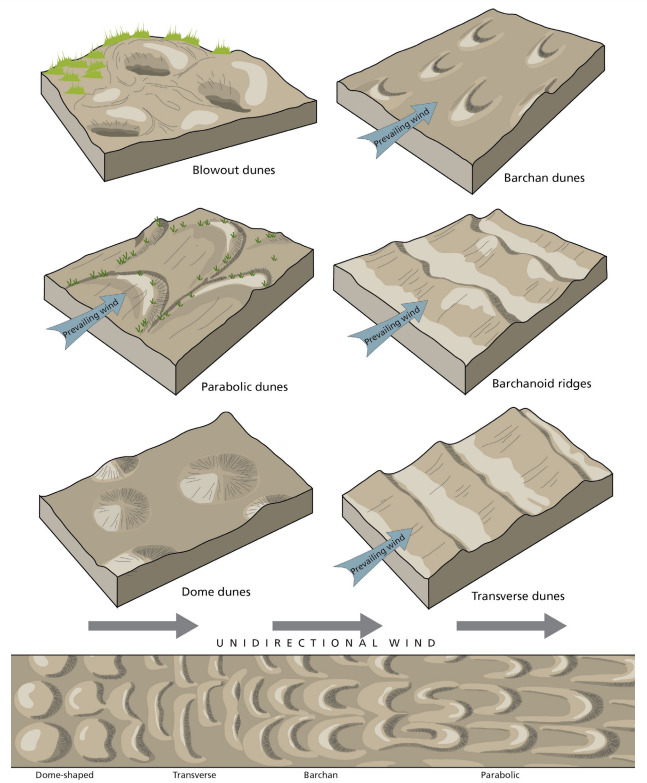
There are five different types of dunes. A wide variety of factors such as sand supply, wind direction, interactions among lake levels, topography, and vegetation growth can all affect the type of sand dune that will be formed. A blowout dune is a saucer or trough shaped hollow and it is formed when wind erodes bare sand on a stabilized dune. Blowout dunes can be further classified into two types, saucer blowouts and trough blowouts. Saucer blowouts are semicircular with a saucer shape while trough blowouts are more elongated and have a deeper basin with steeper slopes. Another type of dune are barchan dunes which are crescent shaped. They are produced by the action of the wind blowing predominantly from one direction. The convex side (outer side) faces the wind. The side of the dune facing the wind has a gentle slope while the side opposite the wind (known as the slip face) has a much steeper slope. These types of dunes generally migrate since sand is eroded on the windward side and deposited on the leeward side. Parabolic dunes are formed from blowouts. When a blowout is eroded by strong winds, vegetation holds the "arms" of the dune in place as the leeward "nose" of the dune migrates forward. Barchanoid ridges are similar to barchan dunes with one major difference. Rather than a dune, they are a series of ridges and consist of parallel rows of connected barchans (often will be formed when there is an abundance of sand). Like barchans, the side facing the wind will have a gentle slope while the leeward side is steep. Barchanoid ridges are oriented perpendicular to the wind direction. There are also dome dunes, which are individual sand piles with a rounded shape and no slip face (steep side). They are considered the rarest type of dune and form when wind velocities are low. Dome dunes can be further classified into two types, mini and mega. Mini domes are a few feet tall and dozens of feet wide. In contrast, mega domes are dozens of feet tall and hundreds of feet wide. Lastly there are transverse dunes, which are long sand dunes with a wavy ridge running along their length. They are formed in locations where there is an abundance of sand. The image above does a good job at showing the different types of dunes and how the direction of the prevailing wind influences their formation. Towards the bottom it shows what the dune would look like from a birds-eye view.
Logging Requirements:
- Describe the dune in front of you. Do you see any vegetation on it? Estimate its height and width. What direction is it oriented? Determine the direction of the prevailing wind.
- Based on the description, what type of dune do you think this is?
- Do you think this dune is moving at a fast or a slow pace? How might this area look 100 years from now?
- Upload a photo with the dune in the background. You don't have to be in the photo though it is strongly encouraged.