This Earthcache will bring you to an interesting exposure on the Rocky Ridge (yellow) Trail at Kloofendal Nature Reserve, illustrating a fascinating geological process called boudinage. Entry is free and the reserve is open from 6am-6pm every day. However, no entry is permitted after 5pm. Please refer to the additional waypoints for more access details.
Terms to understand:
Quartzite: A metamorphic rock formed when sandstone is subjected to severe heat and pressure. Sandstone is a sedimentary rock which forms when sand is deposited and compacted.
Phyllite: A metamorphic rock formed when shale is subjected to severe heat and pressure. Shale is a sedimentary rock which forms through the deposition and compaction of mud.
Competence: The resistance of a rock to undergo deformation. Competent rock undergoes deformation less easily compared to more incompetent rocks.
Deformation: When forces act upon rocks, they experience stress and how they change their shape in response to these stresses is called strain. Under conditions of intense heat and pressure, rocks can deform in many ways. This is dependent on the rock’s composition, whether water is present and the temperature and pressure conditions of the strain. Deformation changes fall into two categories – brittle deformation and ductile or plastic deformation. Brittle deformation happens when rocks break or crack when put under stress while ductile or plastic deformation involves rocks changing their shape without breaking or cracking.
Here on the Rocky Ridge Trail, you will find some eye or lens shaped quartzite rocks called boudins surrounded by phyllite. Boudins are formed in a process called boudinage. These terms come from a French word for dry cured sausages and were first used by the geologist Max Lohest in 1908 after seeing this phenomenon in Belgium.
Boudinage happens when layers of rock are compressed in one direction and they break apart and are stretched or extended out in another direction (Figure 1). This requires rocks of different competencies. The boudins form in layers consisting of stronger rocks more resistant to deformation when compared to the surrounding rocks.
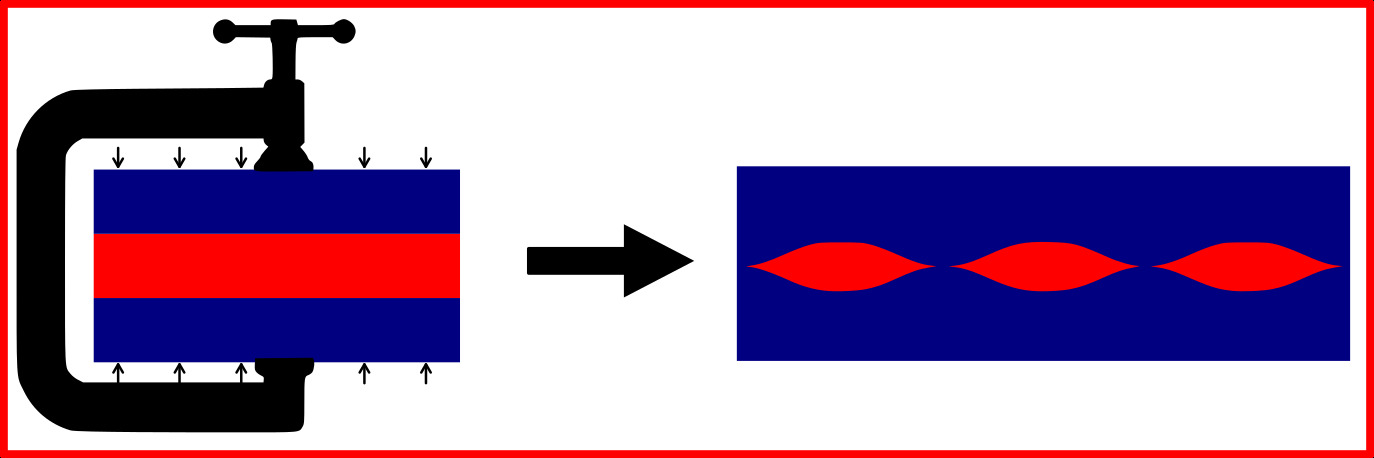
Figure 1: How boudins form. The red layer is more competent compared to the surrounding blue rock and compression (imagine a vice squishing them together) results in the red layer breaking and forming eye, lens or sausage shaped features called boudins.
The shape of the boudins is influenced by the difference in the competency of the rocks – the competence contrast (Figure 2). When there is a big difference in their competencies, the brittle (red) rock fractures and forms blocks with the more ductile (blue) rock wrapping around these blocks. As the difference in the competency decreases, the boudins shape changes. When the boudins are not completely separated but are connected together by a thin layer of rock (like sausages on a string), they are called pinch-and-swell structures and this suggests that the boudin and surrounding rocks both underwent ductile deformation and have similar competencies. When there is no difference in their competencies, the rocks undergo uniform stretching and no boudins form.
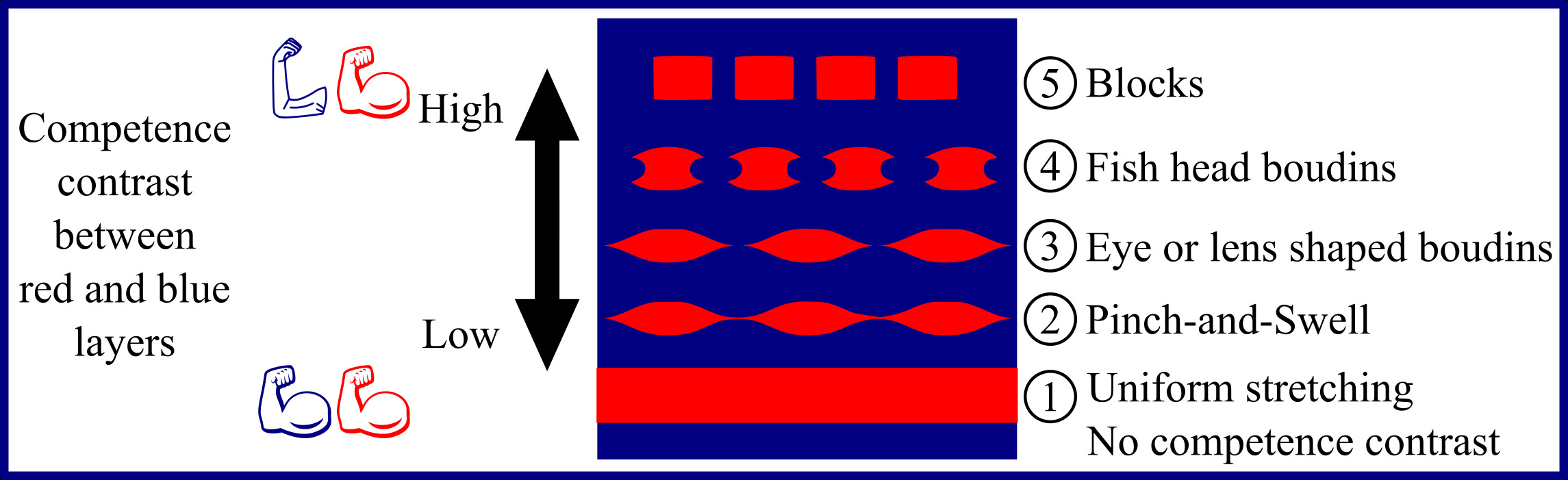
Figure 2: How the competence contrast of adjacent rocks affects the shape of the boudins.
In this exposure, boudinage happened when the rock was compressed sideways and then it stretched out in the direction of the path. The quartzite is more competent than the ductile phyllite and so when this compression happened, the phyllite wrapped around the quartzite and these boudins formed. Quartz veins have filled in some of the gaps.
Boudins are unique geological structures that showcase the strain and deformations that rocks once experienced. They help geologists gauge the strength of adjacent rocks as well as the physical conditions necessary for these deformations to occur.
LOGGING REQUIREMENTS
In order to substantiate your visit, please submit your answers to the following questions to me via the message centre or an email. In your message/email please mention the Earthcache which you are sending answers for. Any logs not accompanied by answers within 7 days will be deleted.
This Earthcache location could be inconspicuous and easy to miss so look carefully. At GZ, you are looking for lens or eye shaped rock sections on the trail. The rocks could be quite dusty. If you have some water to splash over the rocks this may help you see the features more clearly.
1) Describe what you see (rock types, colours and features). How big are the boudins?
2) Based on what you see, how would you describe the shape of the boudins in terms of examples 1 through 5 in Figure 2? Why?
3) How does the competency of the rocks here differ?
OPTIONAL: Feel free to add any non-spoiler photos to your online log.
|
Acknowledgements:
Thank you to the Friends of Kloofendal and Dr Steve Spottiswoode for his invaluable assistance. Steve, thank you for assisting me with the geology to create this Earthcache and revealing all the geological wonders at Kloofendal through a geological walk I attended!
References:
1) Büttner, S.,GLG3 Structural Geology Chapter 2a: Boudins, mullions and competence contrasts (Part 1), Rhodes University Online Lecture.
2) Fossen, H., Structural Geology, Second Edition, Cambridge University Press, 2016.
3) GeologyUpSkill, The Boudinage Effect.
4) Gilotti, J.A., Boudin, augen, horse? A lesson from the Svarttjørna-Turtbakktjørna Lens, Trøndelag, Norway, Geologiska Föreningen i Stockholm Förhandlingar, 111, 385-390, 1989.
5) Marshak, S., Essentials of Geology, Sixth Edition, W.W. Norton & Company, Inc., 2019.
6) Papeschi, S., European Geosciences Union Blog website, Features from the field: Boudinage.
7) Spooner, A.M., Geology for Dummies, Wiley Publishing, Inc., 2011.