Charco Caleta de Fuste
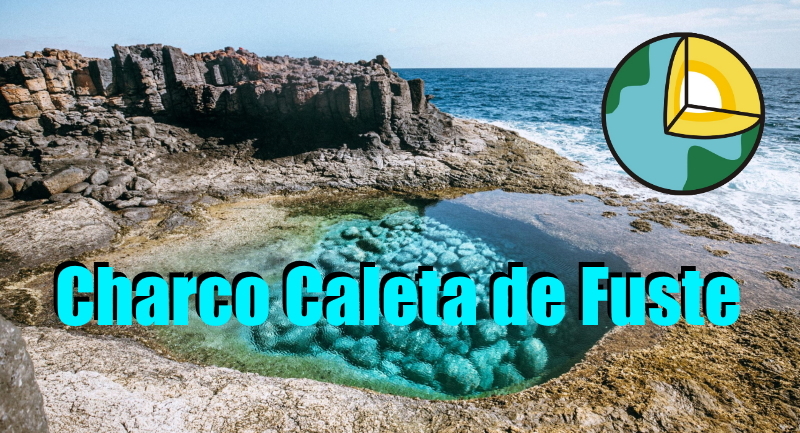
La piscina natural de Caleta de Fuste, tambíén conocida como Charco de Castillo o Charco Caleta de Fuste, es un charcón creado por la naturaleza dónde en marea baja se convierte en una bella piscina natural.
Con este earthcache queremos mostraros uno de nuestros lugares favoritos de Fuerteventura.
Basalto
La variedad más común de roca producida por magma es el basalto. El basalto es una roca ígnea volcánica que se caracteriza por tener un color oscuro, producto de su alto contenido en hierro y magnesio. Se constituye principalmente de óxidos metálicos como el óxido de hierro, óxido de silicio y de magnesio, entre otros. Pueden presentarse pequeños fenocristales en su composición, aunque también se presenta en forma de cristal sin o con muy pocos cristales de forma visible. Presenta una alta dureza (8 en la escala de Mohs) y manejo fácil, en cuanto a su explotación. Por sus características físico-mecánicas, es un material idóneo para la construcción, para revestimientos y pavimentos exteriores, incluso los de circulación intensa (adoquines, piezas estándar, etc.). También es usado como elemento decorativo por su estética y al poder ser tratado en forma, corte, molde y color. De forma inusual, también es utilizado en tratamientos de spa como son los masajes.
El basalto en forma natural se encuentra característicamente como grandes columnas y, según su ubicación y formación, se pueden derivar algunas formas peculiares del basalto, como por ejemplo arcos basálticos o prismas basálticos.
Columnas basálticas
Las columnas basálticas son formaciones naturales de pilares más o menos verticales, con forma de prismas poligonales (predominando los hexagonales). Estas grietas son un caso especial de diaclasado denominado disyunción columnar y puede originarse cuando una colada de lava basáltica penetra en una masa de agua, ya sea un río, un lago o, como en este caso, el océano. Cuando el agua se introduce en el interior de la colada de lava basáltica, en chimeneas volcánicas o en calderas que no llegan a desbordarse o vaciarse repentimanente, ésta se enfría in situ y solidifica reduciendo su volumen, lo que genera la fractura progresiva de la roca siguiendo un patrón regular en forma de prismas de distintos tipos, formando unos conjuntos característicos en muchos relieves volcánicos. El tamaño de las columnas viene determinado por la velocidad de enfriamiento, siendo las más grandes producto de tiempos de enfriamiento más largos.
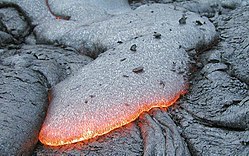 Lava basáltica
Charco Caleta de Fuste
Este charco natural con gran valor geológico se encuentra a pocos metros del paseo marítimo de Caleta de Fuste. Os recomendamos que vayáis con marea baja para poder verlo en su mejor momento.
Para resolver el earthcache tendréis que visitar el charcón pero no hace falta bajar ni bañarse, tened cuidado si bajáis.
Leyendo el listing y visitando el lugar podréis responder a las preguntas de este earth. Recordad haceros la foto obligatoria.
ATENCIÓN, MUY IMPORTANTE: Se recomienda el baño solo en marea baja, si el oceano entra en el charcón es muy peligroso.
PREGUNTAS
Para poder registrar como encontrado este earth, nos tenéis que mandar un correo (podéis hacerlo desde nuestro perfil de usuario) con las respuestas a las siguientes preguntas. Podéis loguear el earthcache sin haber recibido nuestra respuesta. Si no recibimos el correo con las respuestas correctas, el log podrá ser borrado sin previo aviso.
1.- Cuál de las siguientes afirmaciones sobre el basalto es correcta:
A) Alto contenido de hierro y bajo de magnesio
B) Bajo contenido de hierro y alto de magnesio
C) Alto contenido de hierro y alto de magnesio
D) Bajo contenido de hierro y bajo de magnesio
2.- Observa alrededor del charcón. Puedes ver varias columnas basálticas. ¿Cómo crees que se enfriaron cuando se formaron, lentamente o rápidamente? Razona tu respuesta.
3. ¿Crees que llegará el día en qué el charcón se abra al oceano y desaparezca como tal? ¿Por que?
4.- FOTO. Hazte una fotografía con el charco detrás (si no quieres salir, un papel con tu nick o tu GPS será válido). Recuerda que esta fotografía es OBLIGATORIA para demostrar que has visitado este earthcache.
Si no recibimos las respuestas, el log será borrado sin previo aviso.
También podrán ser borrados todos los logs que no incluyan la fotografía obligatoria de la pregunta 4 (desde la actualización de las guidelines de junio de 2019, la fotografía puede ser obligatoria para demostrar que se ha visitado el sitio).
No olvides que estás dentro de un entorno natural, hay que respetarlo y cuidarlo.
Gracias por vuestra comprensión y esperemos que disfrutéis del lugar.

ENGLISH VERSION
Charco Caleta de Fuste (ENG)
The natural pool of Caleta de Fuste, also known as Charco de Castillo or Charco Caleta de Fuste, is a puddle created by nature where at low tide it becomes a beuatiful natural pool.
With this earthcache we want to show you one of our favorite places at Fuerteventura.
Basalt
The most common variety of rock produced by magma is basalt. Basalt is a volcanic igneous rock that is characterized by having a dark color, due to its high content of iron and magnesium. It is mainly made up of metallic oxides such as iron oxide, silicon oxide and magnesium oxide, among others. Small phenocrystals may appear in its composition, although it also appears in crystal form without or with very few crystals in a visible way. It has a high hardness (8 on Mohs scale) and easy handling, in terms of its exploitation. Due to its physical-mechanical characteristics, it is an ideal material for construction, for exterior cladding and flooring, even those with intense circulation (paving stones, standard pieces, etc.). It is also used as a decorative element for its aesthetics and because it can be treated in shape, cut, mold and color. Unusually, it is also used in spa treatments such as massages.
Basalt naturally occurs characteristically as large columns, and depending on its location and formation, some peculiar forms of basalt can be derived, such as basaltic arches or basaltic prisms.
Basaltic columns
The basaltic columns are natural formations of more or less vertical pillars, shaped like polygonal prisms (the hexagonal ones predominate). These cracks are a special case of tiling called columnar disjunction and can be originate when a basaltic lava flow penetrates into water, such a river, a lake or, as in this case, the ocean. When the water is introduced into the basaltic lava flow, in volcanic chimneys or in boilers that do not overflow or suddenly empty, it cools in situ and solidifies reducing its volume, which generates the progressive fracture of the rock following a regular pattern in different types the form of prisms, forming characteristic sets in many volcanic reliefs. The size of the columns is determined by the cooling speed, being the largest ones a product of longer cooling times.
Basaltic lava
Charco Caleta de Fuste
This natural pool of great geological value is located a few meters from the promenade of Caleta de Fuste. We recommend that you go at low tide to see it at its best.
To solve the eartcache you will need to visit the natural pool but you don't need to go down or bathe, be careful if you go down.
By reading the listing and visiting the site you will able to answer the questions of this earth. Remember tot take the obligatory photo.
ATTENTION, VERY IMPORTANT: Swimming is only recommended at low tide, if the ocean enters into the pool it is very dangerous.
QUESTIONS
In order to register as a found this earth, you have to send us an email (you can do it from our user profile) with the answers to the following questions. You can log the earthcache without having received our response. If we do not receive the email with the correct answers, the log may be deleted without prior notice.
1.- Which of the following statements about basalt is correct:
A) High iron and low magnesium content
B) Low iron and high magnesium content
C) High iron and high magnesium content
D) Low iron and low magnesium content
2.- Observe around the charco. You can see the basalt columns. How do you think they cooled when they are formed, slowly or quickly? Reason your answer.
3.- Do you think that in the future the charco will open up to the ocean and disappear? Why?
4.- PHOTO. Take a picture of yourself with the charco (if you don't want to appear, a piece of paper with you nickname or your GPS will be ok). Remember this photograph is REQUIRED to prove that you have visited this earthcache.
If we don't receive the answers, the log will be deleted without prior notice.
All logs that do not include the required photograph in question 4 may also be deleted (since update of the guidelines in June 2019, the photograph may be required to prove that the place has been visited).
Don't forget you are in a natural environment, you have to respect it and take care of it.
Thank you for your understanding and we hope you enjoy the place.