Bee Cave
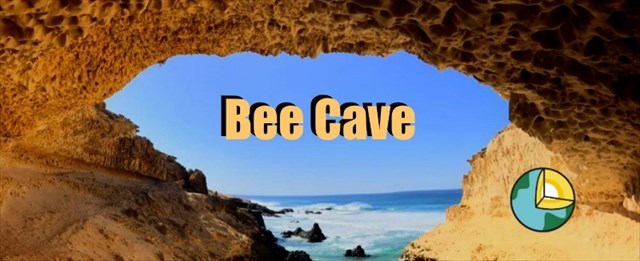
La bee cave es una cueva que te recordará a los nidos de abeja, de aquí viene el nombre que le hemos dado ya que desconocemos su nombre real. Es uno de nuestros lugares favoritos de Fuerteventura.
En realidad podéis estar tranquilos que no hay ninguna abeja, nos encontramos ante una cueva erosionada por el viento en el que podemos observar alveoles o taffonis.
Taffoni
Taffoni, o tafoni, en geomorfología, designa una forma en cavidad o hueco redondeado, de un tamaño desde pocos centímetros a varios metros, tallada por la erosión en rocas cristalinas o arenisca, en climas secos o en algunas costas. Los tafoni se pueden encontrar en todas las áreas del mundo, pero son más comunes en las zonas marítimas, en las zonas áridas y en los desiertos. Fuerteventura reúne todos estos requisitos.
Hay muchas explicaciones sobre el origen de los tafoni: erosión eólica (corrosión), erosión debido a las sales, diferencias en la cohesión interna y en la permeabilidad de las rocas, duración del período seco entre varios períodos húmedos, etc.
Los tafoni se confunden a veces con los nidos de abeja, diferenciándose tanto en escala como en las condiciones del desarrollo: Los taffoni tienen un volumen en unos pocos centímetros cúbicos hasta varios metros cúbicos, mientras que el panal de abeja es un conjunto de agujeros de orden centimétrico. Los taffoni parecen ser favorecidos por la pesencia de humedad y sales, mientras que los nidos de abeja requieren una cierta predisposición estructural: la presencia de microfisuras en la roca, la distribución de minerales frágiles en grupos sobre los que forman los agujeros.
A medida que crecen, los taffoni crean un microclima húmedo que favorece su crecimiento. Los nidos de abeja se convierten en nichos favorables para la instalación de microorganismos (líquenes) que, a su vez, agravan la meteorización.
Meteorización
La meteorización son aquellos procesos combinados que ocurren en la superficie terrestre (sobre la corteza de la tierra) los cuales rompen y corroen la roca sólida o el macizo rocoso en el mismo sitio (in situ), transformándola en sedimento, aquellos procesos de meteorización son de dos tipos principalmente: físicos y químicos.
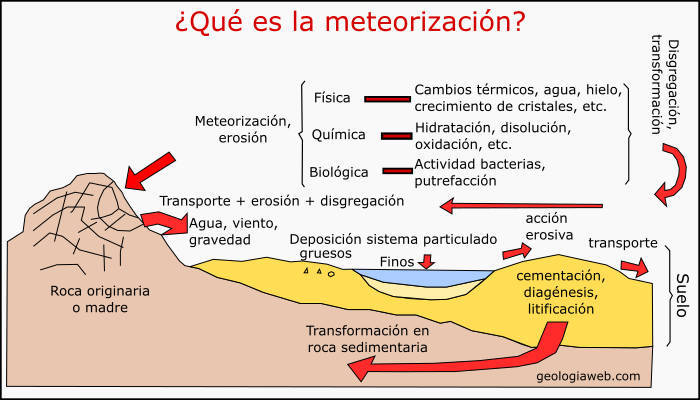 Esquema meteorización
Diferencia entre meteorización y erosión
La meteorización es una combinación de procesos físicos y químicos que desintegran la roca en el mismo sitio (in situ), sin embargo, no ocurre un transporte de aquellos materiales desintegrados.
En cambio, cuando se habla de erosión, aquí si existe el transporte de los materiales que se generaron en la meteorización.
Es decir que la erosión actuá transportando las partículas de pequeñas rocas o minerales por agentes móviles como el agua, el viento, el hielo y el aire para depositarlos en otro lugar diferente a la inicial.
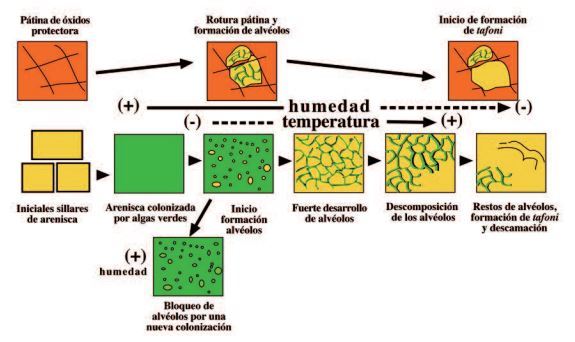 Esquema meteorización
Acceso a la cueva
Nosotros aparcamos en Playa de Garcey y empezamos a andar en las coordenadas N 28° 20.613 W 014° 10.747
No hay camino definido para llegar a la cueva, nosotros decidimos evitar riesgos y andar por el interior volteando los tres barrancos que encontramos. Una vez en la zona de las coordenadas del earthcache, para acceder a la cueva es posible hacerlo por ambos lados. Nosotros bajamos en las coordenadas N 28° 20.330 W 014° 11.254 y desde ahí sigues el caminito hacia el interior de la cueva. Si no tienes miedo a las alturas y llevas buen calzado no tendrás problemas.
PREGUNTAS
Para poder registrar como encontrado este earth, nos tenéis que mandar un correo (podéis hacerlo desde nuestro perfil de usuario) con las respuestas a las siguientes preguntas. Podéis loguear el earthcache sin haber recibido nuestra respuesta. Si no recibimos el correo con las respuestas correctas, el log podrá ser borrado sin previo aviso.
1.- Cual de las siguientes afirmaciones de los taffoni es correcta:
A) Los taffoni crean un microclima seco que favorece su crecimiento
B) Los taffoni crean un microclima húmedo que favorece su crecimiento
C) Los taffoni no crean ningun microclima
D) Los taffoni son creados por las abejas
2.- Observa los agujeros de los laterales de la cueva y del techo, ¿crees que se han formado por erosión o por meteorización? Razona tu respuesta.
3.- ¿Que profundidad tienen los agujeros del techo?
4.- Toca la pared de la cueva. Describe con tus palabras como es al tacto.
5- FOTO. Hazte una fotografía en la cueva (si no quieres salir, un papel con tu nick o tu GPS será válido). Recuerda que esta fotografía es OBLIGATORIA para demostrar que has visitado este earthcache.
Si no recibimos las respuestas, el log será borrado sin previo aviso.
También podrán ser borrados todos los logs que no incluyan la fotografía obligatoria de la pregunta 5 (desde la actualización de las guidelines de junio de 2019, la fotografía puede ser obligatoria para demostrar que se ha visitado el sitio).
No olvides que estás dentro de un entorno natural, hay que respetarlo y cuidarlo.
Gracias por vuestra comprensión y esperemos que disfrutéis del lugar.

ENGLISH VERSION
Bee Cave (ENG)
The bee cave is a cave that will remind you of bee nests, from here comes the name we have given it since we do not know its real name. It is one of our favorite places in Fuerteventura.
Actually, you can rest assured that there are no bees, we are in front of a cave eroded by the wind in which we can see alveoles or taffoni.
Taffoni
Taffoni, or tafoni, in geomorphology, designates a rounded hollow or cavity shape, from a few centimeters to several meters in size, carved by erosion in crystalline rocks or sandstone, in dry climates or on some coasts. Tafoni can be found in all areas of the world, but they are most common in maritime areas, in arid areas, and in deserts. Fuerteventura meets all these requirements.
There are many explanations for the origin of the tafoni: wind erosion (corrosion), erosion due to salts, differences in the internal cohesion and permeability of the rocks, duration of the dry period between various wet periods, etc.
The tafoni are sometimes confused with the honeybee nests, differing both in scale and in the development conditions: The taffoni have a volume of a few cubic centimeters up to several cubic meters, while the honeycomb is a set of holes of centimeter order. The taffoni seem to be favored by the presence of humidity and salts, while the honeycombs require a certain structural predisposition: the presence of microcracks in the rock, the distribution of brittle minerals in groups on which they form the holes.
As they grow, taffoni create a humid microclimate that favors their growth. Bee nests become favorable niches for the installation of microorganisms (lichens) which, in turn, aggravate weathering.
Weathering
Weathering are those combined processes that occur on the earth's surface (on the earth's crust) which break and corrode solid rock or rock mass in the same place (in situ), transforming it into sediment, those weathering processes are of two main types: physical and chemical.
Weathering scheme
Difference between weathering and erosion
Weathering is a combination of physical and chemical processes that disintegrate the rock in the same place (in situ), however, transport of those disintegrated materials does not occur.
On the other hand, when talking about erosion, here there is the transport of the materials that were generated in the weathering.
That is to say that erosion acts by transporting the particles of small rocks or minerals by mobile agents such as water, wind, ice and air to deposit them in another place other than the initial one.
Weathering scheme
Access to the cave
We parked at Playa de Garcey and started walking at the coordinates N 28° 20.613 W 014° 10.747
There is no defined path to get to the cave, we decided to avoid risks and walk inside, turning around the three ravines that we found. Once in the area of the earthcache coordinates, it is possible to access the cave from both sides. We go down at the coordinates N 28° 20.330 W 014° 11.254 and from there you follow the path into the cave. If you are not afraid of heights and wear good shoes you will not have problems.
QUESTIONS
In order to register as a found this earth, you have to send us an email (you can do it from our user profile) with the answers to the following questions. You can log the earthcache without having received our response. If we do not receive the email with the correct answers, the log may be deleted without prior notice.
1.- Which of the following statements about taffoni is correct:
A) Taffoni create a dry microclimate that favors their growth
B) Taffoni create a humid microlimate that favors their growth
C) Taffoni do not create any microclimate
D) Taffoni are created by bees
2.- Observe the holes on the sides and on the ceiling. Do you think they have been formed by erosion or weathering? Reason your answer.
3.- How deep are the holes on the ceiling?
4.- Touch the wall of the cave. Describe with your words what it is like to touch.
5- PHOTO. Take a picture of yourself at the cave (if you don't want to appear, a piece of paper with your nickname or your GPS will be ok). Remember this photograph is REQUIRED to prove that you have visited this earthcache.
If we don't receive the answers, the log will be deleted without prior notice.
All logs that do not include the required photograph in question 5 may also be deleted (since update of the guidelines in June 2019, the photograph may be required to prove that the place has been visited).
Don't forget you are in a natural environment, you have to respect it and take care of it.
Thank you for your understanding and we hope you enjoy the place.