To log this earthcache, send me an email with the answer to the following questions:
1) What kind of tombolo is from Trafalgar? What are the two processes that cause a tombolo?
2) At WP1 ( Rocks), it is possible to visualize several rocks, describe them. ( Color, texture, height from the ground, brightness, grain size )
3) What kind of rocks form the base of the island? How old are you?
4) Add a photograph of yourself in the local, or another in which an object can be seen, or your nick on a piece of paper
-If you think you have successfully completed the objectives of this Earth Cache, and you have sent me all the requested responses, you can log. Then I will check that they are correct, and if there is any problem I will contact you to fix it.
-Logs without responses previously sent, will be deleted without notice |
Location
Near Caños de Meca, is this monument, in the domains of the Cape Trafalgar Lighthouse. Its beautiful landscape mixes fine sand dunes, extensive beaches and a rocky area on which the lighthouse sits.
The sand carried by tides created a double tombolo or tongue that joined the islet with the coast, enclosing a depression flooded by rain. As the sea receded, the wind created dune systems on the beaches to the south of the islet, contributing to its fossilization. On the old coast, the east developed another dune system, today covered with junipers and mastics.
The flowers of the sea wallflower, sea lily and sea thistle form a colorful blanket over the sands. These covers of grass and grass, which fix the substrate, protect the marine spurge. In stabilized areas appear rubies and sea horns, artemisias and pinks.
Reeds grow in the flooded area, becoming a regular perch for birds such as Audouin's gull, the common sandpiper, the lesser tern, the red-billed pagaza and the black-tailed marlin, as well as the little egret. The beaches are home to cañadillas, coñetas and the striking orange sand star.
But the most characteristic of the place is its history. Around the lighthouse, there are archaeological sites, such as a Roman temple of the god Juno with a sacrificial altar and a salted fish factory. From the Spanish-Muslim settlement, part of a watchtower from the 9th century is preserved, dismantled in the 19th century to build the current lighthouse. However, the event that makes it famous is the Battle of Trafalgar, which occurred in 1805, with the tragic death of 5,000 soldiers, the sinking of countless ships and the loss of Spanish naval hegemony to the British Navy.
Tombolos
A tombolo (from Italian tombolo) is a sedimentary landform, such as a bar, that forms a narrow neck of land between an island or a large rock far from the coast and the mainland, or between two islands or large rocks. Examples of tombolos are the Peñón de Ifach, the sandy isthmus that joins the Rock of Gibraltar with the mainland, the one that joins Peñíscola with the mainland, or the one existing at Cape Trafalgar.
How are they formed?
Due to continental drift: This coastal drift occurs when the waves push the sediment. This sediment may be composed of sand, silt, and clay. This sediment accumulates between the beach and the island, creating an accumulation zone that can be seen as the island is tied to the mainland. Longshore drift depends on wind direction. For it to form continuously, the direction of the wind must be towards a predominant direction. Otherwise, you won't be able to accumulate as much sediment in the same direction.
By wave diffraction: Sometimes, if these formations occur due to coastal drift, it is not considered a true tombolo. A true tombolo is the one formed by wave diffraction and wave fraction. The works follow a dynamic governed by the strength and direction of the wind. These tails head towards the coast and slow down as they move through shallower waters. This slowdown is due to the friction of the waves with the ground. This force of friction decreases the speed with which the wave travels to such an extent that it breaks. When it reaches the islands, they are close to the coast, due to the fact that the waves move at a slower rate than normal, they move around the island instead of on it. As the water moves more slowly around the island, it picks up sediment along the way. The sediments are deposited and continue to accumulate until they create the sand bar that connects the island with the plan. Obviously, this or it is a very long process in time.
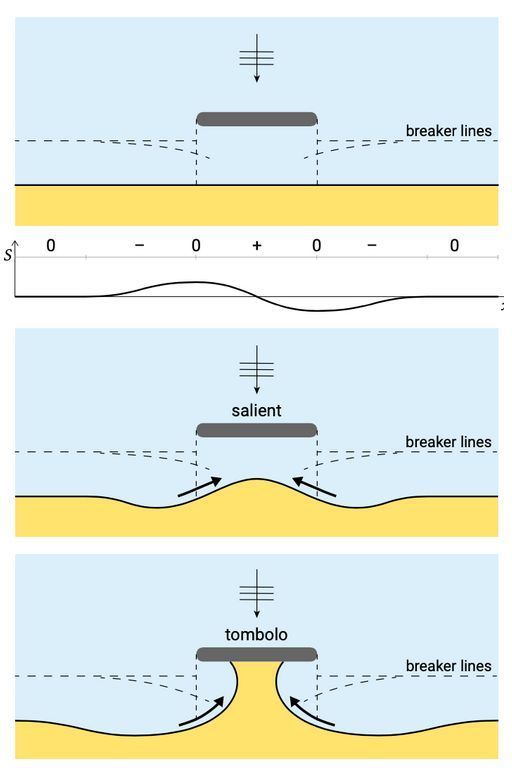
Cabo de Trafalgar is a double tombolo about 1 km long located between Conil and Barbate. The rocky island, about 20 m high, is made up of a quaternary beach basal level made up of conglomerates and sandstones, dated to 107,000 years and located around the current mean sea level. The deposit appears fossilized by a highly laminated fossil or eolianite dune, which forms the main body of the island. The SE edge of the Cape is limited by a rocky platform about 100 m wide modeled on the Quaternary beach. The island is connected to land by two sandy barriers and an intermediate lake area, currently semi-filled with fine sediments.
Fuentes:
Geolodía Cadiz 2011
Meteorologiaenred
|