
Intro: Not only an interesting geologic feature, Steamboat Rock is a Special Closure designed to protect marine mammals and seabirds. From the California Department of Fish & Wildlife: “It is an important breeding location for Steller sea lions and harbor seals, as well. The shallow waters around Steamboat Rock provide habitat for lingcod, cabezon, surfperch, leopard shark, and California halibut, as well as invertebrates such as sea stars, sea urchins, and crabs. Steamboat Rock Special Closure overlaps a portion of South Cape Mendocino State Marine Reserve, along the reserve’s southern border. Placing a special closure here provides very high levels of protection for seabirds, marine mammals, and the habitats they use.”
KNOW BEFORE YOU GO: This location requires a long drive. Begin the drive with a full tank of gas! There are no services nearby this beach and it is NOT a well-traveled area. There is also no cellular phone service. If stuck, you could be stranded for several hours or more. With that all being said, this spot still comes to you highly recommended from myself and is most definitely worth the adventure out here when done safely.
The Spot: The coordinates will bring you to the shore of Black Sand Beach. Steamboat Rock is visible just offshore form the coordinates provided at this earthcache. Since it is a protected area, please observe the rock form the shore and do not attempt to venture out to it. No vessels are allowed from the mean high tide line to a distance of 300 feet seaward of the mean lower low tide line of any shoreline of Steamboat Rock, unless under official business.
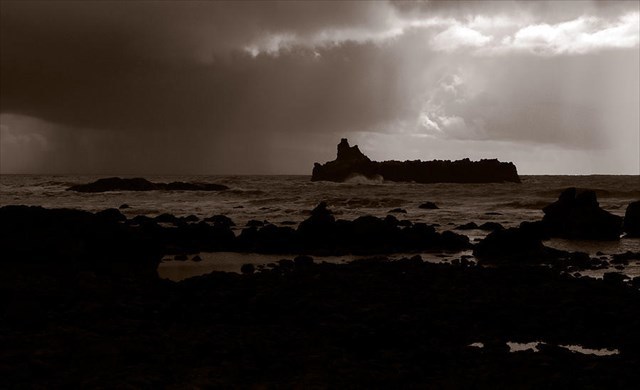
The Rock: Steamboat Rock is a geologic formation that’s known as a sea stack. Sea stacks come in all shapes and sizes. Sea stacks are the result of wind weathering and wave erosion formed over time. They are formed when a weak point of mainland is degraded by hydraulic action. Hydraulic action, in short, is the force of water crashing repeatedly into rock or other material. The constant barrage of the ocean eventually weakens the rocks, forming cracks and widening already existing cracks. This process can either form a stack outright, or form a natural arch (or “bridge”). These natural arches at last breakdown and collapse from gravity, leaving a gap between the mainland and the newly-formed stack. Just like the initial formation due to erosion, these natural processes continue with time, eroding the stacks themselves. When a sea stack finally topples, the base of rock left behind (often at or under the water level) is called a stump.
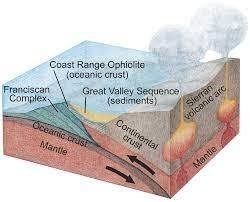
There are some types of rock that more easily fall victim to hydraulic action. This is usually sedimentary rock; cracks, gaps, and unconformities are common with sedimentary layers. The rock formation present in this coastal area of Northern California is the Franciscan Formation. The Franciscan Formation is a diverse complex of sediment comprised of all three types of rock (igneous, sedimentary, and metamorphic). This formation contains 4 main types of rock, two of which are classified as sedimentary (greywacke and chert). Next, the Franciscan Formation was formed by the subduction of an ocean plate. A subduction is the process of a plate being forced sideways or downwards into the mantle beneath another plate. Rock material gets scraped up and forms new layers on top of the subducting plate. As you can imagine, this can create major weak points in the rock layers as material becomes squished, disrupted, and crammed into new positions.
Logging this Earthcache:
Send me a message with the following:
- Name of this Earthcache and the number of people in your group
- How tall do you estimate Steamboat Rock to be?
- Do you think this was its original (or very close to original) height at formation?
- If not, what makes you think it used to be taller?
- Do you think there was ever an arch connecting Steamboat Rock to the mainland? Why or why not?
- Optional: Post any pictures to the cache page of your visit you want!
Sources:
-California Code of Regulations Title 14, Section 632
-https://global.hurtigruten.com/destinations/iceland/inspiration/what-is-a-sea-stack/
-https://en.wikipedia.org/wiki/Stack_(geology)
-https://ucmp.berkeley.edu/education/calandscape/session3/franciscan2.html
-https://en.wikipedia.org/wiki/Subduction