 />
/> In this EC we are going to learn a few geological terms related to rivers while visiting one fascinating and less-known place in the area: Wadi Numeira.
EXTREMELY IMPORTANT (please, read carefully): You will enter a canyon that has not any difficulty where technical knowledge about progression in canyons is not needed. The river bed is totally flat with the exception of a 1-meter-high rock that has a kind of stairs. This is the only technical difficulty and is very easy to sort. Otherwise, you mustn’t venture further than the entrance if there has been rain in the 2 previous days or if there is the slightest chance of rain. When you arrive at a 3 meters high boulder with a via ferrata, we don’t recommend going further up because the end of the canyon ends in 100 meters. Beyond this point there is nothing that you have not seen before. The usual flow of water is no more than 15 centimeters deep along the canyon.
DURATION: Count between 60' and 90' to the end of the canyon. As the river is totally flat, there is no difference between going up or downstream, so you should be back at the entrance in less than 3 hours.
DISCLAIMER: You are entering the canyon at your own risk and by doing that you recognize that you have understood the possible risk of an injury or, worse, of a flash flood.

Slot Canyon
A slot canyon is a long, narrow channel or drainageway with sheer rock walls that are typically eroded into either sandstone or other sedimentary rock. A slot canyon has depth-to-width ratios that typically exceed 10:1 over most of its length and can approach 100:1. Slot canyons are subject to flash flooding and commonly contain unique ecological communities that are distinct from the adjacent, drier uplands.
Many slot canyons are formed in sandstone and limestone rock, although slot canyons in other rock types such as granite and basalt are possible. Even in sandstone and limestone, only a very small number of streams will form slot canyons due to a combination of the particular characteristics of the rock and regional rainfall.
Block fracture
A fracture is any separation in a geologic formation, such as a joint or a fault that divides the rock into two or more pieces. A fracture will sometimes form a deep fissure or crevice in the rock. Fractures are commonly caused by stress exceeding the rock's strength, causing it to lose cohesion along its weakest plane. Fractures can provide permeability for fluid movements, such as water.
Nubian sandstone.
One of the most common types of rock where Jordan lies is called Nubian sandstone. It consists of continental sandstone with thin beds of marine limestones, and marls. The Nubian Sandstone was deposited between the Lower Paleozoic and Upper Cretaceous, with marine beds dating from the Carboniferous to Lower Cretaceous.
Nubian Sandstone is most commonly brownish or reddish, but in places it shows a much wider variety of colours. The ancient temples and tombs in Petra were carved from this rock. In certain places it is extremely friable, and in others compact and hard. Sand in the Arabian deserts was primarily derived from it, carried by prevailing western winds. Where it is covered by a sheet of eruptive rock (charrah), it is protected from erosion. Nubian Sandstone frequently includes strata of clay and shale and thin seams of coal or lignite. This indicates that it was deposited in seas that were relatively shallow at the time. If this sandstone has different minerals, the colours and tonality can be more diverse. It often contains layers of coal, clay or lignite. This indicates that it was deposited in relatively flat seas at that time.
At some points in the canyon, dark deposits appear stronger than the surrounding sandstone. These layers or bands are due to accumulations of iron. Iron oxides dissolved in the leachate deposited in various sandstone layers and solidified. The surrounding sandstone erodes more easily than these "iron bands", making these layers easily visible.
Beds
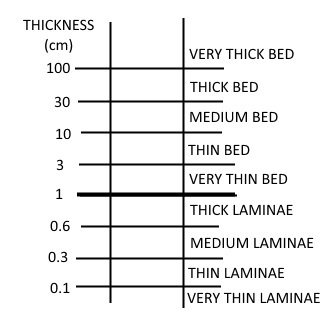
Bedding describes the layering that occurs in sedimentary rock. Bedding may occur when one distinctly different layer of sediment is deposited on an older layer, such as sand and pebbles deposited on silt or when a layer of exposed sedimentary rock has a new layer of sediments deposited on it. Such depositions of sediments produce a clear division between beds called the bedding plane.
Bedding Planes
A bedding plane is the line separating one layer of compressed rock from the next layer of compressed rock. The bedding planes are layers formed as the rocks were compressed under deposits formed above.
Tasks:
- Explain in your own words how this canyon was formed. Hint: Many unusual right angles in the bed river!
- Describe the many beds and bedding planes you will find when you walk through the canyon (different colours, thicknesses, smooth or coarse surfaces, types of sand...). There are lots of them and they are clearly visible.
- Using the provided scale, which thickness of beds is the most common in the canyon?
- At the listed coordinates you will see a big vertical crack that forms a cross (see the picture below and don’t rely on coordinates because inside the canyon the GPS reception is extremely poor). It is situated about 30 to 40' from the entrance of the gorge. Take a photo of you, your GPSr or some paper with your nickname in order to prove that you have been there. This is a compulsory task and logs without this photo will be deleted.
Sources: author knowledge, Wikipedia, Lonely Planet, www.encyclopedia.com, www.tandfonline.com and www.britannica.com
Photos by author.
