Welcome to Las Vegas! Sin City, The Desert Oasis, The Entertainment Capital of the World.
Welcome to Caesars Palace in Las Vegas!
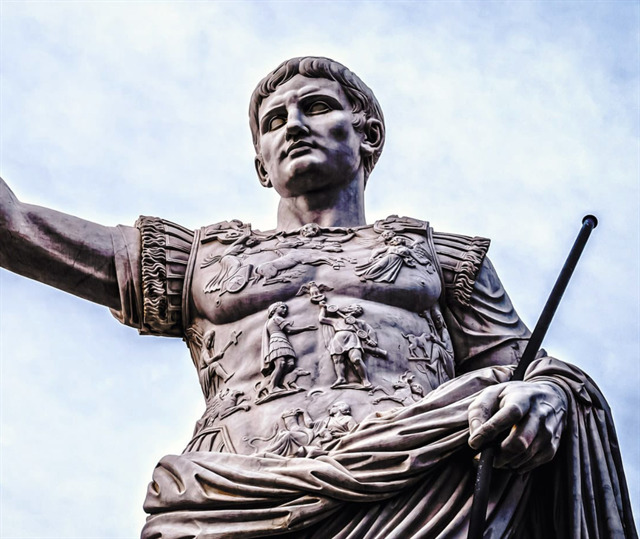
Here at the coordinates is an impressive marble statue of Julius Caesar. These statues are an integral part of Caesars Palace, and can actually be found in other points throughout the shops, casino, and hotel as well (outside and inside!), please post pictures of any other statues you find!
The marble that these statues around Caesars Palace are made from is called Carrara marble. Carrara marble is a white and blue-grey marble that is sourced from the mountains outside the city of Carrara, Italy. The Statue of David replica in Caesars Palace is located at N 36° 07.002' W 115° 10.538' (listed as optional additonal waypoint), and is made of the same marble. This stone is what the original Statue of David was carved out of as well. Carrara marble has been quarried from over 650 sites in Carrara, and is a premium marble used for sculptures.
Marble consists of calcite or dolomite, or a combination of both these minerals. Marble is formed by limestone heating up and being under pressure within the Earth's crust. These forces upon the limestone cause it to undergo recrystallization, changing the texture and makeup of the stone. The limestone recrystallizes to form large, coarse grains of calcite. The purest calcite marble is pure white, and other colors are casued by impurities in the marble. This can be red (casued by hematite), yellow (caused by limonite), or green (caused by serpentine). The formation of marble is one of the archetypal examples of the geologic process of metamorphosis.
Once marble has fully formed as a stone, it is made of a structure of interlocking calcite crystals. This is known as a crystalline structure. This process often happens after periods of intense heat and pressure (which we know marble goes through). The crystallization results in the rock having highly organized, microscopic structures. All these intricate, complex structures result in the stone being very compact (dense) and hard.
To log this earthcache, simply send me a message answering the questions below. You do not have to wait for a response to log your cache. Go ahead! I see each response, I just may not have time to reply to everyone!
1. The name of this earthcache
2. The number of people in your group
3. Looking at the statue, do you notice any other colors due to impurities in the marble?
4. Why would marble would be a wise material to make pillars, statues, etc out of? (Consider the formation process here)
5. On the other hand, what are some drawbacks you could imagine arise from using marble as a building material?
🇪🇸 [Spanish]
1. El nombre de este Earthcache.
2. El número de personas de tu grupo.
3. Al mirar la estatua, ¿notas otros colores debido a las impurezas del mármol?
4. ¿Por qué el mármol sería un buen material para hacer pilares, estatuas, etc.? (Considere el proceso de formación aquí)
5. ¿Cuáles son algunos de los inconvenientes que podrías imaginar al usar mármol?
🇩🇪 [German]
1. Der Name dieses Earthcaches
2. Die Anzahl der Personen in Ihrer Gruppe
3. Bemerken Sie beim Betrachten der Statue andere Farben aufgrund von Verunreinigungen im Marmor?
4. Warum wäre Marmor ein gutes Material für die Herstellung von Säulen, Statuen usw.? (Bedenken Sie hier den Entstehungsprozess)
5. Welche Nachteile könnte die Verwendung von Marmor mit sich bringen?
🇫🇷 [French]
1. Le nom de cette earthcache
2. Le nombre de personnes dans votre groupe
3. En regardant la statue, remarquez-vous d’autres couleurs dues aux impuretés présentes dans le marbre ?
4. Pourquoi le marbre serait-il un bon matériau pour fabriquer des piliers, des statues, etc. ? (Considérez le processus de formation ici)
5. Quels inconvénients pourriez-vous imaginer liés à l'utilisation du marbre ?
