Smash Palace is both a place and a notable New Zealand film.
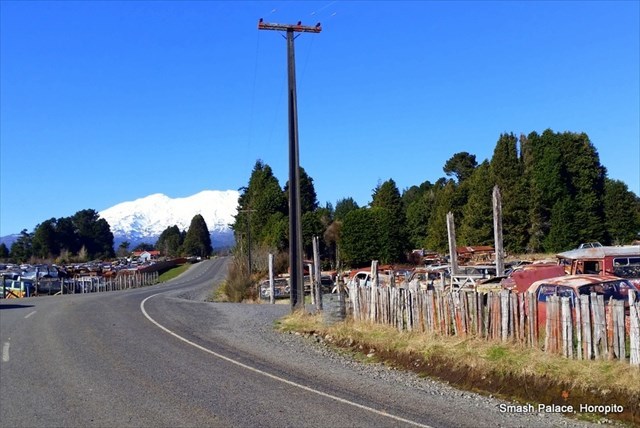
Horopito Motor Wreckers (Smash Palace)
As work gangs laying the North Island Main Trunk rail line from Auckland and Wellington moved inexorably closer together temporary work camps moved with them. Horopito was one such camp but by 1908 with the completion of the line it became obvious that Horopito was to be more than a work camp as a saw milling industry had started to establish in the district. Horopito township was surveyed about this time, the original map showing many streets and residential sections, and areas set aside for cemetery, hospital, police and educational purposes. In fact, studying promotional literature of the time, Horopito was expected to develop into a "Great Central Town located in the natural centre of the Great Waimarino Forest, which embraces tens of thousands of acres of the finest milling bush in the Colony"
However, in spite of this Horopito never really thrived. It depended on sawmilling and railway traffic for its existence and by the late 1950s, with the native forest cleared, the decline had set in and most of the small population had moved on. The school closed in 1966 and the Post Office in 1971.
Sometime during the mid-1940s Bill Cole arrived in town and established a motor garage and repair shop in what was originally a sawmill with cookhouse/bunkroom. He milled existing trees off the property with his own sawmill, which still stands and has been recently restored, built the family home and later the large sheds to house the ever burgeoning collection of cars.
Bill's philosophy was that if a car for dismantling came into the yard and whatever parts were not sold they would stay there. Nothing was scrapped, which explains the vast collection of parts that are here today.
It is believed this yard is unique in Australasia and a like establishment would be a rather rare occurrence elsewhere. In 1981 the noted New Zealand film "Smash Palace" was filmed here and consequently Horopito Motors is known internationally.
Bill Cole died in 1987. His daughter Barbara Fredricksen and her husband Colin now operate the business.1
Horopito Motor Wreckers (Smash Palace) is open Monday to Friday, 8.30am to 5pm; 10am to 4pm Saturday and Closed Sundays
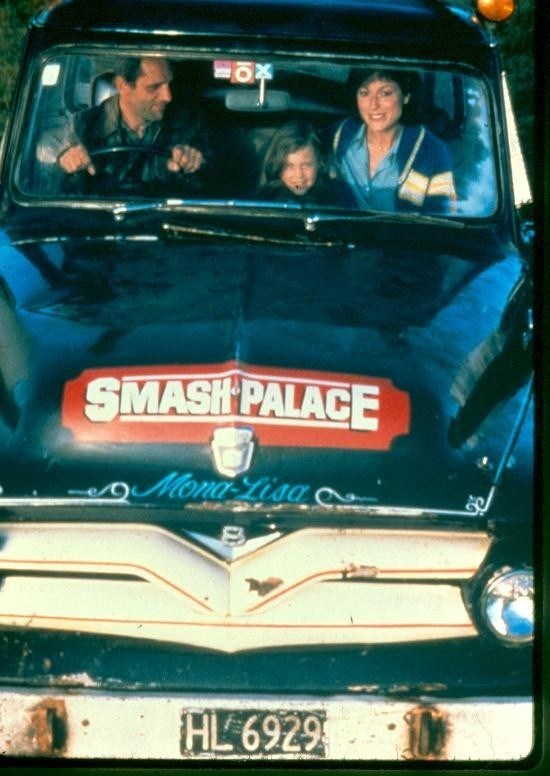
Smash Palace - the film
This movie is not suitable for children with its R16 restriction as it's a psychological thriller detailing a devoted father's reaction to losing custody of his young daughter after his marriage disintegrates and his wife leaves him.
A car crashes on a lonely road in the early morning. The tow-truck driver who is called out to salvage the wreck is Al Shaw (Bruno Lawrence). Once an international Grand Prix racing star, Al returned home to take over his father's business, a car-wrecking yard called Smash Palace located in the remote Central Plateau.
Al's French-born wife Jacqui (Anna Jemison) helps him run the business. But she has become increasingly alienated from her husband, who is obsessed with cars, and increasingly unhappy with her life, which is lived amidst acres of rusting junk collected over the last 50 years by Al's father. But Smash Palace is Al's home; he grew up here and acquired the passion for cars that led to his Grand Prix racing.
Jacqui is also worried about what the future holds for their daughter, nine-year-old Georgie (Greer Robson), whose interests are centered around her father's cars.
Finally, Jacqui can stand it no more, and to force Al to come to terms with her feelings, she leaves, taking Georgie with her.
The story concerns the effect the marriage break-up has on Al and the lengths he is driven to, to get his child back.2
The entire movie was filmed in the region surrounding Smash Palace (Horopito Motor Wreckers).
Director Roger Donaldson's Smash Palace was one of the first films to be funded by the New Zealand Film Commission, Te Tumu Whakaata Taonga, following on from his internationally successful film Sleeping Dogs. Smash Palace was rated one of the year's 10 best films by The New York Times.
Smash Palace became the first New Zealand film to be sold in the United States and, within six months, had been sold to 50 countries. It would also receive screenings in London and Hollywood before the end of 1981. Soon enough critics, including those for Variety and The New Yorker, were raving about the film.
Around this time Jack Nicholson is said to have called Lawrence his favourite actor. In 1982, the film played for months in New York, where passers-by would stop and congratulate Lawrence in the street.
Smash Palace would go on to make a respectable $616,000 at the New Zealand box office (the runaway hit of the time was Goodbye Pork Pie, which took $1.6 million). When Smash Palace finally screened on New Zealand television in 1985 it drew an audience of more than a quarter of the population.
Furthermore Smash Palace gave Roger Donaldson a Hollywood career. In the 40 years since, he has made numerous Hollywood feature films and worked with Tom Cruise, Al Pacino and Ben Kingsley among others. It also allowed him to finally make the hit movie The World's Fastest Indian, a pet project since the early 1970s (though Donaldson reckons his favourite film probably remains Smash Palace).
And the New Zealand film industry benefited from the success of Smash Palace. In the next three decades further successful New Zealand films in the world's cinemas include Once Were Warriors, What Becomes of the Brokenhearted, Whale Rider, The Piano, Sione's Wedding, Boy, Hunt for the Wilderpeople, and of course the works of Peter Jackson.3
Interestingly, in a nod to Smash Palace, Hunt for the Wilderpeople also features Horopito Motors, Smash Palace in its final scene.
References: 1Horopito Motor Wreckers - History, http://www.horopitomotors.co.nz/history/ (Accessed 8 Nov 2020)
2New Zealand Film Commission (Te Tumu Whakaata Taonga) - Smash Palace, https://www.nzfilm.co.nz/films/smash-palace (Accessed 8 Nov 2020)
3Author unknown. 20 May 2011. New Zealand Herald - Smash Palace: The little movie that did https://www.nzherald.co.nz/entertainment/smash-palace-the-little-movie-that-did (Accessed 8 Nov 2020)